



 Chat with AI
Exam 11: Price-Searcher Markets With High Entry Barriers

Exam 1: The Economic Approach225 Questions
Exam 2: Some Tools of the Economist239 Questions
Exam 3: Demand, Supply, and the Market Process408 Questions
Exam 4: Supply and Demand: Applications and Extensions270 Questions
Exam 5: Difficult Cases for the Market, and the Role of Government184 Questions
Exam 6: The Economics of Political Action208 Questions
Exam 7: Consumer Choice and Elasticity229 Questions
Exam 8: Costs and the Supply of Goods222 Questions
Exam 9: Price Takers and the Competitive Process261 Questions
Exam 10: Price-Searcher Markets With Low Entry Barriers232 Questions
Exam 11: Price-Searcher Markets With High Entry Barriers260 Questions
Exam 12: The Supply of and Demand for Productive Resources154 Questions
Exam 13: Earnings, Productivity, and the Job Market91 Questions
Exam 14: Investment, the Capital Market, and the Wealth of Nations106 Questions
Exam 15: Income Inequality and Poverty105 Questions
Exam 16: Gaining From International Trade179 Questions
Select questions type


Which of the following is the most efficient way to reduce pollution emissions?
(Multiple Choice)
4.8/5  (78)
(78) Use the figure to answer the following question(s).
Figure 11-6 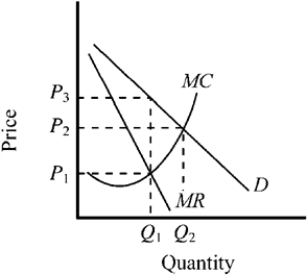 -If the output in the industry is produced by a monopolist, at what price will the good sell and what quantity will be produced in Figure 11-6?
 (Multiple Choice)
4.9/5 (69)
(69) Use the figure to answer the following question(s).
Figure 11-13  -If the firms in the industry depicted in Figure 11-13 compete with each other, what would the industry's price and output be?
 (Multiple Choice)
5.0/5 (80)
(80) Figure 11-17  -Refer to Figure 11-17. The demand curve for a monopoly firm is depicted by curve
 (Multiple Choice)
4.8/5 (77)
(77) A profit-maximizing monopolist that produces in the short run will
(Multiple Choice)
4.7/5 (71)
(71) Higher levels of carbon dioxide may have led, over the past century, to approximately a
(Multiple Choice)
4.8/5 (81)
(81) Use the figure to answer the following question(s).
Figure 11-10 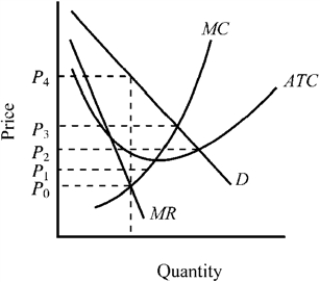 -If the monopolist is regulated by the "marginal cost pricing" technique, what price in Figure 11-10 will be charged?
 (Multiple Choice)
4.8/5 (69)
(69) If the firms in an oligopolistic industry can collude effectively (from the firms' viewpoints), the resulting price and output in the market will be most similar to that of
(Multiple Choice)
4.8/5 (82)
(82) When firms use resources in an attempt to secure and maintain grants of market protection from the government, it is called
(Multiple Choice)
4.8/5 (79)
(79) Which of the following factors is least likely to be a barrier limiting the entry of potential competitors into a market?
(Multiple Choice)
4.9/5 (67)
(67) Use the figure to answer the following question(s).
Figure 11-10
-Given the cost and revenue curves illustrated in Figure 11-10, what price will a profit-maximizing monopolist charge?
-Given the cost and revenue curves illustrated in Figure 11-10, what price will a profit-maximizing monopolist charge? (Multiple Choice)
4.8/5 (65)
(65) When members of an oligopolistic industry agree to collude, raising their product price substantially above average cost, the passage of time (months and years)
(Multiple Choice)
5.0/5 (99)
(99) If marginal revenue exceeds marginal cost, a profit-maximizing monopolist will
(Multiple Choice)
4.8/5 (74)
(74) 
Filters
- Essay(0)
- Multiple Choice(0)
- Short Answer(0)
- True False(0)
- Matching(0)