



 Chat with AI
Exam 14: Modern Macroeconomics and Monetary Policy

Exam 1: The Economic Approach164 Questions
Exam 2: Some Tools of the Economist200 Questions
Exam 3: Demand, Supply, and the Market Process336 Questions
Exam 4: Supply and Demand: Applications and Extensions254 Questions
Exam 5: Difficult Cases for the Market, and the Role of Government130 Questions
Exam 6: The Economics of Political Action154 Questions
Exam 7: Taking the Nations Economic Pulse214 Questions
Exam 8: Economic Fluctuations, Unemployment, and Inflation174 Questions
Exam 9: An Introduction to Basic Macroeconomic Markets219 Questions
Exam 10: Dynamic Change, Economic Fluctuations, and the Ad-As Model189 Questions
Exam 11: Fiscal Policy: the Keynesian View and the Historical Development of Macroeconomics109 Questions
Exam 12: Fiscal Policy, Incentives, and Secondary Effects146 Questions
Exam 13: Money and the Banking System209 Questions
Exam 14: Modern Macroeconomics and Monetary Policy192 Questions
Exam 15: Stabilization Policy, Output, and Employment148 Questions
Exam 16: Creating an Environment for Growth and Prosperity120 Questions
Exam 17: Institutions, Policies, and Cross-Country Differences in Income and Growth111 Questions
Exam 18: Gaining From International Trade170 Questions
Exam 19: International Finance and the Foreign Exchange Market148 Questions
Select questions type


In response to a severe recession, the Fed more than doubled the monetary base and pushed short-term interest rates to near zero during 2009-2010. What happened in 2011?
(Multiple Choice)
4.8/5  (70)
(70) If the long-run equilibrium of an economy is disrupted by an unexpected shift to a more expansionary monetary policy, the policy shift will
(Multiple Choice)
4.9/5 (71)
(71) In the short run, an unanticipated increase in the money supply will exert its primary impact on
(Multiple Choice)
4.7/5 (74)
(74) Other things constant, a decrease in nominal GDP will generally
(Multiple Choice)
4.8/5 (97)
(97) Use the figure below to answer the following question(s).
Figure 14-2 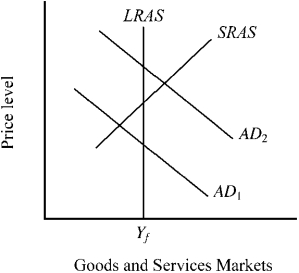 -If the Fed anticipates that the conditions illustrated by AD1 and SRAS in Figure 14-2 will be present in the near future, it should
 (Multiple Choice)
4.9/5 (85)
(85) As the Fed shifted to a highly expansionary monetary policy during the second half of 2008, why were banks reluctant to extend loans and make investments?
(Multiple Choice)
4.8/5 (82)
(82) If the Fed wanted to institute a more expansionary monetary policy, which of the following would it be most likely to do?
(Multiple Choice)
4.8/5 (80)
(80) Since the mid-1980s, the primary indicator of monetary policy has been
(Multiple Choice)
5.0/5 (82)
(82) Continuous rapid growth of the money supply relative to the growth of real output will most likely lead to
(Multiple Choice)
4.9/5 (83)
(83) When expansionary monetary policy pushes interest rates downward to a low level,
(Multiple Choice)
4.7/5 (80)
(80) Which of the following was true of the actions of the Federal Reserve in response to the recession of 2008?
(Multiple Choice)
4.7/5 (78)
(78) During the second half of 2008 the monetary base was growing far more rapidly than the money supply because
(Multiple Choice)
4.7/5 (89)
(89) If a country was operating well below its long-run capacity (potential GDP), the initial impact of an unanticipated increase in the money supply would most likely result in an increase in
(Multiple Choice)
4.9/5 (76)
(76) Since the mid-1980s, if the Fed wanted to shift to a more expansionary monetary policy, it would
(Multiple Choice)
4.8/5 (72)
(72) If the Fed sells bonds and, thereby, unexpectedly shifts to a more restrictive monetary policy, in the short run, the primary impact of this policy will tend to
(Multiple Choice)
4.8/5 (74)
(74) An unexpected shift to a more expansionary monetary policy will generally
(Multiple Choice)
4.9/5 (87)
(87) Which of the following makes it more difficult for monetary policy makers to time policy changes correctly?
(Multiple Choice)
4.9/5 (85)
(85) In the long run, changes in the money supply affect only the price level because
(Multiple Choice)
4.9/5 (97)
(97) 
Filters
- Essay(0)
- Multiple Choice(0)
- Short Answer(0)
- True False(0)
- Matching(0)