



 Chat with AI
Exam 14: Modern Macroeconomics and Monetary Policy

Exam 1: The Economic Approach164 Questions
Exam 2: Some Tools of the Economist200 Questions
Exam 3: Demand, Supply, and the Market Process336 Questions
Exam 4: Supply and Demand: Applications and Extensions254 Questions
Exam 5: Difficult Cases for the Market, and the Role of Government130 Questions
Exam 6: The Economics of Political Action154 Questions
Exam 7: Taking the Nations Economic Pulse214 Questions
Exam 8: Economic Fluctuations, Unemployment, and Inflation174 Questions
Exam 9: An Introduction to Basic Macroeconomic Markets219 Questions
Exam 10: Dynamic Change, Economic Fluctuations, and the Ad-As Model189 Questions
Exam 11: Fiscal Policy: the Keynesian View and the Historical Development of Macroeconomics109 Questions
Exam 12: Fiscal Policy, Incentives, and Secondary Effects146 Questions
Exam 13: Money and the Banking System209 Questions
Exam 14: Modern Macroeconomics and Monetary Policy192 Questions
Exam 15: Stabilization Policy, Output, and Employment148 Questions
Exam 16: Creating an Environment for Growth and Prosperity120 Questions
Exam 17: Institutions, Policies, and Cross-Country Differences in Income and Growth111 Questions
Exam 18: Gaining From International Trade170 Questions
Exam 19: International Finance and the Foreign Exchange Market148 Questions
Select questions type


When the Fed unexpectedly increases the money supply, it will cause an increase in aggregate demand because
(Multiple Choice)
4.8/5  (76)
(76) As the Fed maintained interest rates at near zero during 2008-2012,
(Multiple Choice)
4.9/5 (101)
(101) During 2008-2013, the Fed initiated several rounds of "quantitative easing." Under this policy, the Fed
(Multiple Choice)
4.9/5 (69)
(69) A study of countries with high inflation rates indicates that the inflation is generally
(Multiple Choice)
4.9/5 (69)
(69) In the short run, which of the following is the most likely effect of an unanticipated move to expansionary monetary policy?
(Multiple Choice)
4.8/5 (79)
(79) Suppose the economy is in long-run equilibrium at the level of potential output. What will be the long-run effect of an expansionary monetary policy?
(Multiple Choice)
4.9/5 (81)
(81) Monetarists reject using discretionary monetary policy as an effective stabilization tool because
(Multiple Choice)
4.8/5 (86)
(86) The short run sequence of events following an unanticipated shift to a more expansionary monetary policy would be
(Multiple Choice)
4.8/5 (88)
(88) The Fed's purchase of U.S. government securities constitutes
(Multiple Choice)
4.9/5 (82)
(82) When the Fed conducts expansionary monetary policy, lower short-term interest rates will tend to stimulate the economy. How will the change in the velocity of money affect this result?
(Multiple Choice)
4.7/5 (81)
(81) If there is a "long and variable time lag" between when a change in monetary policy is instituted and when it impacts aggregate demand and output, this will
(Multiple Choice)
4.8/5 (73)
(73) If the economy is in an inflationary boom, the Fed would most likely
(Multiple Choice)
4.9/5 (84)
(84) If the Fed unexpectedly increases the money supply, real GDP
(Multiple Choice)
4.7/5 (84)
(84) Which of the following correctly indicates a potential path for the transmission of expansionary monetary policy to the goods and services market?
(Multiple Choice)
5.0/5 (77)
(77) Starting from an initial long-run equilibrium, an unanticipated shift to a more expansionary monetary policy would tend to increase
(Multiple Choice)
4.8/5 (80)
(80) Which of the following would be most indicative of a shift to a more expansionary monetary policy?
(Multiple Choice)
4.9/5 (85)
(85) Use the figure below to answer the following question(s).
Figure 14-5 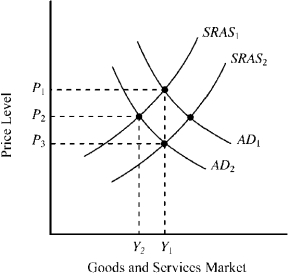 -In Figure 14-5, AD1 and SRAS1 indicate an economy initially operating at full-employment output level, Y1. The short-run impact of the Fed unexpectedly shifting to a more restrictive monetary policy will be
 (Multiple Choice)
4.8/5 (65)
(65) The Fed pushed interest rates to artificially low levels during 2002-2004. The Austrian view predicts that this policy will lead to
(Multiple Choice)
4.8/5 (84)
(84) 
Filters
- Essay(0)
- Multiple Choice(0)
- Short Answer(0)
- True False(0)
- Matching(0)