



 Chat with AI
Exam 14: Modern Macroeconomics and Monetary Policy

Exam 1: The Economic Approach164 Questions
Exam 2: Some Tools of the Economist200 Questions
Exam 3: Demand, Supply, and the Market Process336 Questions
Exam 4: Supply and Demand: Applications and Extensions254 Questions
Exam 5: Difficult Cases for the Market, and the Role of Government130 Questions
Exam 6: The Economics of Political Action154 Questions
Exam 7: Taking the Nations Economic Pulse214 Questions
Exam 8: Economic Fluctuations, Unemployment, and Inflation174 Questions
Exam 9: An Introduction to Basic Macroeconomic Markets219 Questions
Exam 10: Dynamic Change, Economic Fluctuations, and the Ad-As Model189 Questions
Exam 11: Fiscal Policy: the Keynesian View and the Historical Development of Macroeconomics109 Questions
Exam 12: Fiscal Policy, Incentives, and Secondary Effects146 Questions
Exam 13: Money and the Banking System209 Questions
Exam 14: Modern Macroeconomics and Monetary Policy192 Questions
Exam 15: Stabilization Policy, Output, and Employment148 Questions
Exam 16: Creating an Environment for Growth and Prosperity120 Questions
Exam 17: Institutions, Policies, and Cross-Country Differences in Income and Growth111 Questions
Exam 18: Gaining From International Trade170 Questions
Exam 19: International Finance and the Foreign Exchange Market148 Questions
Select questions type


Which of the following is true of home mortgage loans since the late 1990s?
(Multiple Choice)
4.9/5  (72)
(72) If the Fed unexpectedly shifts to a more restrictive monetary policy, which of the following will most likely occur in the short run?
(Multiple Choice)
4.9/5 (69)
(69) Which of the following contributed to the financial crisis of 2008?
(Multiple Choice)
4.9/5 (67)
(67) In the short run, an unanticipated shift to a more restrictive monetary policy is most likely to result in
(Multiple Choice)
4.9/5 (85)
(85) Starting from a position of macroeconomic equilibrium at the full-employment level of real GDP, in the short run an unanticipated increase in the money supply will
(Multiple Choice)
4.9/5 (69)
(69) When the Fed buys bonds and injects additional reserves into the banking system, this action will
(Multiple Choice)
5.0/5 (76)
(76) Why didn't the Fed's quantitative easing policies exert a stronger impact on aggregate demand and lead to a more rapid recovery during 2010-2012?
(Multiple Choice)
5.0/5 (88)
(88) If policy makers wanted to use both monetary and fiscal policy to stimulate demand and reduce a high rate of unemployment, which of the following would be most appropriate?
(Multiple Choice)
4.7/5 (89)
(89) If the Fed unexpectedly decreases the money supply, real GDP
(Multiple Choice)
4.9/5 (83)
(83) What happens to the aggregate demand curve when the Fed reduces the money supply?
(Multiple Choice)
4.9/5 (85)
(85) According to the quantity theory of money, which one of the following economic variables would change in response to an increase in the money supply?
(Multiple Choice)
4.7/5 (74)
(74) If the Federal Reserve unexpectedly increases the money supply, which of the following will most likely happen in the short run?
(Multiple Choice)
4.9/5 (76)
(76) Unanticipated restrictive monetary policy would tend to cause
(Multiple Choice)
4.8/5 (78)
(78) Figure 14-4 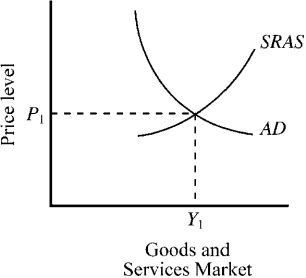 -In Figure 14-4, an unanticipated shift to a more restrictive monetary policy will shift
 (Multiple Choice)
4.8/5 (74)
(74) If the Fed fears an economic downturn, it would be most likely to
(Multiple Choice)
4.9/5 (88)
(88) Which of the following contributed to the strong auto sales and soaring housing prices during 2002-2004?
(Multiple Choice)
5.0/5 (74)
(74) The short run sequence of events following an unanticipated shift to restrictive monetary policy would be higher interest rates followed by dollar
(Multiple Choice)
4.9/5 (88)
(88) 
Filters
- Essay(0)
- Multiple Choice(0)
- Short Answer(0)
- True False(0)
- Matching(0)