



 Chat with AI
Exam 14: Modern Macroeconomics and Monetary Policy

Exam 1: The Economic Approach164 Questions
Exam 2: Some Tools of the Economist200 Questions
Exam 3: Demand, Supply, and the Market Process336 Questions
Exam 4: Supply and Demand: Applications and Extensions254 Questions
Exam 5: Difficult Cases for the Market, and the Role of Government130 Questions
Exam 6: The Economics of Political Action154 Questions
Exam 7: Taking the Nations Economic Pulse214 Questions
Exam 8: Economic Fluctuations, Unemployment, and Inflation174 Questions
Exam 9: An Introduction to Basic Macroeconomic Markets219 Questions
Exam 10: Dynamic Change, Economic Fluctuations, and the Ad-As Model189 Questions
Exam 11: Fiscal Policy: the Keynesian View and the Historical Development of Macroeconomics109 Questions
Exam 12: Fiscal Policy, Incentives, and Secondary Effects146 Questions
Exam 13: Money and the Banking System209 Questions
Exam 14: Modern Macroeconomics and Monetary Policy192 Questions
Exam 15: Stabilization Policy, Output, and Employment148 Questions
Exam 16: Creating an Environment for Growth and Prosperity120 Questions
Exam 17: Institutions, Policies, and Cross-Country Differences in Income and Growth111 Questions
Exam 18: Gaining From International Trade170 Questions
Exam 19: International Finance and the Foreign Exchange Market148 Questions
Select questions type


The short run sequence of events following an unanticipated shift to a more expansionary monetary policy would be lower interest rates followed by dollar
(Multiple Choice)
4.8/5  (81)
(81) Figure 14-3 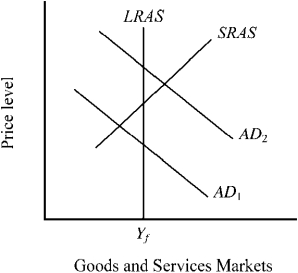 -Suppose the economy was currently operating at SRAS and AD2 in Figure 14-3. To combat inflation, the Fed institutes restrictive monetary policy. Suppose that by the time the policy impacts the economy, AD has already moved to AD1. Which of the following would be true?
 (Multiple Choice)
4.9/5 (80)
(80) When the Fed unexpectedly increases the money supply, it will cause an increase in aggregate demand because
(Multiple Choice)
4.9/5 (86)
(86) Monetary policy pushed interest rates to historically low levels during 2002-2004, but was more restrictive during 2005-2006. Economic analysis indicates that this policy
(Multiple Choice)
4.8/5 (70)
(70) Which economist made the following statement: "Every major contraction in the U.S. economy has either been created or greatly exacerbated by monetary instability. Every major inflation has been caused by monetary expansion."
(Multiple Choice)
4.8/5 (68)
(68) According to monetarists, which of the following would be most important for the control of inflation?
(Multiple Choice)
4.8/5 (72)
(72) Which of the following interest rates will be least affected by a shift in monetary policy that alters the money supply?
(Multiple Choice)
5.0/5 (79)
(79) The short run sequence of events following an unanticipated shift to a more restrictive monetary policy would be
(Multiple Choice)
4.7/5 (68)
(68) Indicate how changes in monetary policy are transmitted to the goods and services market? Discuss for the case of an expansion in the money supply.
(Essay)
4.9/5 (67)
(67) According to the monetarists, which of the following is true?
(Multiple Choice)
4.8/5 (90)
(90) When an expansionary monetary policy leads to an acceleration in the rate of inflation, it will also result in
(Multiple Choice)
4.8/5 (87)
(87) The coefficient that represents the average number of times a dollar is used to buy goods and services is called
(Multiple Choice)
4.8/5 (85)
(85) Comparisons of the link between the growth of the money supply and inflation indicate that
(Multiple Choice)
5.0/5 (85)
(85) Use the figure below to answer the following question(s).
Figure 14-2 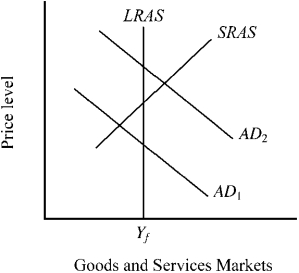 -If the Fed anticipates that the conditions illustrated by AD2 and SRAS in Figure 14-2 will be present in the near future, it should
 (Multiple Choice)
4.9/5 (68)
(68) 
Filters
- Essay(0)
- Multiple Choice(0)
- Short Answer(0)
- True False(0)
- Matching(0)