



 Chat with AI
Exam 18: Energy and Metabolism

Exam 1: Matter, Energy, and Measurement91 Questions
Exam 2: Atomic Structure and Radioisotopes107 Questions
Exam 3: Ionic and Covalent Compounds95 Questions
Exam 4: Molecular Geometry, Polarity, and Intermolecular86 Questions
Exam 5: Chemical Quantities and Introduction to Reactions88 Questions
Exam 6: Chemical Reactions: Energy, Rates, and Equilibrium87 Questions
Exam 7: Changes of State and Gas Laws99 Questions
Exam 8: Mixtures, Solution Concentrations, and Diffusion97 Questions
Exam 9: Acids and Bases, Ph, and Buffers83 Questions
Exam 10: Introduction to Organic Chemistry:111 Questions
Exam 11: Alcohols, Phenols, Thiols, Ethers, and Amines69 Questions
Exam 12: The Carbonyl Containing Functional Groups70 Questions
Exam 13: The Common Organic Reactions in Biochemistry82 Questions
Exam 14: Carbohydrates: Structure and Function97 Questions
Exam 15: Lipids: Structure and Function106 Questions
Exam 16: Proteins: Structure and Function134 Questions
Exam 17: Nucleotides and Nucleic Acids109 Questions
Exam 18: Energy and Metabolism115 Questions
Select questions type


Overall, how much ATP is produced when 1 molecule of glucose is oxidized to 6 molecules of carbon dioxide through glycolysis, aerobic oxidation of pyruvate, the citric acid cycle, and oxidative phosphorylation?
(Multiple Choice)
5.0/5  (84)
(84) Which of the following choices illustrates the general pathway by which fats are catabolized?
(Multiple Choice)
5.0/5 (81)
(81) The following is step 3 of the citric acid cycle.Isocitrate is converted into α-ketoglutarate by a(n)_______ reaction followed by _______. 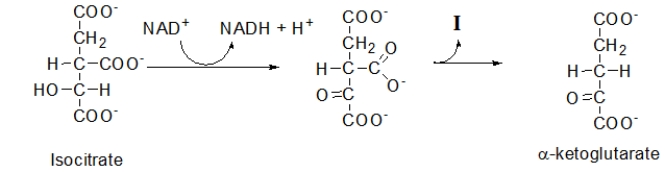
(Multiple Choice)
4.8/5 (84)
(84) Whether a sugar starts out as a fructose, galactose, or glucose, it must undergo enzyme-catalyzed reactions in order to become a single type of monosaccharide so that it can go through glycolysis, the second stage of catabolism.Which monosaccharide must all of these sugars become?
(Multiple Choice)
4.8/5 (87)
(87) Which choice BEST describes the purpose of the following step of glycolysis? 
(Multiple Choice)
4.8/5 (75)
(75) How many times will a fatty acid with 20 carbons go through β-oxidation?
(Multiple Choice)
4.8/5 (90)
(90) Which statement about the role of oxygen in the electron transport chain is FALSE?
(Multiple Choice)
4.9/5 (71)
(71) Which of the following statements describes what can happen to pyruvate after it is produced during glycolysis? I.Pyruvate immediately enters the citric acid cycle.
II)It is oxidized.
III)It is reduced.
(Multiple Choice)
4.7/5 (71)
(71) Every acetyl-CoA molecule that enters the citric acid cycle provides the energy to phosphorylate _______ APD to ATP.
(Multiple Choice)
5.0/5 (78)
(78) What ultimately happens to oxygen as a result of the electron transport chain?
(Multiple Choice)
4.8/5 (87)
(87) The citric acid cycle has a unique circular appearance when written due to the regeneration of oxaloacetate.Which of the following molecules is oxaloacetate? 
(Multiple Choice)
4.8/5 (83)
(83) The second step of β-oxidation is shown below.What type of reaction is this? 
(Multiple Choice)
5.0/5 (85)
(85) ATP-synthase, an enzyme that catalyzes the phosphorylation of ADP to ATP, is found in the
(Multiple Choice)
4.8/5 (78)
(78) The following diagrams illustrate the two aqueous spaces and the inner membrane of the mitochondrial.In which diagram is the relative concentration of protons such that oxidative phosphorylation could occur if ATP synthase were present? 
(Multiple Choice)
4.8/5 (68)
(68) Which statement does NOT describe the safest and healthiest way for a person to lose weight?
(Multiple Choice)
4.8/5 (80)
(80) What is the fate of oxygen in the electron transport chain?
(Multiple Choice)
4.8/5 (86)
(86) 
Filters
- Essay(0)
- Multiple Choice(0)
- Short Answer(0)
- True False(0)
- Matching(0)