



 Chat with AI
Exam 18: Energy and Metabolism

Exam 1: Matter, Energy, and Measurement91 Questions
Exam 2: Atomic Structure and Radioisotopes107 Questions
Exam 3: Ionic and Covalent Compounds95 Questions
Exam 4: Molecular Geometry, Polarity, and Intermolecular86 Questions
Exam 5: Chemical Quantities and Introduction to Reactions88 Questions
Exam 6: Chemical Reactions: Energy, Rates, and Equilibrium87 Questions
Exam 7: Changes of State and Gas Laws99 Questions
Exam 8: Mixtures, Solution Concentrations, and Diffusion97 Questions
Exam 9: Acids and Bases, Ph, and Buffers83 Questions
Exam 10: Introduction to Organic Chemistry:111 Questions
Exam 11: Alcohols, Phenols, Thiols, Ethers, and Amines69 Questions
Exam 12: The Carbonyl Containing Functional Groups70 Questions
Exam 13: The Common Organic Reactions in Biochemistry82 Questions
Exam 14: Carbohydrates: Structure and Function97 Questions
Exam 15: Lipids: Structure and Function106 Questions
Exam 16: Proteins: Structure and Function134 Questions
Exam 17: Nucleotides and Nucleic Acids109 Questions
Exam 18: Energy and Metabolism115 Questions
Select questions type


Why is fatty acid catabolism called β-oxidation?

Free
(Multiple Choice)
4.8/5  (85)
(85) Correct Answer: Verified
A
L-malate is an intermediate in the citric acid cycle.What does the L imply about L-malate?
Free
(Multiple Choice)
5.0/5 (74)
(74) Correct Answer:Verified
VerifiedC
A difference in proton concentration between adjacent regions is known as a
(Multiple Choice)
4.9/5 (84)
(84) The figure below illustrates protons (the circles)separated by a membrane permeable to the protons and water.What will happen to the protons as time passes and the system equilibrates? 
(Multiple Choice)
4.8/5 (76)
(76) Which of the following is NOT a purpose of the glycolysis pathway?
(Multiple Choice)
4.7/5 (56)
(56) 
When ATP synthase catalyzes the synthesis of ATP, protons are shunted through it.Which diagram BEST illustrates this process? Note that the circles represent protons and the arrows through the enzyme represent the direction of proton flow. 
(Multiple Choice)
4.7/5 (82)
(82) 
The following reaction is a key step in the metabolism of glucose.Which of the following molecules is formed as a result of this reaction? 
(Multiple Choice)
4.9/5 (77)
(77) Which statement BEST describes why proteins are metabolized when calories are severely reduced?
(Multiple Choice)
4.7/5 (77)
(77) Which statement BEST describes what is illustrated in this diagram? 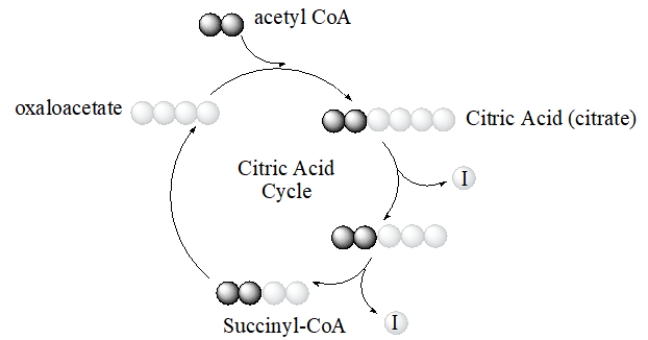
(Multiple Choice)
5.0/5 (74)
(74) The following is step 3 of the citric acid cycle.During this step, NAD+ is ________, while isocitrate is ________. 
(Multiple Choice)
4.8/5 (92)
(92) Most enzymes involved in the citric acid cycle are found in the ________ of the mitochondria.
(Multiple Choice)
4.9/5 (83)
(83) When acetyl coenzyme A is hydrolyzed during the citric acid cycle, which bond in the molecule is broken? 
(Multiple Choice)
4.8/5 (80)
(80) 
Filters
- Essay(0)
- Multiple Choice(0)
- Short Answer(0)
- True False(0)
- Matching(0)