



 Chat with AI
Exam 18: Energy and Metabolism

Exam 1: Matter, Energy, and Measurement91 Questions
Exam 2: Atomic Structure and Radioisotopes107 Questions
Exam 3: Ionic and Covalent Compounds95 Questions
Exam 4: Molecular Geometry, Polarity, and Intermolecular86 Questions
Exam 5: Chemical Quantities and Introduction to Reactions88 Questions
Exam 6: Chemical Reactions: Energy, Rates, and Equilibrium87 Questions
Exam 7: Changes of State and Gas Laws99 Questions
Exam 8: Mixtures, Solution Concentrations, and Diffusion97 Questions
Exam 9: Acids and Bases, Ph, and Buffers83 Questions
Exam 10: Introduction to Organic Chemistry:111 Questions
Exam 11: Alcohols, Phenols, Thiols, Ethers, and Amines69 Questions
Exam 12: The Carbonyl Containing Functional Groups70 Questions
Exam 13: The Common Organic Reactions in Biochemistry82 Questions
Exam 14: Carbohydrates: Structure and Function97 Questions
Exam 15: Lipids: Structure and Function106 Questions
Exam 16: Proteins: Structure and Function134 Questions
Exam 17: Nucleotides and Nucleic Acids109 Questions
Exam 18: Energy and Metabolism115 Questions
Select questions type


Which part of the electron transport chain does cyanide inhibit?
(Multiple Choice)
4.9/5  (86)
(86) Two molecules of carbon dioxide are released for every turn of the citric acid cycle.What happens to those molecules of carbon dioxide?
(Multiple Choice)
4.9/5 (83)
(83) One of the steps of glycolysis is given below.What type of reaction is this? 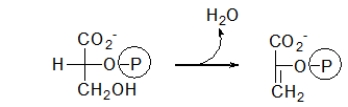
(Multiple Choice)
5.0/5 (75)
(75) During ATP hydrolysis, to what molecule is a phosphoryl group transferred?
(Multiple Choice)
4.7/5 (80)
(80) Generally, how do compounds such as rotenone and cyanide inhibit the electron transport chain?
(Multiple Choice)
4.7/5 (88)
(88) Electrons from _____ enter the electron transport chain where they drive the ________ of ADP to ATP.
(Multiple Choice)
4.9/5 (88)
(88) Which choice BEST describes the purpose of the following step of glycolysis? 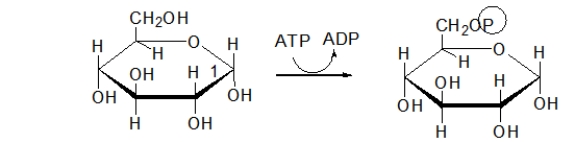
(Multiple Choice)
4.8/5 (66)
(66) Fats, proteins, and carbohydrates are all broken down into __________, the central molecule of metabolism.
(Multiple Choice)
4.9/5 (80)
(80) The following is step 3 of the citric acid cycle.What is the identity of the molecule represented by I? 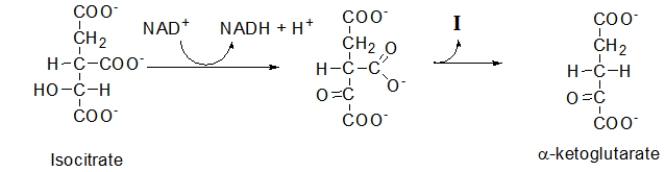
(Multiple Choice)
4.9/5 (74)
(74) The first step of β-oxidation is shown below.What type of reaction is this? 
(Multiple Choice)
4.9/5 (82)
(82) What is the name of the force that drives the phosphorylation of ADP?
(Multiple Choice)
4.8/5 (83)
(83) Which statement BEST describes the electron transport chain?
(Multiple Choice)
4.8/5 (66)
(66) The ATP synthesized during catabolic processes is used to provide energy for ____ processes in the cell.
(Multiple Choice)
4.9/5 (77)
(77) Which choice BEST describes the purpose of the following step of glycolysis? 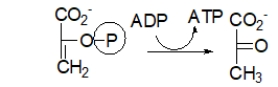
(Multiple Choice)
4.8/5 (83)
(83) The citric acid cycle is a unique metabolic pathway because it is cyclic.Which statement BEST describes how it is cyclic?
(Multiple Choice)
4.8/5 (79)
(79) 
Filters
- Essay(0)
- Multiple Choice(0)
- Short Answer(0)
- True False(0)
- Matching(0)