



 Chat with AI
Exam 24: Carbohydrate,lipid,and Protein Metabolism

Exam 1: Matter and Measurement87 Questions
Exam 2: Atoms and the Periodic Table95 Questions
Exam 3: Ionic Compounds100 Questions
Exam 4: Covalent Compounds101 Questions
Exam 5: Chemical Reactions98 Questions
Exam 6: Energy Changes,reaction Rates,and Equilibrium102 Questions
Exam 7: Gases,liquids,and Solids98 Questions
Exam 8: Solutions98 Questions
Exam 9: Acids and Bases108 Questions
Exam 10: Nuclear Chemistry93 Questions
Exam 11: Introduction to Organic Molecules and Functional Groups123 Questions
Exam 12: Alkanes104 Questions
Exam 13: Unsaturated Hydrocarbons104 Questions
Exam 14: Organic Compounds That Contain Oxygen,halogen,or Sulfur112 Questions
Exam 15: The Three-Dimensional Shape of Molecules101 Questions
Exam 16: Aldehydes and Ketones114 Questions
Exam 17: Carboxylic Acids,esters,and Amides107 Questions
Exam 18: Amines and Neurotransmitters115 Questions
Exam 19: Lipids115 Questions
Exam 20: Carbohydrates100 Questions
Exam 21: Amino Acids,proteins,and Enzymes98 Questions
Exam 22: Nucleic Acids and Protein Synthesis98 Questions
Exam 23: Metabolism and Energy Production102 Questions
Exam 24: Carbohydrate,lipid,and Protein Metabolism99 Questions
Select questions type


Catabolism of a fatty acid produces more than twice the energy per gram as glucose (in terms of moles of ATP generated).
(True/False)
4.8/5  (83)
(83) The glycerol formed from triacylglycerol hydrolysis is converted in two steps to dihydroxyacetone phosphate.
(True/False)
4.7/5 (82)
(82) Gluconeogenesis is not a commonly used metabolic pathway when carbohydrate intake is high.
(True/False)
4.8/5 (75)
(75) Which quantities need to be considered in determining the ATP yield from the complete catabolism of a fatty acid?
(Multiple Choice)
5.0/5 (77)
(77) Glucosamine,shown below,is a competitive inhibitor of the enzyme hexokinase,which catalyzes the phosphorylation of glucose in the first step of glycolysis (Eqn. 1 below). Which statement best describes the inhibition by glucosamine? 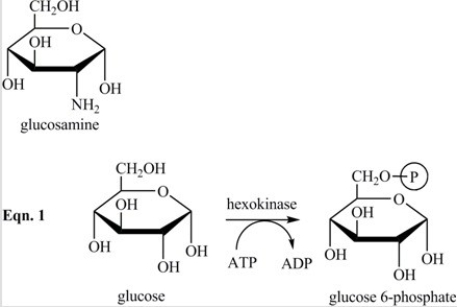
(Multiple Choice)
4.8/5 (82)
(82) Six of the steps of gluconeogenesis use the same enzymes as used in glycolysis.
(True/False)
4.9/5 (95)
(95) When energy demands are low,glucose is stored as the polymer ________ in the liver and muscles.
(Short Answer)
4.9/5 (88)
(88) Which statement best describes the energy requirement for the conversion of a fatty acid to a thioester with coenzyme A in the β-oxidation of a fatty acid?
(Multiple Choice)
4.8/5 (72)
(72) Transamination is the transfer of an amino group from a(n)_____to a(n)________,usually α-ketoglutarate.
(Short Answer)
4.8/5 (80)
(80) In fermentation,the six carbon atoms of glucose are converted to three molecules of ethanol.
(True/False)
4.7/5 (65)
(65) What are the products formed in the transamination reaction shown? 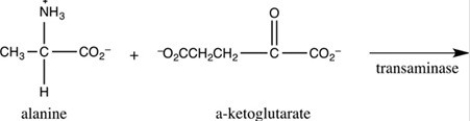
(Multiple Choice)
4.8/5 (77)
(77) The breakdown of amino acids forms NH4+,which enters the urea cycle to form urea,and a carbon skeleton that is metabolized to either pyruvate,acetyl CoA,or an intermediate in the citric acid cycle.
(True/False)
4.8/5 (76)
(76) In oxidative deamination,glutamate is re-converted to α-ketoglutarate,which can undergo transamination with another molecule of an amino acid and the cycle repeats.
(True/False)
4.9/5 (78)
(78) Conceptually,gluconeogenesis is the reverse of glycolysis; that is,two molecules of pyruvate are converted to glucose by a stepwise pathway that passes through all of the same intermediates encountered in glycolysis.
(True/False)
4.9/5 (88)
(88) When acetyl CoA levels exceed the capacity of the citric acid cycle,acetyl CoA is converted to ketone bodies.
(True/False)
4.9/5 (84)
(84) The reduction of acetaldehyde,shown below,is the last step in the fermentation process. What is the product of the reduction of acetaldehyde? 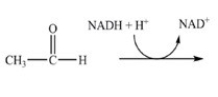
(Multiple Choice)
4.8/5 (76)
(76) 
Filters
- Essay(0)
- Multiple Choice(0)
- Short Answer(0)
- True False(0)
- Matching(0)