



 Chat with AI
Exam 16: A Universe of Galaxies

Exam 1: A Modern View of the Universe118 Questions
Exam 2: Discovering the Universe for Yourself137 Questions
Exam 3: The Science of Astronomy111 Questions
Exam 4: Making Sense of the Universe: Understanding Motion, Energy, and Gravity122 Questions
Exam 5: Light: the Cosmic Messenger148 Questions
Exam 6: Formation of the Solar System142 Questions
Exam 7: Earth and the Terrestrial Worlds193 Questions
Exam 8: Jovian Planet System98 Questions
Exam 9: Asteroids, Comets, and Dwarf Planets: Their Nature, Orbits, and Impacts130 Questions
Exam 10: Other Planetary Systems: the New Science of Distant Worlds86 Questions
Exam 11: Our Star114 Questions
Exam 12: Surveying the Stars146 Questions
Exam 13: Star Stuff142 Questions
Exam 14: The Bizarre Stellar Graveyard116 Questions
Exam 15: Our Galaxy124 Questions
Exam 16: A Universe of Galaxies160 Questions
Exam 17: The Birth of the Universe96 Questions
Exam 18: Dark Matter, Dark Energy, and the Fate of the Universe117 Questions
Exam 19: Life in the Universe94 Questions
Select questions type


Which galaxy, as observed, has aged the most since it was born?
(Multiple Choice)
4.9/5  (87)
(87) Why is the Hyades Cluster important for building up a catalog of the true luminosities of main- sequence stars?
(Multiple Choice)
4.9/5 (84)
(84) 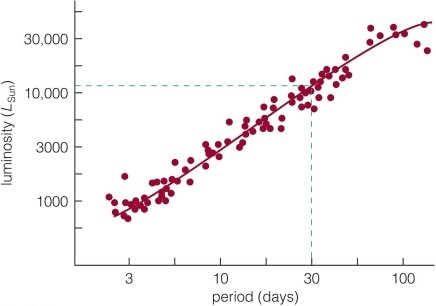 This figure shows the Cepheid period- luminosity relation. What is the approximate luminosity of a Cepheid star that varies in brightness on a 10 day cycle?
 (Multiple Choice)
4.9/5 (80)
(80) What is the most accurate way to determine the distance to a nearby galaxy?
(Multiple Choice)
4.8/5 (99)
(99) Suppose we observe a source of X- rays that varies substantially in brightness over a period of a few days. What can we conclude?
(Multiple Choice)
5.0/5 (78)
(78) Explain how we can estimate that there are about 50- 100 billion galaxies in the observable universe.
(Essay)
4.9/5 (89)
(89) Based on counting the number of galaxies in a small patch of the sky and multiplying by the number of such patches needed to cover the entire sky, the total number of galaxies in the observable universe is estimated to be approximately
(Multiple Choice)
4.9/5 (90)
(90) How do observations of galaxies at different distances help us learn about galaxy evolution?
(Multiple Choice)
4.8/5 (83)
(83) The collision of two spiral galaxies will likely result in a single giant spiral galaxy.
(True/False)
4.8/5 (82)
(82) Which of the following phenomena is probably not related to the presence of a supermassive black hole?
(Multiple Choice)
4.8/5 (70)
(70) Explain individual galaxies or clusters of galaxies do not expand in size despite the overall expansion of the universe implied by Hubble's Law.
(Essay)
4.9/5 (74)
(74) In 1924, Edwin Hubble proved that the Andromeda Galaxy lay far beyond the bounds of the Milky Way, thus putting to rest the idea that it might have been a cloud within our own galaxy. How was he able to prove this?
(Multiple Choice)
4.8/5 (72)
(72) Why should galaxy collisions have been more common in the past than they are today?
(Multiple Choice)
4.9/5 (87)
(87) Approximately how many stars does a dwarf elliptical galaxy have?
(Multiple Choice)
4.9/5 (81)
(81) How do astronomers use the Hubble Constant (H0)to estimate the age of the universe?
(Multiple Choice)
4.8/5 (85)
(85) What evidence tells us that quasars are the centers of distant galaxies?
(Multiple Choice)
4.8/5 (61)
(61) 
Filters
- Essay(0)
- Multiple Choice(0)
- Short Answer(0)
- True False(0)
- Matching(0)