



 Chat with AI
Exam 16: A Universe of Galaxies

Exam 1: A Modern View of the Universe118 Questions
Exam 2: Discovering the Universe for Yourself137 Questions
Exam 3: The Science of Astronomy111 Questions
Exam 4: Making Sense of the Universe: Understanding Motion, Energy, and Gravity122 Questions
Exam 5: Light: the Cosmic Messenger148 Questions
Exam 6: Formation of the Solar System142 Questions
Exam 7: Earth and the Terrestrial Worlds193 Questions
Exam 8: Jovian Planet System98 Questions
Exam 9: Asteroids, Comets, and Dwarf Planets: Their Nature, Orbits, and Impacts130 Questions
Exam 10: Other Planetary Systems: the New Science of Distant Worlds86 Questions
Exam 11: Our Star114 Questions
Exam 12: Surveying the Stars146 Questions
Exam 13: Star Stuff142 Questions
Exam 14: The Bizarre Stellar Graveyard116 Questions
Exam 15: Our Galaxy124 Questions
Exam 16: A Universe of Galaxies160 Questions
Exam 17: The Birth of the Universe96 Questions
Exam 18: Dark Matter, Dark Energy, and the Fate of the Universe117 Questions
Exam 19: Life in the Universe94 Questions
Select questions type


List at least three qualities that make an astronomical object a good standard candle.

Free
(Essay)
4.8/5  (77)
(77) Correct Answer: Verified
All standard candles must have some observable property that allows us to recognize the object as a member of the unique class. For example, Cepheids vary in brightness in a characteristic way, allowing us to distinguish them from other stars; white dwarf supernova have a unique light- curve that allows us to distinguish them from massive star supernova. The remaining answers will vary, but some additional key properties include little statistical scatter in brightness; high luminosity so that they can be seen at a great distance; and relative commonness so that they can be found in many objects.
Based on the number of galaxies visible in the Hubble Deep Field (Figure 16.1 in your textbook), the estimated number of galaxies in our observable universe is about .
Free
(Multiple Choice)
4.8/5 (94)
(94) Correct Answer:Verified
VerifiedD
Which of the following is a consequence of Hubble's Law?
Free
(Multiple Choice)
4.9/5 (86)
(86) Correct Answer:Verified
VerifiedC
Which of the following cannot be true of the very first stars formed in the universe?
(Multiple Choice)
5.0/5 (84)
(84) Which of the following gives the two main assumptions of theoretical models of galaxy evolution?
(Multiple Choice)
4.8/5 (84)
(84) Ming measures a recession velocity of 2000 km/sec for a galaxy. About how far away is that galaxy if the Hubble constant is 20 km/sec/million light years? (Hint: be sure to check the units in your calculation.)
(Multiple Choice)
4.9/5 (89)
(89) Suppose we observe a source of X- rays that varies substantially in brightness over a period of a few days. What can we conclude?
(Multiple Choice)
4.7/5 (70)
(70) In a uniformly expanding universe, which statement best describes the situation as viewed from an observer in Galaxy C (not the Milky Way Galaxy)?
(Multiple Choice)
4.7/5 (90)
(90) All of the following observations are real. Which one does not support the theory that active galactic nuclei are powered by accretion disks around massive black holes?
(Multiple Choice)
4.8/5 (88)
(88) 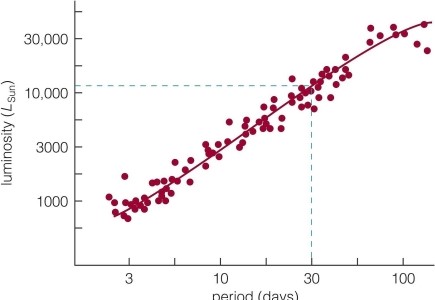 This figure shows the Cepheid period- luminosity relation. A Cepheid star with a period of 30 days has the same apparent brightness as a nearby G2 star. How many times further away is the Cepheid star?
 (Multiple Choice)
4.8/5 (72)
(72) Which of the following types of galaxies appear reddest in color?
(Multiple Choice)
4.8/5 (75)
(75) According to the theory that active galactic nuclei are powered by supermassive black holes, the energy released as light comes from .
(Multiple Choice)
4.8/5 (72)
(72) Give several observations supporting the idea that the high redshifts of quasars really do imply great distances.
(Essay)
4.8/5 (73)
(73) What two quantities did Edwin Hubble compare for a sample of galaxies to discover the expansion of the universe?
(Multiple Choice)
5.0/5 (81)
(81) Which of the following types of protogalactic clouds is most likely to form an elliptical galaxy?
(Multiple Choice)
4.9/5 (73)
(73) The observed relationship between the masses of central black holes and the bulge masses of galaxies implies that .
(Multiple Choice)
4.8/5 (79)
(79) One possible explanation for a galaxy's type invokes the angular momentum of the protogalactic cloud from which it formed. Suppose a galaxy forms from a protogalactic cloud with a lot of angular momentum. Assuming its type has not changed due to other interactions, we'd expect this galaxy to be .
(Multiple Choice)
4.8/5 (81)
(81) 
Filters
- Essay(0)
- Multiple Choice(0)
- Short Answer(0)
- True False(0)
- Matching(0)