



 Chat with AI
Exam 14: The Bizarre Stellar Graveyard

Exam 1: A Modern View of the Universe118 Questions
Exam 2: Discovering the Universe for Yourself137 Questions
Exam 3: The Science of Astronomy111 Questions
Exam 4: Making Sense of the Universe: Understanding Motion, Energy, and Gravity122 Questions
Exam 5: Light: the Cosmic Messenger148 Questions
Exam 6: Formation of the Solar System142 Questions
Exam 7: Earth and the Terrestrial Worlds193 Questions
Exam 8: Jovian Planet System98 Questions
Exam 9: Asteroids, Comets, and Dwarf Planets: Their Nature, Orbits, and Impacts130 Questions
Exam 10: Other Planetary Systems: the New Science of Distant Worlds86 Questions
Exam 11: Our Star114 Questions
Exam 12: Surveying the Stars146 Questions
Exam 13: Star Stuff142 Questions
Exam 14: The Bizarre Stellar Graveyard116 Questions
Exam 15: Our Galaxy124 Questions
Exam 16: A Universe of Galaxies160 Questions
Exam 17: The Birth of the Universe96 Questions
Exam 18: Dark Matter, Dark Energy, and the Fate of the Universe117 Questions
Exam 19: Life in the Universe94 Questions
Select questions type


Why does the size of a white dwarf decrease with increasing mass?

Free
(Essay)
4.8/5  (79)
(79) Correct Answer: Verified
A more massive white dwarf has a stronger gravitational force that compresses its mass to a greater density. The degeneracy pressure that supports a white dwarf against collapse increases as the density increases, and the balance between degeneracy pressure and gravity is reached such that the a more massive white dwarf is smaller in radius.
Answer Key Testname: C14
Brown dwarfs, white dwarfs, and neutrons stars are all kept from collapsing by degeneracy pressure.
Free
(True/False)
4.8/5 (87)
(87) Correct Answer:Verified
VerifiedTrue
No visible light can escape a black hole, but things such as gamma rays, X- rays, and neutrinos can.
Free
(True/False)
4.8/5 (70)
(70) Correct Answer:Verified
VerifiedFalse
Which of the following best describes what would happen if a 1.5 solar mass neutron star, with a diameter of a few kilometers, were suddenly to appear in your hometown?
(Multiple Choice)
4.8/5 (91)
(91) Suppose you drop a clock toward a black hole. As you look at the clock from a high orbit, what will you notice?
(Multiple Choice)
4.8/5 (79)
(79) 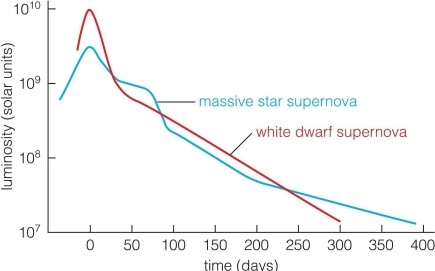 This figure shows how the luminosity of supernovae change over time. How long does it take a white dwarf supernova to decrease in luminosity by a factor of 100 from its peak?
 (Multiple Choice)
4.8/5 (97)
(97) The coolest white- dwarf: Surveys have been carried out to identify isolated white- dwarfs throughout the galaxy and its globular clusters. They have been found to span a range of temperatures, with a sharp lower limit of about 3000 K (i.e. many have been found at all temperatures from 10s of thousands of Kelvin down to 3000K, but none cooler). What does this observation reveal about the age of our galaxy?
(Essay)
4.9/5 (73)
(73) Neutron stars are the densest objects that we can directly observe in the universe.
(True/False)
4.7/5 (82)
(82) A paperclip with the density of a neutron star would weigh (on the Earth)
(Multiple Choice)
4.8/5 (88)
(88) Which of the following statements about electron degeneracy pressure and neutron degeneracy pressure is true?
(Multiple Choice)
4.9/5 (73)
(73) You want to determine whether a mystery object is a neutron star or a white dwarf. Which of the following properties would demonstrate that it is definitely a neutron star?
(Multiple Choice)
5.0/5 (69)
(69) In which wavelength region(s)would we need to carry out observations in order to study the accretion disk around a white dwarf in a binary system?
(Multiple Choice)
4.9/5 (83)
(83) Which of the following observatories is most likely to discover a black hole in a binary system?
(Multiple Choice)
4.9/5 (88)
(88) 
Filters
- Essay(0)
- Multiple Choice(0)
- Short Answer(0)
- True False(0)
- Matching(0)