



 Chat with AI
Exam 16: A Universe of Galaxies

Exam 1: A Modern View of the Universe118 Questions
Exam 2: Discovering the Universe for Yourself137 Questions
Exam 3: The Science of Astronomy111 Questions
Exam 4: Making Sense of the Universe: Understanding Motion, Energy, and Gravity122 Questions
Exam 5: Light: the Cosmic Messenger148 Questions
Exam 6: Formation of the Solar System142 Questions
Exam 7: Earth and the Terrestrial Worlds193 Questions
Exam 8: Jovian Planet System98 Questions
Exam 9: Asteroids, Comets, and Dwarf Planets: Their Nature, Orbits, and Impacts130 Questions
Exam 10: Other Planetary Systems: the New Science of Distant Worlds86 Questions
Exam 11: Our Star114 Questions
Exam 12: Surveying the Stars146 Questions
Exam 13: Star Stuff142 Questions
Exam 14: The Bizarre Stellar Graveyard116 Questions
Exam 15: Our Galaxy124 Questions
Exam 16: A Universe of Galaxies160 Questions
Exam 17: The Birth of the Universe96 Questions
Exam 18: Dark Matter, Dark Energy, and the Fate of the Universe117 Questions
Exam 19: Life in the Universe94 Questions
Select questions type


According to the theory that active galactic nuclei are powered by supermassive black holes, the high luminosity of an active galactic nucleus primarily consists of .
(Multiple Choice)
4.7/5  (99)
(99) Does It Matter What the Universe Expands Into? A natural question of anyone who meets Hubble's Law for the first time is to ask what exactly the universe is expanding into. This is often further motivated by the analogy of an inflating balloon universe, where two- dimensional galaxies ride along on the surface of the balloon. Imagine that you live in one of these balloon- borne galaxies. Your universe is the surface of the balloon. You can move along the surface, but you can never exist above or below it. Now one of your two- dimensional friends asks what your (balloon)space is expanding into. Do you need to answer this question, or can the expansion you experience be completely described without reference to an unseen, third- dimension? Imagine someone argues that question "what is the universe expanding into?" does not even need an answer! Would you agree or disagree? Explain. If you disagree, would there be any way to gather scientific evidence to answer this question?
(Essay)
4.8/5 (80)
(80) Why should galaxy collisions have been more common in the past than they are today?
(Multiple Choice)
4.8/5 (79)
(79) A protogalactic cloud with very little angular momentum is more likely to form an elliptical galaxy than a spiral galaxy.
(True/False)
4.9/5 (94)
(94) If an object doubles its luminosity in 10 hours, how large can the emitting source of light be?
(Multiple Choice)
4.9/5 (74)
(74) Hubble's galaxy classification diagram (the "tuning fork").
(Multiple Choice)
4.8/5 (73)
(73) How does a lenticular galaxy differ from a normal spiral galaxy?
(Multiple Choice)
4.8/5 (80)
(80) In the 1960s, Maarten Schmidt determined that quasars were very distant objects by
(Multiple Choice)
4.7/5 (94)
(94) The unusually bright centers found in some galaxies are called .
(Multiple Choice)
4.8/5 (65)
(65) Does Hubble's law work well for galaxies in the Local Group? Why or why not?
(Multiple Choice)
4.7/5 (76)
(76) Building new telescopes: With current telescopes, we can see galaxies as they existed 1 billion years after the Big Bang. Discuss innovations that could be made with new telescopes in order to see even further.
(Essay)
5.0/5 (78)
(78) What is the current limit to distances we can measure via parallax, until the results of the new Gaia mission become available?
(Multiple Choice)
4.8/5 (70)
(70) There are more large spiral galaxies than there are large elliptical galaxies.
(True/False)
4.7/5 (78)
(78) Recall that a raisin cake is sometimes used to imagine how an expanding universe behaves. Suppose you are in a uniformly expanding raisin cake, sitting on Raisin A, looking at Raisin B, 2 cm away from you. Raisin B is moving away from you at 1 cm/sec. At the same time, you observe another Raisin C, which is moving away from you at 3 cm/sec. How far away is Raisin C from Raisin A?
(Multiple Choice)
4.9/5 (91)
(91) 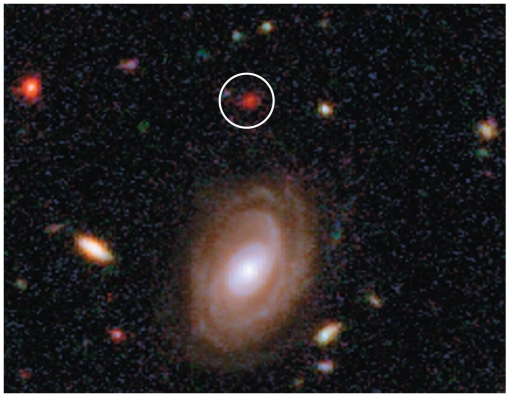 In this picture, we are seeing light from the circled elliptical galaxy (HUDF- JD2)from when the universe was only about 800 million years old. The spiral galaxy below it is much closer. Why does HUDF- JD2 appear a deep red, compared to the whitish color of the nearby spiral?
 (Multiple Choice)
4.9/5 (69)
(69) 
Filters
- Essay(0)
- Multiple Choice(0)
- Short Answer(0)
- True False(0)
- Matching(0)