



 Chat with AI
Exam 16: A Universe of Galaxies

Exam 1: A Modern View of the Universe118 Questions
Exam 2: Discovering the Universe for Yourself137 Questions
Exam 3: The Science of Astronomy111 Questions
Exam 4: Making Sense of the Universe: Understanding Motion, Energy, and Gravity122 Questions
Exam 5: Light: the Cosmic Messenger148 Questions
Exam 6: Formation of the Solar System142 Questions
Exam 7: Earth and the Terrestrial Worlds193 Questions
Exam 8: Jovian Planet System98 Questions
Exam 9: Asteroids, Comets, and Dwarf Planets: Their Nature, Orbits, and Impacts130 Questions
Exam 10: Other Planetary Systems: the New Science of Distant Worlds86 Questions
Exam 11: Our Star114 Questions
Exam 12: Surveying the Stars146 Questions
Exam 13: Star Stuff142 Questions
Exam 14: The Bizarre Stellar Graveyard116 Questions
Exam 15: Our Galaxy124 Questions
Exam 16: A Universe of Galaxies160 Questions
Exam 17: The Birth of the Universe96 Questions
Exam 18: Dark Matter, Dark Energy, and the Fate of the Universe117 Questions
Exam 19: Life in the Universe94 Questions
Select questions type


What evidence supports the idea that a collision between two spiral galaxies might lead to the formation of a single elliptical galaxy?
(Multiple Choice)
4.8/5  (70)
(70) A quasar's spectrum is hugely redshifted. What does this large redshift tells us about the quasar?
(Multiple Choice)
4.8/5 (81)
(81) What is the most accurate way to determine the distance to a very distant galaxy?
(Multiple Choice)
4.7/5 (73)
(73) How does a starburst end? What might happen to the galaxy afterwards?
(Essay)
4.9/5 (81)
(81) Which of the following is not a piece of evidence supporting the conclusion that active galactic nuclei are powered by accretion disks around massive black holes?
(Multiple Choice)
4.9/5 (93)
(93) Why are white dwarf supernovae more useful than massive star supernovae for measuring cosmic distances?
(Multiple Choice)
4.9/5 (75)
(75) Which of the following is evidence for supermassive black holes in active galaxies?
(Multiple Choice)
4.7/5 (73)
(73) Suppose that we look at a photograph of many galaxies. Assuming that all galaxies formed at about the same time, which galaxy in the picture is the youngest?
(Multiple Choice)
4.9/5 (72)
(72) 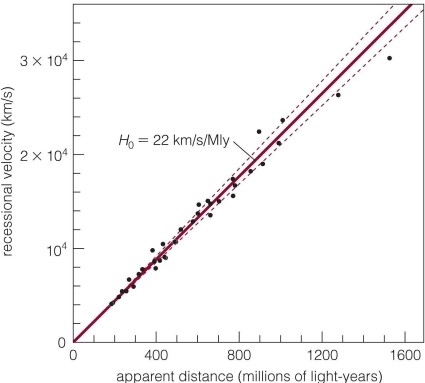 This figure shows Hubble's law. If a galaxy is observed to be moving away from us at 30,000 km/s, how far away is it?
 (Multiple Choice)
4.9/5 (83)
(83) Use the graph above showing data for the brightest galaxies in clusters of galaxies to answer the following question. If new studies show that the exceptions are a class of galaxies with extraordinarily bright centers, which conclusion is not justified based on the plot and the findings of these new studies?
(Multiple Choice)
4.9/5 (81)
(81) Suppose we observe a Cepheid variable in a distant galaxy. The Cepheid brightens and dims with a regular period of about 10 days. What can we learn from this observation?
(Multiple Choice)
4.9/5 (70)
(70) Which of the following phenomena are not thought to be results of collisions or other interactions between galaxies?
(Multiple Choice)
4.9/5 (90)
(90) The most basic difference between elliptical galaxies and spiral galaxies is that .
(Multiple Choice)
4.8/5 (70)
(70) How did Edwin Hubble measure the distance to the Andromeda Galaxy?
(Multiple Choice)
4.8/5 (82)
(82) The larger the value of Hubble's constant, the more rapid the expansion of the universe and the smaller (and hence younger)our estimate for the age of the universe.
(True/False)
4.7/5 (82)
(82) Recall that Hubble's law is written v = H0d, where v is the recession velocity of a galaxy located a distance d away from us, and H0 is Hubble's constant. Suppose H0 = 20 km/s/Mly. How fast would a galaxy 1000 Mly distant be receding from us?
(Multiple Choice)
4.9/5 (77)
(77) Where are the X- rays produced that are emitted by quasars and other active galactic nuclei?
(Multiple Choice)
5.0/5 (73)
(73) Using the technique of main- sequence fitting to determine the distance to a star cluster requires that .
(Multiple Choice)
4.9/5 (85)
(85) 
Filters
- Essay(0)
- Multiple Choice(0)
- Short Answer(0)
- True False(0)
- Matching(0)