



 Chat with AI
Exam 12: Investment and Financial Markets

Exam 1: Introduction: What Is Economics144 Questions
Exam 2: The Key Principles of Economics195 Questions
Exam 3: Exchange and Markets135 Questions
Exam 4: Demand, Supply, and Market Equilibrium279 Questions
Exam 5: Measuring a Nations Production and Income161 Questions
Exam 6: Unemployment and Inflation206 Questions
Exam 7: The Economy at Full Employment165 Questions
Exam 8: Why Do Economies Grow203 Questions
Exam 9: Aggregate Demand and Aggregate Supply189 Questions
Exam 10: Fiscal Policy166 Questions
Exam 11: The Income-Expenditure Model265 Questions
Exam 12: Investment and Financial Markets179 Questions
Exam 13: Money and the Banking System184 Questions
Exam 14: The Federal Reserve and Monetary Policy203 Questions
Exam 15: Modern Macroeconomics: From the Short Run to the Long Run176 Questions
Exam 16: The Dynamics of Inflation and Unemployment186 Questions
Exam 17: Macroeconomic Policy Debates143 Questions
Exam 18: International Trade and Public Policy226 Questions
Exam 19: The World of International Finance189 Questions
Select questions type


If Andrew is paid an interest rate of 10% on his savings account, but the inflation rate is 20%, the real (effective) value of his savings account is
(Multiple Choice)
4.9/5  (89)
(89) As interest rates rise, there will be fewer profitable projects that firms will be willing to invest in.
(True/False)
4.7/5 (84)
(84) Recall Application 3, "Underwater Homes: Bets Gone Wrong" to answer the following questions:
-According to the application, a home is underwater when:
(Multiple Choice)
4.9/5 (85)
(85) Optimistic expectations about the future increase investment spending because they inflate the price of stock shares.
(True/False)
4.9/5 (71)
(71) Bob meets with a banker to discuss the terms of a 1- year loan. Bob and the banker both expect that inflation will be 4 percent over the next year and agree on a nominal interest rate of 9 percent. In actuality, the inflation rate is 5 percent over the next year.
(a) What was the expected real interest rate on the loan?
(b) What was the actual real interest rate on the loan?
(Essay)
4.7/5 (67)
(67) According to Keynes, the wild swings in investment spending are caused by
(Multiple Choice)
4.8/5 (77)
(77) 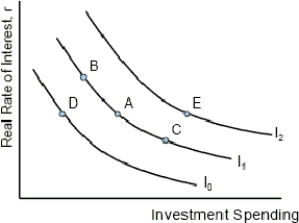 Figure 12.1
-Refer to Figure 12.1. Which of the following causes a movement from Point A to Point C?
Figure 12.1
-Refer to Figure 12.1. Which of the following causes a movement from Point A to Point C? (Multiple Choice)
4.9/5 (71)
(71) Recall Application 2, "Options for a Lottery Winner," to answer the following questions:
-The higher the interest rates, the higher the present value.
(True/False)
5.0/5 (86)
(86) During the 1970s homeowners in California borrowed money at 10 percent interest rates per year because the growth rate in the value of housing prices exceeded:
(Multiple Choice)
4.9/5 (79)
(79) Recall Application 1, "Energy Price Uncertainty Reduces Investment Spending," to answer the following questions:
-According to the application, the wild swing in the price of oil in 2008- 2009 resulted in:
(Multiple Choice)
4.9/5 (81)
(81) In the late 1970s, nominal interest rates were high and inflation rates were also very high and were even higher than the nominal interest rate on some years. During this period, real interest rates were:
(Multiple Choice)
4.8/5 (68)
(68) Which of the following is a determinant of firms' investment and employment decisions?
(Multiple Choice)
4.8/5 (65)
(65) What did Keynes mean by the phrase "animal spirits"? Why do these "spirits" make investment a volatile component of GDP?
(Essay)
4.9/5 (81)
(81) 
Filters
- Essay(0)
- Multiple Choice(0)
- Short Answer(0)
- True False(0)
- Matching(0)