



 Chat with AI
Exam 13: Money and the Banking System

Exam 1: Introduction: What Is Economics144 Questions
Exam 2: The Key Principles of Economics195 Questions
Exam 3: Exchange and Markets135 Questions
Exam 4: Demand, Supply, and Market Equilibrium279 Questions
Exam 5: Measuring a Nations Production and Income161 Questions
Exam 6: Unemployment and Inflation206 Questions
Exam 7: The Economy at Full Employment165 Questions
Exam 8: Why Do Economies Grow203 Questions
Exam 9: Aggregate Demand and Aggregate Supply189 Questions
Exam 10: Fiscal Policy166 Questions
Exam 11: The Income-Expenditure Model265 Questions
Exam 12: Investment and Financial Markets179 Questions
Exam 13: Money and the Banking System184 Questions
Exam 14: The Federal Reserve and Monetary Policy203 Questions
Exam 15: Modern Macroeconomics: From the Short Run to the Long Run176 Questions
Exam 16: The Dynamics of Inflation and Unemployment186 Questions
Exam 17: Macroeconomic Policy Debates143 Questions
Exam 18: International Trade and Public Policy226 Questions
Exam 19: The World of International Finance189 Questions
Select questions type


The amount of money banks can loan out is determined by the discount rate.
(True/False)
4.8/5  (95)
(95) Explain why a country with a central bank that is not independent of external political pressure is a country that tends to have higher inflation.
(Essay)
4.8/5 (89)
(89) John transfers $1,000 from his checking account to his savings account. This transaction will:
(Multiple Choice)
4.8/5 (91)
(91) The seven members of the Board of Governors are appointed to _______ terms by the President.
(Multiple Choice)
4.7/5 (74)
(74)  -Refer to Table 13.1. First Commercial Bank's total loans equal $ _______.
 (Multiple Choice)
4.9/5 (73)
(73) Which of the following is included in M2 but not included in M1?
(Multiple Choice)
4.9/5 (83)
(83) A monetary system in which gold backs up paper money is called:
(Multiple Choice)
4.9/5 (74)
(74) _______ is a monetary system in which the money has no intrinsic value. In this system, the money is backed by the government.
(Multiple Choice)
4.8/5 (71)
(71) Assume there is only one bank in Maldavia-The First National Bank. The required reserve ratio is 25%. The First National Bank has no excess reserves. Suppose that there is a new deposit of $200 million into the banking system. What is the value of the money multiplier in Maldavia? By how much can the money supply increase in Maldavia?
(Essay)
4.8/5 (81)
(81) Which of the following assets is the largest component of M1?
(Multiple Choice)
4.9/5 (80)
(80) 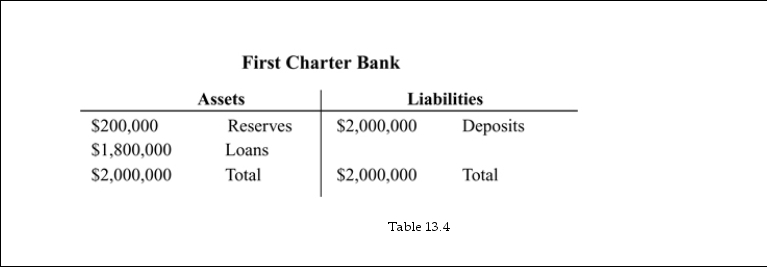 -Refer to Table 13.4. If First Charter Bank earns a loss of $100,000, then:
 (Multiple Choice)
4.9/5 (78)
(78) Bank of Sim City has $500 million in deposits. The required reserve ratio is 25%. Bank of Sim City must keep _______ in reserves.
(Multiple Choice)
4.8/5 (72)
(72) COPING WITH A STOCK MARKET CRASH: BLACK MONDAY, 1987
How did the Fed successfully respond to the major stock market crash in 1987?
On October 19, 1987, known as "Black Monday," the Dow Jones index of the stock market fell a dramatic 22.6 percent in one
day. Similar declines were felt in other indexes and stock markets around the world. These
declines shocked both businesses and investors. In just 24 hours, many people and firms found themselves much less
wealthy. The public began to worry that banks and other financial institutions—to protect their own
loans and investments—would call in borrowers’’ existing loans and stop making new ones. A sharp drop in available credit
could, conceivably, plunge the economy into a deep recession.
Alan Greenspan had just become chairman of the Federal Reserve that year. As a sophisticated economist with historical
knowledge of prior financial crises, he recognized the seriousness of the situation. He quickly issued
a public statement in which he said that the Federal Reserve stood ready to provide liquidity to the economy and the
financial system. Banks were told that the Fed would let them borrow liberally. In fact, the Fed provided liquidity to such an
extent that interest rates even fell. As a result of Greenspan’s action, "Black Monday" did not cause a recession in the United
States.
-The dramatic drop in stock values on October 19, 1987, known as "Black Monday," was potentially catastrophic for the economy because:
(Multiple Choice)
4.9/5 (89)
(89) We know that money is an asset that can be used to transport purchasing power from one time period to another. This description of money illustrates its role as a:
(Multiple Choice)
4.8/5 (80)
(80) First National Bank has liabilities of $1 million and owners' equity of $300,000. First National Bank's assets are:
(Multiple Choice)
4.9/5 (90)
(90) 
Filters
- Essay(0)
- Multiple Choice(0)
- Short Answer(0)
- True False(0)
- Matching(0)