



 Chat with AI
Exam 15: Modern Macroeconomics: From the Short Run to the Long Run

Exam 1: Introduction: What Is Economics144 Questions
Exam 2: The Key Principles of Economics195 Questions
Exam 3: Exchange and Markets135 Questions
Exam 4: Demand, Supply, and Market Equilibrium279 Questions
Exam 5: Measuring a Nations Production and Income161 Questions
Exam 6: Unemployment and Inflation206 Questions
Exam 7: The Economy at Full Employment165 Questions
Exam 8: Why Do Economies Grow203 Questions
Exam 9: Aggregate Demand and Aggregate Supply189 Questions
Exam 10: Fiscal Policy166 Questions
Exam 11: The Income-Expenditure Model265 Questions
Exam 12: Investment and Financial Markets179 Questions
Exam 13: Money and the Banking System184 Questions
Exam 14: The Federal Reserve and Monetary Policy203 Questions
Exam 15: Modern Macroeconomics: From the Short Run to the Long Run176 Questions
Exam 16: The Dynamics of Inflation and Unemployment186 Questions
Exam 17: Macroeconomic Policy Debates143 Questions
Exam 18: International Trade and Public Policy226 Questions
Exam 19: The World of International Finance189 Questions
Select questions type


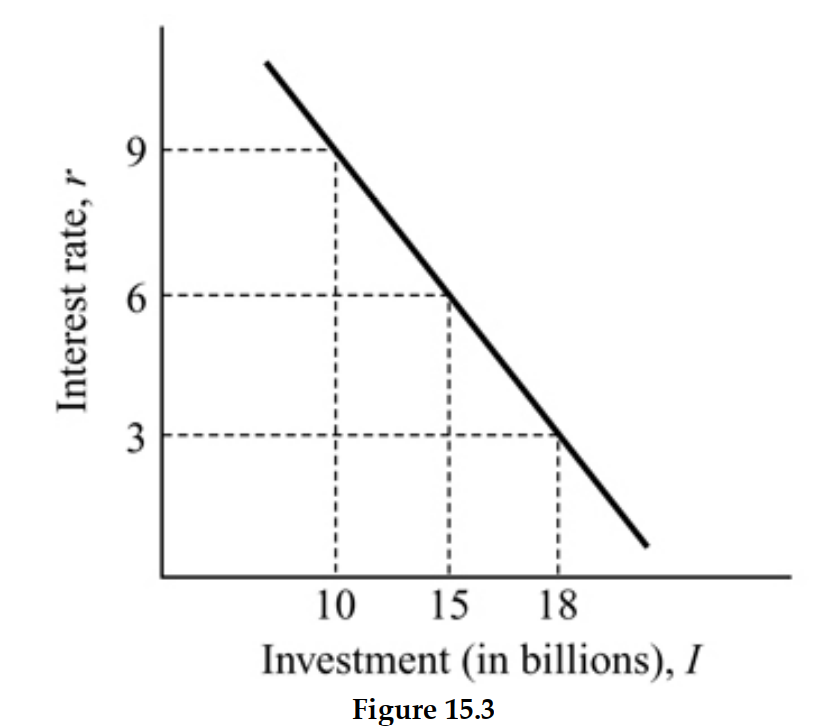 -Refer to Figure 15.3. At full employment equilibrium, investment would increase from $10 million to $15 million if:
 (Multiple Choice)
4.9/5  (71)
(71) Suppose that the natural rate of unemployment for the economy is 6 percent and the economy is currently experiencing a 9 percent unemployment rate. Explain what will likely happen to wages and prices as the economy adjusts to the long- run equilibrium.
(Essay)
4.7/5 (80)
(80) Recall Application 2, "Elections, Political Parties, and Voter Expectations," to answer the following questions:
-There is little evidence to support the view that political parties have different goals and preferences.
(True/False)
4.7/5 (82)
(82) Recall Application 1, "Avoiding a Liquidity Trap," to answer the following questions:
-What is the reason why the Fed started paying interest on bank reserves in 2008?
(Multiple Choice)
4.8/5 (83)
(83) Which policy is effective in getting the economy out of a recession if the economy is in a liquidity trap? Which policy is ineffective?
(Essay)
4.8/5 (86)
(86) According to the classical model, an excess supply of labor would drive up wages to a new equilibrium level and therefore unemployment would not persist.
(True/False)
4.7/5 (89)
(89) Because the long- run aggregate supply curve is vertical, firms will produce all they can in the long run
(Multiple Choice)
4.7/5 (75)
(75) For crowding out to occur in the long run, an increase in government spending must cause the money demand curve to _______ in order to _______ the interest rate.
(Multiple Choice)
4.8/5 (79)
(79) 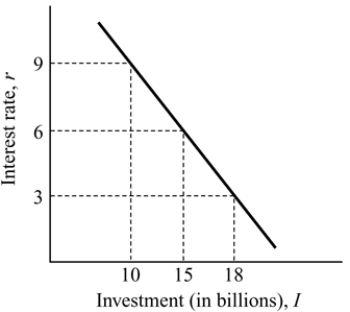 Figure 15.3
-Refer to Figure 15.3. At full employment equilibrium, investment would decrease from $18 million to $15 million if:
Figure 15.3
-Refer to Figure 15.3. At full employment equilibrium, investment would decrease from $18 million to $15 million if: (Multiple Choice)
4.8/5 (76)
(76) The reduction in investment spending in the long run results from an increase in government expenditures because:
(Multiple Choice)
5.0/5 (81)
(81) The government can use contractionary fiscal policies to prevent a wage- price spiral.
(True/False)
4.8/5 (83)
(83) Suppose the economy is producing above the potential output. Explain how money demand and investments will change to bring the economy back to potential output.
(Essay)
4.9/5 (70)
(70) Recall Application 1, "Avoiding a Liquidity Trap," to answer the following questions:
-Which of the following is the warning sign that the economy was facing a looming liquidity trap?
(Multiple Choice)
4.8/5 (82)
(82) Friedman believed that economic policies are ineffective because they don't affect the aggregate demand in the economy.
(True/False)
4.8/5 (76)
(76) Which of the following sequence of events follows an expansionary fiscal policy?
(Multiple Choice)
4.9/5 (81)
(81) 
Filters
- Essay(0)
- Multiple Choice(0)
- Short Answer(0)
- True False(0)
- Matching(0)