



 Chat with AI
Exam 4: Demand, Supply, and Market Equilibrium

Exam 1: Introduction: What Is Economics144 Questions
Exam 2: The Key Principles of Economics195 Questions
Exam 3: Exchange and Markets135 Questions
Exam 4: Demand, Supply, and Market Equilibrium279 Questions
Exam 5: Measuring a Nations Production and Income161 Questions
Exam 6: Unemployment and Inflation206 Questions
Exam 7: The Economy at Full Employment165 Questions
Exam 8: Why Do Economies Grow203 Questions
Exam 9: Aggregate Demand and Aggregate Supply189 Questions
Exam 10: Fiscal Policy166 Questions
Exam 11: The Income-Expenditure Model265 Questions
Exam 12: Investment and Financial Markets179 Questions
Exam 13: Money and the Banking System184 Questions
Exam 14: The Federal Reserve and Monetary Policy203 Questions
Exam 15: Modern Macroeconomics: From the Short Run to the Long Run176 Questions
Exam 16: The Dynamics of Inflation and Unemployment186 Questions
Exam 17: Macroeconomic Policy Debates143 Questions
Exam 18: International Trade and Public Policy226 Questions
Exam 19: The World of International Finance189 Questions
Select questions type


If the law of supply holds, then the supply curve can never:
(Multiple Choice)
4.8/5  (75)
(75) 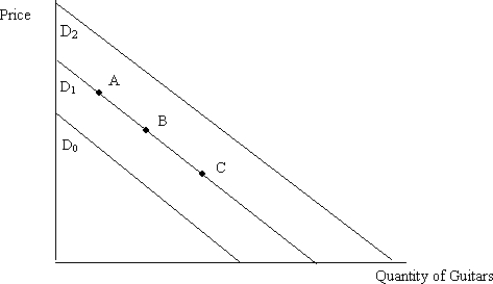 Figure 4.4
-Figure 4.4 illustrates the demand for guitars. A decrease in price of guitars would bring about a movement from:
Figure 4.4
-Figure 4.4 illustrates the demand for guitars. A decrease in price of guitars would bring about a movement from: (Multiple Choice)
4.9/5 (92)
(92) If the equilibrium price of a good increases and the equilibrium quantity of the good decreases, we can conclude that:
(Multiple Choice)
4.9/5 (74)
(74) Suppose that the quantity demanded for cars exceeds the quantity supplied of cars. We would expect that:
(Multiple Choice)
4.9/5 (83)
(83) A major freeze in Florida has reduced the orange yield this winter. What will be the effect of this freeze on the price and quantity in the orange market and also in the peach market? (Assume that oranges and peaches are substitutes.)
(Essay)
4.9/5 (79)
(79) Why do the demand curves for inferior goods slope downward, even though the law of demand is driven in part by the income effect?
(Essay)
4.9/5 (71)
(71) 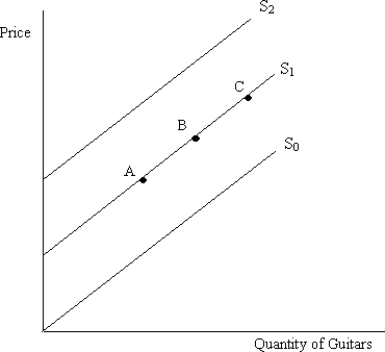 Figure 4.5
-Figure 4.5 illustrates the supply of guitars. An increase in the price of rosewood, which is used to make guitars, would most likely cause a movement from:
Figure 4.5
-Figure 4.5 illustrates the supply of guitars. An increase in the price of rosewood, which is used to make guitars, would most likely cause a movement from: (Multiple Choice)
4.9/5 (82)
(82) Suppose that the price of fertilizer, an input in the production of corn, falls. We would predict that the equilibrium quantity of corn will _______ and the equilibrium price of corn will _______ .
(Multiple Choice)
4.9/5 (82)
(82) When Tom's income decreases, he purchases more hamburgers. We can conclude that for Tom, hamburger is a(n) _______ good.
(Multiple Choice)
4.7/5 (64)
(64) Two goods are complements if an increase in the price of one good leads to an increase in demand for the other.
(True/False)
4.8/5 (96)
(96) Recall Application 3, "The Supply and Demand for Cruise Ship Berths," to answer the following questions:
-Because the application claims that a recession will decrease the demand for cruise ships, we can infer that cruise ship berths are:
(Multiple Choice)
4.7/5 (78)
(78) What does an increase in population do to the demand for a product?
(Short Answer)
4.7/5 (82)
(82) When a demand curve is drawn, which of the following is not held constant?
(Multiple Choice)
4.8/5 (79)
(79) 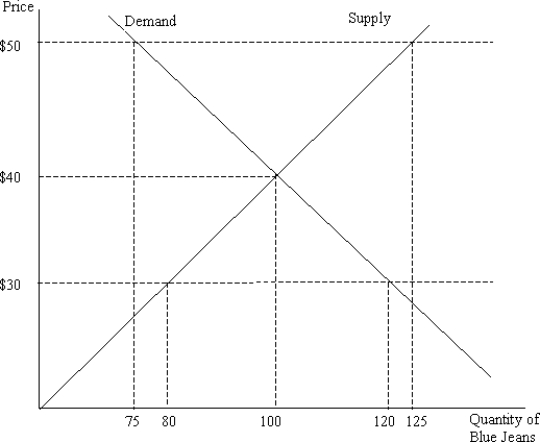 Figure 4.3
-Figure 4.3 illustrates the supply and demand for blue jeans. If the actual price of blue jeans is $30, we would expect the price of blue jeans to _______, the quantity demanded of blue jeans to _______, and the quantity supplied of blue jeans _______.
Figure 4.3
-Figure 4.3 illustrates the supply and demand for blue jeans. If the actual price of blue jeans is $30, we would expect the price of blue jeans to _______, the quantity demanded of blue jeans to _______, and the quantity supplied of blue jeans _______. (Multiple Choice)
4.8/5 (84)
(84) People will buy more of a normal good when their income decreases.
(True/False)
4.8/5 (85)
(85) If the incomes decrease and electricity is a normal good, then:
(Multiple Choice)
5.0/5 (82)
(82) Governments often get involved in creating a market equilibrium by setting a maximum price that is less than the equilibrium price, resulting in a permanent excess demand for the products.
(True/False)
4.7/5 (82)
(82) 
Filters
- Essay(0)
- Multiple Choice(0)
- Short Answer(0)
- True False(0)
- Matching(0)