



 Chat with AI
Exam 15: International Trade Policy

Exam 1: What Is Economics472 Questions
Exam 2: The Economic Problem432 Questions
Exam 3: Demand and Supply503 Questions
Exam 4: Measuring Gdp and Economic Growth393 Questions
Exam 5: Monitoring Jobs and Inflation398 Questions
Exam 6: Economic Growth343 Questions
Exam 7: Finance, Saving, and Investment233 Questions
Exam 8: Money, the Price Level, and Inflation583 Questions
Exam 9: The Exchange Rate and the Balance of Payments482 Questions
Exam 10: Aggregate Supply and Aggregate Demand411 Questions
Exam 11: Expenditure Multipliers: the Keynesian Model444 Questions
Exam 12: U.S Inflation, Unemployment, and Business Cycle391 Questions
Exam 13: Fiscal Policy251 Questions
Exam 14: Monetary Policy216 Questions
Exam 15: International Trade Policy187 Questions
Review101 Questions
Select questions type


During the first 6 months of 2008, the United States imported more than 1.6 billion pounds of coffee. Suppose the United States is considering placing trade restrictions on the importation of coffee. What would be a potential consequence of such a trade restriction?
(Multiple Choice)
4.9/5  (73)
(73) The most efficient way to encourage the growth of an infant-industry is through a
(Multiple Choice)
4.8/5 (89)
(89) Some people assert that protection from foreign competition prevents rich countries from exploiting developing countries. What is this argument in more detail and what is its flaw?
(Essay)
5.0/5 (96)
(96) How does a quota affect the domestic price of the import, the domestic consumption, the domestic production, and the quantity imported?
(Essay)
4.9/5 (82)
(82) Suppose the world price of a good is $4. Based on the table below, the country willould
Price QD emanded QSupplied 2 100 70 4 95 75 6 90 80 8 85 85 10 80 90 12 75 95
(Multiple Choice)
4.7/5 (87)
(87)  The figure shows the market for shirts in the United States, where D is the domestic demand curve and S is the domestic supply curve. The world price is $20 per shirt. The United States imposes a tariff on imported shirts, $4 per shirt.
-In the figure above, the tariff_________ the domestic production of shirts in the United States by_________ per year.
The figure shows the market for shirts in the United States, where D is the domestic demand curve and S is the domestic supply curve. The world price is $20 per shirt. The United States imposes a tariff on imported shirts, $4 per shirt.
-In the figure above, the tariff_________ the domestic production of shirts in the United States by_________ per year. (Multiple Choice)
4.8/5 (85)
(85) Two arguments used to promote trade barriers are the infant-industry argument, and the dumping argument. Explain each of these arguments and evaluate whether each one has any flaws.
(Essay)
4.8/5 (90)
(90) When a firms ʺdumpsʺ some of its products in another country, it
(Multiple Choice)
4.9/5 (76)
(76) In industrial countries, there is more reliance on_________ , as opposed to _________for government revenue.
(Multiple Choice)
4.9/5 (77)
(77) Most economists agree that valid reasons for protecting trade include which of the following?
I. The economies of scale argument.
II. The saving jobs argument.
III. The protection of high wages argument.
(Multiple Choice)
4.9/5 (74)
(74) Define comparative advantage and discuss its role in international trade.
(Essay)
4.8/5 (76)
(76) A tax that is imposed by the importing country when an imported good crosses its international boundary is called
(Multiple Choice)
4.7/5 (84)
(84) Which of the following are reasons economists consider valid for trade protection?
I. Protection penalizes countries that have weak environmental standards.
II. Protection limits dumping of low-wage jobs into the domestic economy.
III. Protection prevents low-wage jobs in foreign countries from lowering wages in the United States.
(Multiple Choice)
4.8/5 (85)
(85) 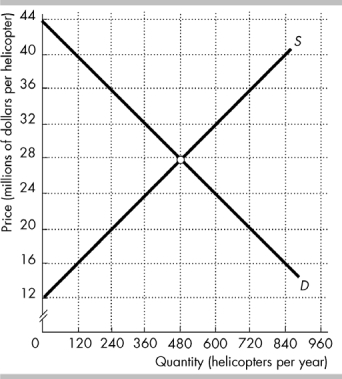 The figure shows the market for helicopters in the United States, where D is the domestic demand curve and S is the domestic supply curve. The United States trades helicopters with the rest of the world at a price of $36 million per helicopter.
-In the figure above, with international trade U.S. companies buy _________helicopters per year.
The figure shows the market for helicopters in the United States, where D is the domestic demand curve and S is the domestic supply curve. The United States trades helicopters with the rest of the world at a price of $36 million per helicopter.
-In the figure above, with international trade U.S. companies buy _________helicopters per year. (Multiple Choice)
4.8/5 (67)
(67) In developing countries, there is more reliance on as opposed to for government revenue.
(Multiple Choice)
4.9/5 (79)
(79) Price (dollars per pound) Quantity supplied (thousands of pounds per year) Quantity demanded (thousands of pounds peryear) 21 120 60 18 100 100 15 80 140 12 60 180 9 40 220
-The United States imports cheese from a variety of countries. The table above gives the domestic supply of, and demand for, cheese in the United States. The world price of cheese is $12 per pound, and trade is unrestricted.
a) How many pounds of cheese are consumed in the United States?
b) How many pounds of cheese are produced in the United States?
c) How many pounds of cheese are imported into the United States? If a $3 per pound tariff is imposed,
d) How many pounds of cheese are consumed in the United States?
e) How many pounds of cheese are produced in the United States?
f) How many pounds of cheese are imported into the United States?
g) How much will the U.S. government collect in tariff revenue?
h) Who benefits from the tariff? Who loses?
(Essay)
4.7/5 (76)
(76) 
Filters
- Essay(0)
- Multiple Choice(0)
- Short Answer(0)
- True False(0)
- Matching(0)