



 Chat with AI
Exam 15: International Trade Policy

Exam 1: What Is Economics472 Questions
Exam 2: The Economic Problem432 Questions
Exam 3: Demand and Supply503 Questions
Exam 4: Measuring Gdp and Economic Growth393 Questions
Exam 5: Monitoring Jobs and Inflation398 Questions
Exam 6: Economic Growth343 Questions
Exam 7: Finance, Saving, and Investment233 Questions
Exam 8: Money, the Price Level, and Inflation583 Questions
Exam 9: The Exchange Rate and the Balance of Payments482 Questions
Exam 10: Aggregate Supply and Aggregate Demand411 Questions
Exam 11: Expenditure Multipliers: the Keynesian Model444 Questions
Exam 12: U.S Inflation, Unemployment, and Business Cycle391 Questions
Exam 13: Fiscal Policy251 Questions
Exam 14: Monetary Policy216 Questions
Exam 15: International Trade Policy187 Questions
Review101 Questions
Select questions type


Suppose that the country of Pacifica imposes a quota on bananas. The reason that the government imposed this trade restriction could be
(Multiple Choice)
4.8/5  (73)
(73) Discuss reasons why we see trade restrictions. Are any of these reasons valid?
(Essay)
4.9/5 (88)
(88) Most economists would agree that ʺsaving jobsʺ is a valid reason for restricting trade.
(True/False)
4.9/5 (68)
(68) Prior to international trade, if country A has a lower price of good X than does country B, then we know definitely that
(Multiple Choice)
4.9/5 (90)
(90) Based on the table below, at what world price would the country export?
Price QD emanded QSupplied 2 100 70 4 95 75 6 90 80 8 85 85 10 80 90 12 75 95
(Multiple Choice)
4.9/5 (83)
(83) Increasing a tariff will_________ the domestic quantity consumed of the good, while _________the domestic production of the good.
(Multiple Choice)
4.9/5 (88)
(88) 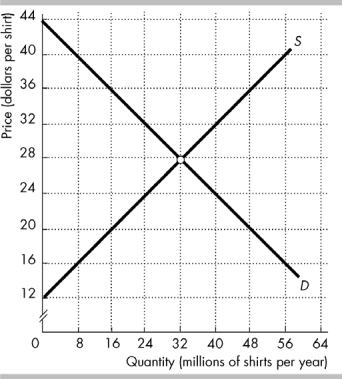 The figure shows the market for shirts in the United States, where D is the domestic demand curve and S is the domestic supply curve. The world price is $20 per shirt.
-In the figure above, with international trade the United States _________million shirts per year.
The figure shows the market for shirts in the United States, where D is the domestic demand curve and S is the domestic supply curve. The world price is $20 per shirt.
-In the figure above, with international trade the United States _________million shirts per year. (Multiple Choice)
4.9/5 (75)
(75) The United States has a comparative advantage in producing cotton if the U.S. price of cotton before international trade is _________the world price
(Multiple Choice)
4.9/5 (73)
(73) An assumption behind the infant-industry argument for tariff protection is that
(Multiple Choice)
4.9/5 (83)
(83) The United States imports cars from Japan. If the United States imposes a tariff on cars imported from Japan, American
(Multiple Choice)
4.9/5 (84)
(84) Currently Belize, a country in Central America, has a small coffee industry but does not export any coffee. Suppose the government of Belize, in order to protect the new coffee industry to enable it to grow into a mature industry that can compete in world markets, places a tariff on the importation of coffee. What is the argument for placing the tariff on coffee?
(Multiple Choice)
4.9/5 (91)
(91) Which of the following are TRUE regarding the argument that trade barriers protect U.S. workers from cheap foreign labor?
I. Low-wage foreigners are just as productive as U.S. workers.
II. U.S. workers have a comparative advantage in low -wage jobs.
(Multiple Choice)
4.8/5 (90)
(90) Which of the following is an explanation for the existence of trade restrictions?
(Multiple Choice)
5.0/5 (72)
(72) Economics demonstrates that opening up unrestricted free international trade is beneficial to all nations. However, are there any losers from such a policy change?
(Essay)
4.8/5 (70)
(70) The idea of dynamic comparative advantage is the basis for which of the following arguments for protection from foreign competition?
(Multiple Choice)
4.8/5 (73)
(73) 
Filters
- Essay(0)
- Multiple Choice(0)
- Short Answer(0)
- True False(0)
- Matching(0)