



 Chat with AI
Exam 9: The Exchange Rate and the Balance of Payments

Exam 1: What Is Economics472 Questions
Exam 2: The Economic Problem432 Questions
Exam 3: Demand and Supply503 Questions
Exam 4: Measuring Gdp and Economic Growth393 Questions
Exam 5: Monitoring Jobs and Inflation398 Questions
Exam 6: Economic Growth343 Questions
Exam 7: Finance, Saving, and Investment233 Questions
Exam 8: Money, the Price Level, and Inflation583 Questions
Exam 9: The Exchange Rate and the Balance of Payments482 Questions
Exam 10: Aggregate Supply and Aggregate Demand411 Questions
Exam 11: Expenditure Multipliers: the Keynesian Model444 Questions
Exam 12: U.S Inflation, Unemployment, and Business Cycle391 Questions
Exam 13: Fiscal Policy251 Questions
Exam 14: Monetary Policy216 Questions
Exam 15: International Trade Policy187 Questions
Review101 Questions
Select questions type


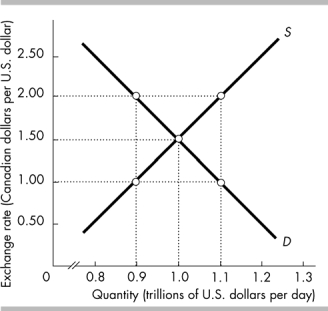 -In the figure above, an increase in the U.S. interest rate relative to that in Canada shifts the demand curve for U.S. dollars __________and shifts the supply curve of U.S. dollars __________.
 (Multiple Choice)
4.8/5  (76)
(76) In June 2008, the dollar bought 1.6 Brazilian reals and in October, the dollar bought 2.4 reals. This resulted in a
(Multiple Choice)
4.8/5 (68)
(68) According to purchasing power parity, a rise in inflation in the United States. relative to the rest of the world will lead to
(Multiple Choice)
4.8/5 (76)
(76) Currency 2007 exchange rate (per U . dollar) 2008 exchange rate (per U.S. dollar) Euro 0.9954 1.0747 Japanese yen 102.20 114.90 Canadian dollar 1.44 1.50
-The table above shows the exchange rates between various currencies and the U.S. dollar. Between 2007 and 2008, the U.S. dollar_________ against the euro and _________against the Japanese yen.
(Multiple Choice)
5.0/5 (69)
(69) Suppose the current exchange rate between the euro and the United States dollar is 1.15 euros per dollar. If interest rates in the United States increase and interest rates in Europe remain unchanged then
(Multiple Choice)
4.9/5 (87)
(87) A net borrower is a country that___________ , while a net lender is a country that___________ .
(Multiple Choice)
4.9/5 (82)
(82) Suppose this year Angola borrows $100 million from foreign countries while it lends $15 million. Angola definitely is a
(Multiple Choice)
4.9/5 (81)
(81) If the U.S. current account balance is -$500 billion and the capital and financial account balance is
+$510 billion,
(Multiple Choice)
4.8/5 (67)
(67) Component Amount (billions of dollars) Investment ,I 700 Net taxes, T 1,300 Government expenditure , 1,200 G Exports, X 1,500 Imports ,M 1,700
-In the above table, the government sector balance is a
(Multiple Choice)
4.9/5 (73)
(73) 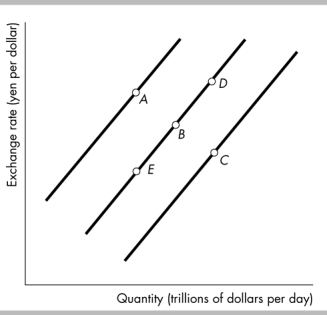 -In the figure above, suppose the economy is initially at point B. Then the interest rate in Japan rises relative to the interest rate in the United States. This change__________ the supply of dollars and the market moves to a point such as__________.
 (Multiple Choice)
4.7/5 (82)
(82)  -In the figure above, the shift in the supply curve for U.S. dollars from S0 to S2 could occur when
 (Multiple Choice)
4.8/5 (74)
(74) Which of the following examples definitely illustrates an appreciation of the U.S. dollar?
(Multiple Choice)
4.7/5 (69)
(69) If interest rates in Mexico decrease while the interest rates in the United States remain unchanged then
(Multiple Choice)
4.9/5 (76)
(76) When you arrive at the airport in Paris and go to the bank window to exchange dollars into euros, you are
(Multiple Choice)
4.7/5 (87)
(87) Suppose the exchange rate between the U.S. dollar and the Mexican peso was $1 = 5 pesos. A can of Pepsi sells for $2 in Boston and 12 pesos in Mexico City.
(Multiple Choice)
5.0/5 (87)
(87) If the Fed wants to lower the U.S. exchange rate, what action should it take in the foreign exchange market? Why does the action lower the exchange rate?
(Essay)
4.9/5 (86)
(86) The balance of payments account which records foreign investment in the United States and U.S. investments abroad is the
(Multiple Choice)
4.9/5 (80)
(80) In the foreign exchange market, the supply curve for dollars slopes upwards because
(Multiple Choice)
4.8/5 (86)
(86) With everything else the same, which of the following would increase the demand for U.S. dollars in the foreign exchange market?
I. a rise in the U.S. interest rate
II. a fall in interest rates in foreign countries
III. a rise in the expected future exchange rate
(Multiple Choice)
4.8/5 (89)
(89) ʺFluctuations in exchange rates, other things remaining the same, creates a situation in which money buys the same amount of goods and services in different currencies.ʺ What does the previous statement describe? Will these fluctuations occur in the short run or the long run?
(Essay)
4.7/5 (80)
(80) 
Filters
- Essay(0)
- Multiple Choice(0)
- Short Answer(0)
- True False(0)
- Matching(0)