



 Chat with AI
Exam 7: Cellular Respiration and Fermentation

Exam 1: Introduction: Evolution and the Foundations of Biology36 Questions
Exam 2: The Chemical Context of Life135 Questions
Exam 3: Carbon and the Molecular Diversity of Life136 Questions
Exam 4: A Tour of the Cell75 Questions
Exam 5: Membrane Transport and Cell Signaling86 Questions
Exam 6: An Introduction to Metabolism79 Questions
Exam 7: Cellular Respiration and Fermentation99 Questions
Exam 8: Photosynthesis68 Questions
Exam 9: The Cell Cycle57 Questions
Exam 10: Meiosis and Sexual Life Cycles59 Questions
Exam 11: Mendel and the Gene Idea57 Questions
Exam 12: The Chromosomal Basis of Inheritance43 Questions
Exam 13: The Molecular Basis of Inheritance62 Questions
Exam 14: Gene Expression: From Gene to Protein77 Questions
Exam 15: Regulation of Gene Expression48 Questions
Exam 16: Development,stem Cells,and Cancer34 Questions
Exam 17: Viruses35 Questions
Exam 18: Genomes and Their Evolution31 Questions
Exam 19: Descent With Modification61 Questions
Exam 20: Phylogeny72 Questions
Exam 21: The Evolution of Populations81 Questions
Exam 22: The Origin of Species75 Questions
Exam 23: Broad Patterns of Evolution60 Questions
Exam 24: Early Life and the Diversification of Prokaryotes99 Questions
Exam 25: The Origin and Diversification of Eukaryotes80 Questions
Exam 26: The Colonization of Land by Plants and Fungi128 Questions
Exam 27: The Rise of Animal Diversity93 Questions
Exam 28: Plant Structure and Growth67 Questions
Exam 29: Resource Acquisition,nutrition,and Transport in Vascular Plants115 Questions
Exam 30: Reproduction and Domestication of Flowering Plants72 Questions
Exam 31: Plant Responses to Internal and External Signals74 Questions
Exam 32: Homeostasis and Endocrine Signaling116 Questions
Exam 33: Animal Nutrition75 Questions
Exam 34: Circulation and Gas Exchange94 Questions
Exam 35: The Immune System96 Questions
Exam 36: Reproduction and Development123 Questions
Exam 37: Neurons,synapses,and Signaling77 Questions
Exam 38: Nervous and Sensory Systems105 Questions
Exam 39: Motor Mechanisms and Behavior83 Questions
Exam 40: Population Ecology and the Distribution of Organisms93 Questions
Exam 41: Ecological Communities59 Questions
Exam 42: Ecosystems and Energy86 Questions
Exam 43: Conservation Biology and Global Change71 Questions
Select questions type


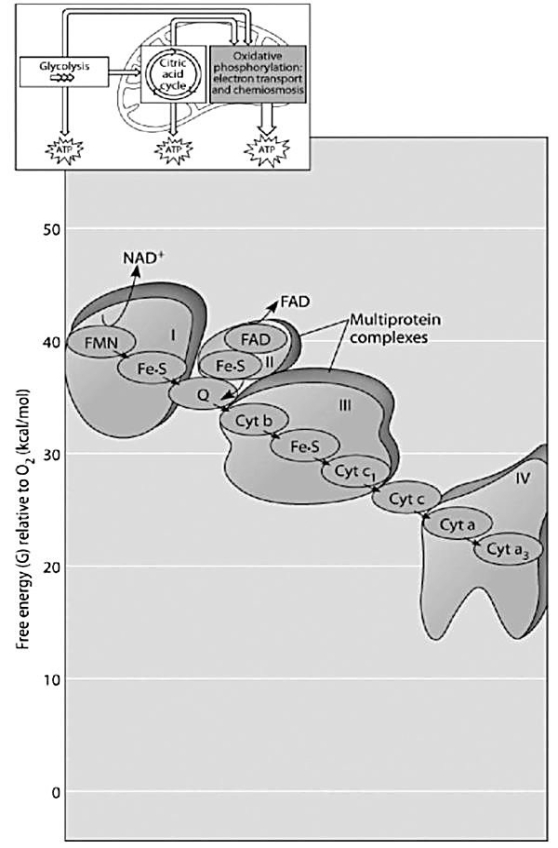 Figure 7.2
-Figure 7.2 illustrates the electron transport chain.Which of the following is initially added to the chain with the highest free energy?
Figure 7.2
-Figure 7.2 illustrates the electron transport chain.Which of the following is initially added to the chain with the highest free energy? (Multiple Choice)
4.9/5  (87)
(87) The final electron acceptor of the electron transport chain that functions in aerobic oxidative phosphorylation is
(Multiple Choice)
4.9/5 (80)
(80) If 30 molecules of ATP are produced for each molecule of glucose completely oxidized to carbon dioxide and water,how many ATP molecules will be produced for each molecule of pyruvate completely oxidized to carbon dioxide and water?
(Multiple Choice)
4.8/5 (77)
(77) Brown fat cells produce a protein called thermogenin in their mitochondrial inner membrane.Thermogenin is an ion channel that facilitates diffusion of protons across the membrane.What will occur in the brown fat cells when thermogenin is present in their inner mitochondrial membranes?
(Multiple Choice)
4.9/5 (81)
(81) When electrons flow along the electron transport chains of mitochondria,which of the following changes occurs?
(Multiple Choice)
4.9/5 (88)
(88) Inside an active mitochondrion,most electrons follow which of the following pathways?
(Multiple Choice)
4.8/5 (66)
(66) Which of the following statements is true for a molecule that is phosphorylated?
(Multiple Choice)
4.9/5 (63)
(63) Which one of the following molecules is formed by the removal of a carbon (as CO2)from a molecule of pyruvate during aerobic respiration?
(Multiple Choice)
4.8/5 (69)
(69) The synthesis of ATP by oxidative phosphorylation,using the energy released by movement of protons across the membrane down their electrochemical gradient,is an example of
(Multiple Choice)
4.8/5 (83)
(83) 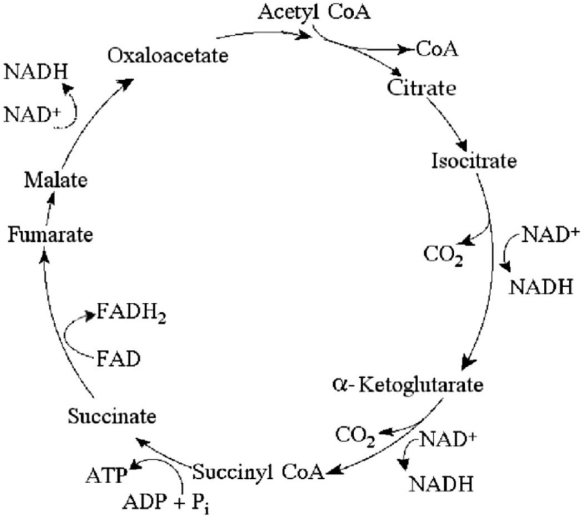 Figure 7.1
-Which of the following combinations of products would result from three acetyl CoA molecules entering the citric acid cycle (see Figure 7.1)?
Figure 7.1
-Which of the following combinations of products would result from three acetyl CoA molecules entering the citric acid cycle (see Figure 7.1)? (Multiple Choice)
4.9/5 (86)
(86) Which of the following metabolic processes produces the most ATP when glucose (C6H12O6)is completely oxidized to carbon dioxide (CO2)and water?
(Multiple Choice)
4.8/5 (78)
(78) Which of the following metabolic pathways occur(s)in the cytosol of eukaryotic cells?
(Multiple Choice)
4.7/5 (62)
(62) In an oxidation-reduction reaction,how is the reducing agent changed?
(Multiple Choice)
5.0/5 (71)
(71) Assuming glucose is the only energy source for a cell,what fraction of the carbon dioxide produced by aerobic respiration is generated by the oxidation of pyruvate to acetyl CoA?
(Multiple Choice)
4.8/5 (73)
(73) The free-energy change for the oxidation of glucose to CO2 and water is -686 kcal/mol,and the free-energy change for the reduction of NAD+ to NADH is +53 kcal/mol.Why are only two molecules of NADH formed during glycolysis when it appears that as many as a dozen could be formed?
(Multiple Choice)
4.8/5 (75)
(75) Which of the following processes is responsible for the ATP made during fermentation?
(Multiple Choice)
5.0/5 (91)
(91) 
Filters
- Essay(0)
- Multiple Choice(0)
- Short Answer(0)
- True False(0)
- Matching(0)