



 Chat with AI
Exam 7: Cellular Respiration and Fermentation

Exam 1: Introduction: Evolution and the Foundations of Biology36 Questions
Exam 2: The Chemical Context of Life135 Questions
Exam 3: Carbon and the Molecular Diversity of Life136 Questions
Exam 4: A Tour of the Cell75 Questions
Exam 5: Membrane Transport and Cell Signaling86 Questions
Exam 6: An Introduction to Metabolism79 Questions
Exam 7: Cellular Respiration and Fermentation99 Questions
Exam 8: Photosynthesis68 Questions
Exam 9: The Cell Cycle57 Questions
Exam 10: Meiosis and Sexual Life Cycles59 Questions
Exam 11: Mendel and the Gene Idea57 Questions
Exam 12: The Chromosomal Basis of Inheritance43 Questions
Exam 13: The Molecular Basis of Inheritance62 Questions
Exam 14: Gene Expression: From Gene to Protein77 Questions
Exam 15: Regulation of Gene Expression48 Questions
Exam 16: Development,stem Cells,and Cancer34 Questions
Exam 17: Viruses35 Questions
Exam 18: Genomes and Their Evolution31 Questions
Exam 19: Descent With Modification61 Questions
Exam 20: Phylogeny72 Questions
Exam 21: The Evolution of Populations81 Questions
Exam 22: The Origin of Species75 Questions
Exam 23: Broad Patterns of Evolution60 Questions
Exam 24: Early Life and the Diversification of Prokaryotes99 Questions
Exam 25: The Origin and Diversification of Eukaryotes80 Questions
Exam 26: The Colonization of Land by Plants and Fungi128 Questions
Exam 27: The Rise of Animal Diversity93 Questions
Exam 28: Plant Structure and Growth67 Questions
Exam 29: Resource Acquisition,nutrition,and Transport in Vascular Plants115 Questions
Exam 30: Reproduction and Domestication of Flowering Plants72 Questions
Exam 31: Plant Responses to Internal and External Signals74 Questions
Exam 32: Homeostasis and Endocrine Signaling116 Questions
Exam 33: Animal Nutrition75 Questions
Exam 34: Circulation and Gas Exchange94 Questions
Exam 35: The Immune System96 Questions
Exam 36: Reproduction and Development123 Questions
Exam 37: Neurons,synapses,and Signaling77 Questions
Exam 38: Nervous and Sensory Systems105 Questions
Exam 39: Motor Mechanisms and Behavior83 Questions
Exam 40: Population Ecology and the Distribution of Organisms93 Questions
Exam 41: Ecological Communities59 Questions
Exam 42: Ecosystems and Energy86 Questions
Exam 43: Conservation Biology and Global Change71 Questions
Select questions type


In the complete oxidation of a molecule of glucose (C6H12O6)in aerobic cellular respiration,how many molecules of ATP are produced by substrate-level phosphorylation?
(Multiple Choice)
4.8/5  (77)
(77) Which kind of metabolic poison would most directly interfere with glycolysis?
(Multiple Choice)
4.8/5 (75)
(75) Which catabolic processes may have been used by cells on ancient Earth before free oxygen became available?
(Multiple Choice)
4.9/5 (57)
(57) The complete oxidation of two molecules of glucose (C6H12O6)in cellular respiration produces about how many molecules of ATP?
(Multiple Choice)
4.9/5 (75)
(75) A mutation in yeast knocks out the ability of cells to convert pyruvate to ethanol.How might this mutation affect these yeast cells?
(Multiple Choice)
4.8/5 (86)
(86) Glycolysis results in a net production of which of the following molecules from each molecule of glucose?
(Multiple Choice)
4.8/5 (78)
(78) Which of the following molecules donates electrons directly to the electron transport chain at the highest energy level?
(Multiple Choice)
4.9/5 (88)
(88) In the presence of oxygen,the pyruvate can be catabolized in the citric acid cycle.First,however,the pyruvate (1)loses a carbon, (2)is oxidized to form a two-carbon compound,which (3)is covalently bound to coenzyme A.These three steps result in the formation of
(Multiple Choice)
4.8/5 (71)
(71) In a mitochondrion,if the matrix ATP concentration is high and there is no proton gradient across the inner mitochondrial membrane to generate a proton-motive force,then what might you expect to occur?
(Multiple Choice)
4.9/5 (76)
(76) 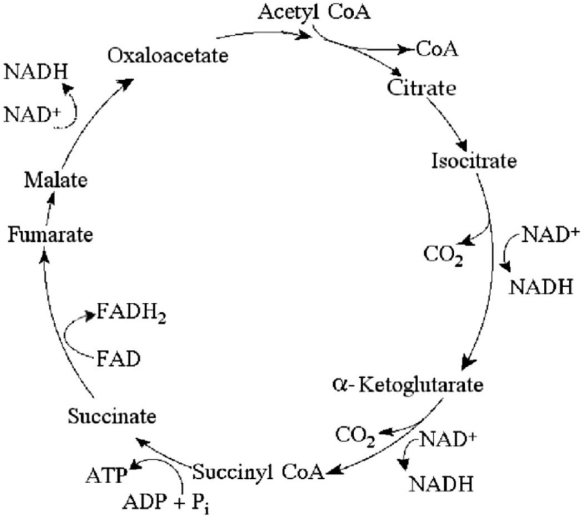 Figure 7.1
-How would you predict that blocking the oxidation of pyruvate would affect the levels of oxaloacetate and citrate in the citric acid cycle (see Figure 7.1)?
Figure 7.1
-How would you predict that blocking the oxidation of pyruvate would affect the levels of oxaloacetate and citrate in the citric acid cycle (see Figure 7.1)? (Multiple Choice)
4.9/5 (70)
(70) Which of the following sequences represents the correct order in which metabolic reactions occur during the complete oxidation of glucose through aerobic respiration?
(Multiple Choice)
4.9/5 (95)
(95) Which chemical process generates the ATP produced in the citric acid cycle?
(Multiple Choice)
4.9/5 (71)
(71) Catabolism of each molecule of glucose in glycolysis is associated with a net consumption of which of the following other molecules?
(Multiple Choice)
4.7/5 (69)
(69) Energy released by the electron transport chain is used to pump H+ into which location in eukaryotic cells?
(Multiple Choice)
4.8/5 (92)
(92) What is the source of the energy used to generate the proton gradient across the inner mitochondrial membrane?
(Multiple Choice)
4.9/5 (102)
(102) Which of the following statements correctly describes how ATP is involved in the oxidation of one molecule of glucose in glycolysis?
(Multiple Choice)
4.8/5 (70)
(70) Why are carbohydrates and fats considered high-energy foods?
(Multiple Choice)
4.9/5 (88)
(88) Which of the following metabolic pathways is common to both aerobic cellular respiration and anaerobic fermentation?
(Multiple Choice)
4.8/5 (91)
(91) 
Filters
- Essay(0)
- Multiple Choice(0)
- Short Answer(0)
- True False(0)
- Matching(0)