



 Chat with AI
Exam 7: Cellular Respiration and Fermentation

Exam 1: Introduction: Evolution and the Foundations of Biology36 Questions
Exam 2: The Chemical Context of Life135 Questions
Exam 3: Carbon and the Molecular Diversity of Life136 Questions
Exam 4: A Tour of the Cell75 Questions
Exam 5: Membrane Transport and Cell Signaling86 Questions
Exam 6: An Introduction to Metabolism79 Questions
Exam 7: Cellular Respiration and Fermentation99 Questions
Exam 8: Photosynthesis68 Questions
Exam 9: The Cell Cycle57 Questions
Exam 10: Meiosis and Sexual Life Cycles59 Questions
Exam 11: Mendel and the Gene Idea57 Questions
Exam 12: The Chromosomal Basis of Inheritance43 Questions
Exam 13: The Molecular Basis of Inheritance62 Questions
Exam 14: Gene Expression: From Gene to Protein77 Questions
Exam 15: Regulation of Gene Expression48 Questions
Exam 16: Development,stem Cells,and Cancer34 Questions
Exam 17: Viruses35 Questions
Exam 18: Genomes and Their Evolution31 Questions
Exam 19: Descent With Modification61 Questions
Exam 20: Phylogeny72 Questions
Exam 21: The Evolution of Populations81 Questions
Exam 22: The Origin of Species75 Questions
Exam 23: Broad Patterns of Evolution60 Questions
Exam 24: Early Life and the Diversification of Prokaryotes99 Questions
Exam 25: The Origin and Diversification of Eukaryotes80 Questions
Exam 26: The Colonization of Land by Plants and Fungi128 Questions
Exam 27: The Rise of Animal Diversity93 Questions
Exam 28: Plant Structure and Growth67 Questions
Exam 29: Resource Acquisition,nutrition,and Transport in Vascular Plants115 Questions
Exam 30: Reproduction and Domestication of Flowering Plants72 Questions
Exam 31: Plant Responses to Internal and External Signals74 Questions
Exam 32: Homeostasis and Endocrine Signaling116 Questions
Exam 33: Animal Nutrition75 Questions
Exam 34: Circulation and Gas Exchange94 Questions
Exam 35: The Immune System96 Questions
Exam 36: Reproduction and Development123 Questions
Exam 37: Neurons,synapses,and Signaling77 Questions
Exam 38: Nervous and Sensory Systems105 Questions
Exam 39: Motor Mechanisms and Behavior83 Questions
Exam 40: Population Ecology and the Distribution of Organisms93 Questions
Exam 41: Ecological Communities59 Questions
Exam 42: Ecosystems and Energy86 Questions
Exam 43: Conservation Biology and Global Change71 Questions
Select questions type


An organism is discovered that thrives in both the presence and absence of oxygen.Curiously,the consumption of sugar increases as oxygen is removed from the organism's environment,even though the organism does not gain much weight.This organism
(Multiple Choice)
4.8/5  (67)
(67) As a result of an oxidation-reduction reaction,how is the oxidizing agent changed?
(Multiple Choice)
4.9/5 (82)
(82) How many carbon atoms from one molecule of pyruvate enter the citric acid cycle?
(Multiple Choice)
4.9/5 (76)
(76) What is the oxidizing agent in the following reaction?
Pyruvate + NADH + H+ → Lactate + NAD+
(Multiple Choice)
4.9/5 (91)
(91) 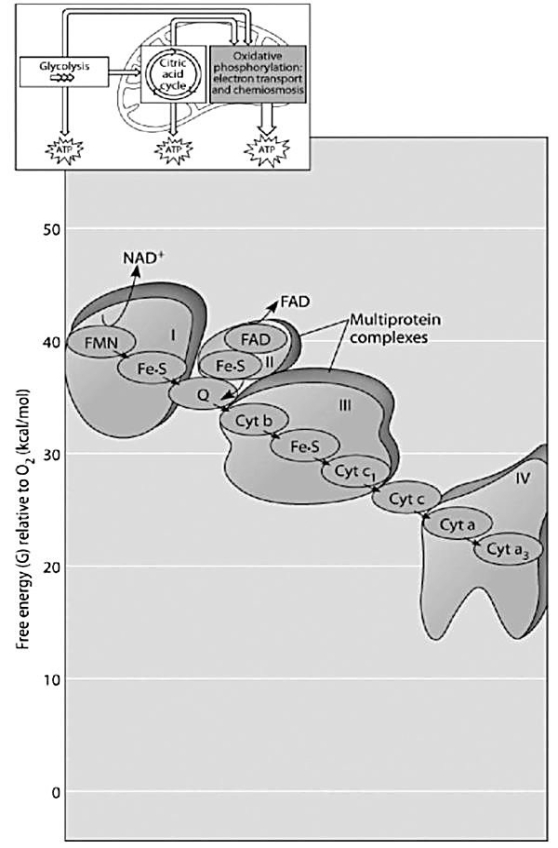 Figure 7.2
-What happens at the end of the chain in Figure 7.2?
Figure 7.2
-What happens at the end of the chain in Figure 7.2? (Multiple Choice)
4.8/5 (91)
(91) Which organelles or organisms are capable of synthesizing ATP using energy from chemiosmosis?
(Multiple Choice)
4.9/5 (87)
(87) Which of the following metabolic processes in eukaryotic cells will proceed normally whether oxygen (O2)is present or absent?
(Multiple Choice)
4.7/5 (90)
(90) Which of the following indicates a primary path by which electrons travel downhill energetically during aerobic respiration?
(Multiple Choice)
4.9/5 (73)
(73) Figure 7.2
-Which of the following is an accurate description of the events that occur along the electron transport chain depicted in Figure 7.2?
Figure 7.2
-Which of the following is an accurate description of the events that occur along the electron transport chain depicted in Figure 7.2? (Multiple Choice)
4.7/5 (85)
(85) How many molecules of oxygen (O2)are consumed by the complete oxidation of glucose (C6H12O6)to carbon dioxide and water in aerobic respiration?
(Multiple Choice)
4.7/5 (92)
(92) Assuming glucose is the only energy source for a cell,what fraction of the carbon dioxide produced by aerobic respiration is generated by the reactions of the citric acid cycle?
(Multiple Choice)
4.7/5 (89)
(89) In what form do the catabolic products of beta oxidation enter into the citric acid cycle?
(Multiple Choice)
4.8/5 (77)
(77) What is the primary function of beta oxidation in respiration?
(Multiple Choice)
4.8/5 (84)
(84) What is the primary role of oxygen in cellular respiration?
(Multiple Choice)
4.7/5 (75)
(75) Where in mitochondria is the enzyme ATP synthase localized?
(Multiple Choice)
4.9/5 (86)
(86) 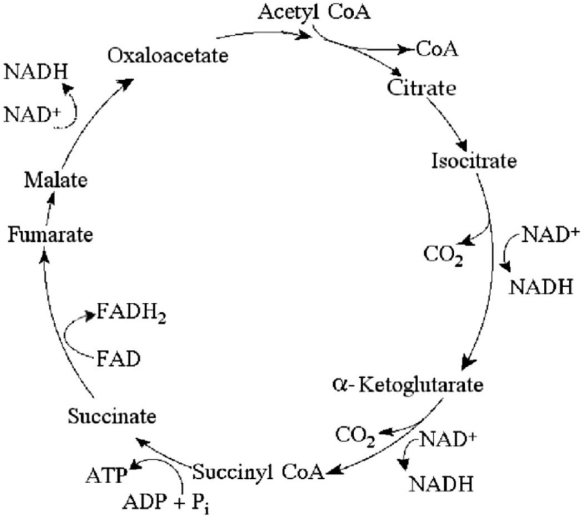 Figure 7.1
-Carbon skeletons for amino acid biosynthesis are supplied by intermediates of the citric acid cycle (see Figure 7.1).Which intermediate would you predict may directly supply the carbon skeleton for synthesis of a five-carbon amino acid?
Figure 7.1
-Carbon skeletons for amino acid biosynthesis are supplied by intermediates of the citric acid cycle (see Figure 7.1).Which intermediate would you predict may directly supply the carbon skeleton for synthesis of a five-carbon amino acid? (Multiple Choice)
4.8/5 (82)
(82) In vertebrate animals,brown fat tissue's color is derived from abundant blood vessels and capillaries.White fat tissue,on the other hand,is specialized for fat storage and contains relatively few blood vessels or capillaries.Brown fat cells produce the protein thermogenin,which is an ion channel that facilitates diffusion of protons across the membrane.Which of the following statements might best describe the function of the brown fat tissue?
(Multiple Choice)
4.8/5 (88)
(88) For each molecule of glucose that is catabolized in glycolysis and the citric acid cycle,how many NADH molecules are produced?
(Multiple Choice)
4.8/5 (83)
(83) During strenuous exercise,human muscle cells can become oxygen-deprived.When this occurs,muscle cells perform anaerobic fermentation,which results in the production of lactate from pyruvate.What happens to the lactate produced in muscle cells?
(Multiple Choice)
4.7/5 (78)
(78) Yeast cells with defective mitochondria are incapable of cellular respiration.Catabolism of which of the following energy sources would allow these to grow?
(Multiple Choice)
4.8/5 (79)
(79) 
Filters
- Essay(0)
- Multiple Choice(0)
- Short Answer(0)
- True False(0)
- Matching(0)