



 Chat with AI
Exam 14: Gene Expression: From Gene to Protein

Exam 1: Introduction: Evolution and the Foundations of Biology36 Questions
Exam 2: The Chemical Context of Life135 Questions
Exam 3: Carbon and the Molecular Diversity of Life136 Questions
Exam 4: A Tour of the Cell75 Questions
Exam 5: Membrane Transport and Cell Signaling86 Questions
Exam 6: An Introduction to Metabolism79 Questions
Exam 7: Cellular Respiration and Fermentation99 Questions
Exam 8: Photosynthesis68 Questions
Exam 9: The Cell Cycle57 Questions
Exam 10: Meiosis and Sexual Life Cycles59 Questions
Exam 11: Mendel and the Gene Idea57 Questions
Exam 12: The Chromosomal Basis of Inheritance43 Questions
Exam 13: The Molecular Basis of Inheritance62 Questions
Exam 14: Gene Expression: From Gene to Protein77 Questions
Exam 15: Regulation of Gene Expression48 Questions
Exam 16: Development,stem Cells,and Cancer34 Questions
Exam 17: Viruses35 Questions
Exam 18: Genomes and Their Evolution31 Questions
Exam 19: Descent With Modification61 Questions
Exam 20: Phylogeny72 Questions
Exam 21: The Evolution of Populations81 Questions
Exam 22: The Origin of Species75 Questions
Exam 23: Broad Patterns of Evolution60 Questions
Exam 24: Early Life and the Diversification of Prokaryotes99 Questions
Exam 25: The Origin and Diversification of Eukaryotes80 Questions
Exam 26: The Colonization of Land by Plants and Fungi128 Questions
Exam 27: The Rise of Animal Diversity93 Questions
Exam 28: Plant Structure and Growth67 Questions
Exam 29: Resource Acquisition,nutrition,and Transport in Vascular Plants115 Questions
Exam 30: Reproduction and Domestication of Flowering Plants72 Questions
Exam 31: Plant Responses to Internal and External Signals74 Questions
Exam 32: Homeostasis and Endocrine Signaling116 Questions
Exam 33: Animal Nutrition75 Questions
Exam 34: Circulation and Gas Exchange94 Questions
Exam 35: The Immune System96 Questions
Exam 36: Reproduction and Development123 Questions
Exam 37: Neurons,synapses,and Signaling77 Questions
Exam 38: Nervous and Sensory Systems105 Questions
Exam 39: Motor Mechanisms and Behavior83 Questions
Exam 40: Population Ecology and the Distribution of Organisms93 Questions
Exam 41: Ecological Communities59 Questions
Exam 42: Ecosystems and Energy86 Questions
Exam 43: Conservation Biology and Global Change71 Questions
Select questions type


A eukaryotic transcription unit that is 8,000 nucleotides long may use 1,200 nucleotides to make a protein consisting of approximately 400 amino acids.Which of the following statements best explains this fact?
(Multiple Choice)
4.7/5  (84)
(84) A mutation in a cell results in a structural change in the signal-recognition particle (SRP)so that it does not bind to the translocation complex in the ER correctly.Which of the following processes will occur because of this mutation?
(Multiple Choice)
4.9/5 (87)
(87) There are 61 mRNA codons that specify an amino acid,but only 45 tRNAs.This is best explained by the fact that
(Multiple Choice)
4.7/5 (69)
(69)  -Given the locally unwound double strand of DNA in the figure above,in which direction and on what strand does the RNA polymerase move during transcription?
 (Multiple Choice)
4.8/5 (80)
(80) Garrod hypothesized that inherited diseases such as alkaptonuria,the inability to metabolize the chemical alkapton,occur because
(Multiple Choice)
4.8/5 (81)
(81) What is the effect of a nucleotide-pair substitution that results in a nonsense mutation in a gene?
(Multiple Choice)
4.9/5 (70)
(70) 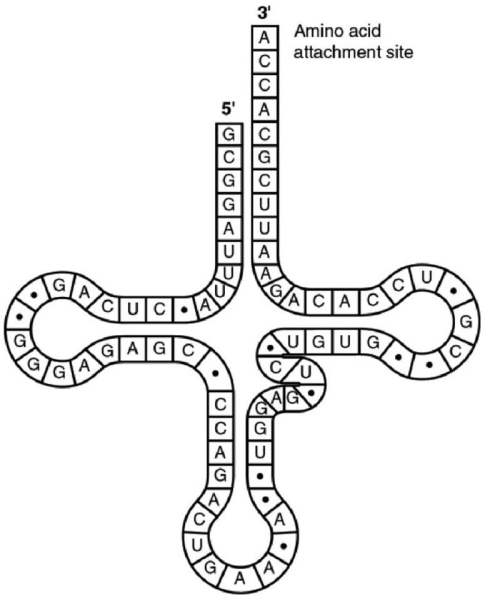 -The figure above represents a tRNA molecule that recognizes and binds a particular amino acid (in this instance,phenylalanine).Which codon on the mRNA strand codes for this amino acid?
 (Multiple Choice)
5.0/5 (78)
(78) A mutant bacterial cell has a defective aminoacyl-tRNA synthetase that attaches a lysine to tRNAs with the anticodon AAA instead of the normal phenylalanine.What would be a potential consequence for a cell in which this happens? Remember that phenylalanine may be encoded by multiple codons.
(Multiple Choice)
4.7/5 (81)
(81) An experimenter has altered the 3' end of the tRNA corresponding to the amino acid methionine in such a way as to remove the 3' AC.Which of the following statements correctly describes the most likely result of this change?
(Multiple Choice)
4.8/5 (81)
(81) Which small-scale mutation would be most likely to have the least negative effect on the function of a protein?
(Multiple Choice)
4.8/5 (74)
(74) Which of the following statements best describes the termination of transcription in bacteria?
(Multiple Choice)
4.9/5 (72)
(72) Which of the following statements correctly describes alternative RNA splicing?
(Multiple Choice)
4.9/5 (80)
(80) Which of the following statements correctly defines the most current and complete description of a gene?
(Multiple Choice)
4.7/5 (74)
(74) Using the figure below,identify a 5' → 3' sequence of nucleotides in the DNA template strand for an mRNA coding for the polypeptide sequence Phe-Pro-Lys. 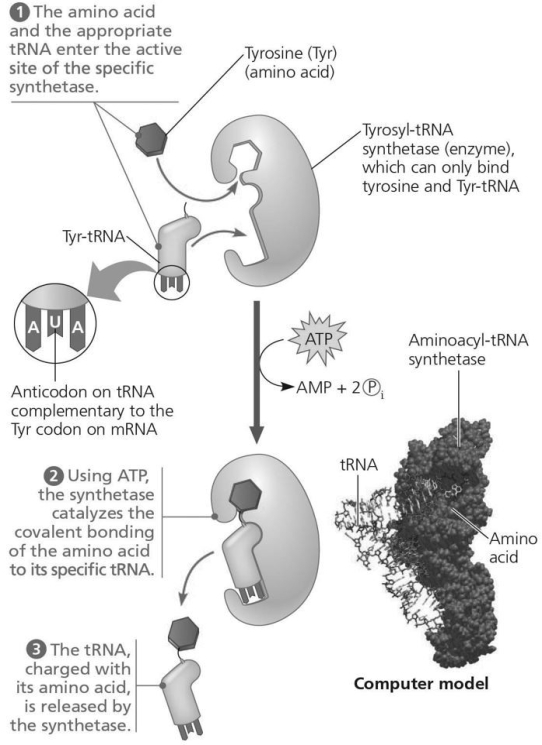 Figure 14.6
 (Multiple Choice)
4.9/5 (83)
(83)
-The tRNA shown in the figure above has its 3' end projecting beyond its 5' end.Which of the following will occur at this 3' end?
-The tRNA shown in the figure above has its 3' end projecting beyond its 5' end.Which of the following will occur at this 3' end? (Multiple Choice)
4.9/5 (88)
(88) 
Filters
- Essay(0)
- Multiple Choice(0)
- Short Answer(0)
- True False(0)
- Matching(0)