



 Chat with AI
Exam 14: Gene Expression: From Gene to Protein

Exam 1: Introduction: Evolution and the Foundations of Biology36 Questions
Exam 2: The Chemical Context of Life135 Questions
Exam 3: Carbon and the Molecular Diversity of Life136 Questions
Exam 4: A Tour of the Cell75 Questions
Exam 5: Membrane Transport and Cell Signaling86 Questions
Exam 6: An Introduction to Metabolism79 Questions
Exam 7: Cellular Respiration and Fermentation99 Questions
Exam 8: Photosynthesis68 Questions
Exam 9: The Cell Cycle57 Questions
Exam 10: Meiosis and Sexual Life Cycles59 Questions
Exam 11: Mendel and the Gene Idea57 Questions
Exam 12: The Chromosomal Basis of Inheritance43 Questions
Exam 13: The Molecular Basis of Inheritance62 Questions
Exam 14: Gene Expression: From Gene to Protein77 Questions
Exam 15: Regulation of Gene Expression48 Questions
Exam 16: Development,stem Cells,and Cancer34 Questions
Exam 17: Viruses35 Questions
Exam 18: Genomes and Their Evolution31 Questions
Exam 19: Descent With Modification61 Questions
Exam 20: Phylogeny72 Questions
Exam 21: The Evolution of Populations81 Questions
Exam 22: The Origin of Species75 Questions
Exam 23: Broad Patterns of Evolution60 Questions
Exam 24: Early Life and the Diversification of Prokaryotes99 Questions
Exam 25: The Origin and Diversification of Eukaryotes80 Questions
Exam 26: The Colonization of Land by Plants and Fungi128 Questions
Exam 27: The Rise of Animal Diversity93 Questions
Exam 28: Plant Structure and Growth67 Questions
Exam 29: Resource Acquisition,nutrition,and Transport in Vascular Plants115 Questions
Exam 30: Reproduction and Domestication of Flowering Plants72 Questions
Exam 31: Plant Responses to Internal and External Signals74 Questions
Exam 32: Homeostasis and Endocrine Signaling116 Questions
Exam 33: Animal Nutrition75 Questions
Exam 34: Circulation and Gas Exchange94 Questions
Exam 35: The Immune System96 Questions
Exam 36: Reproduction and Development123 Questions
Exam 37: Neurons,synapses,and Signaling77 Questions
Exam 38: Nervous and Sensory Systems105 Questions
Exam 39: Motor Mechanisms and Behavior83 Questions
Exam 40: Population Ecology and the Distribution of Organisms93 Questions
Exam 41: Ecological Communities59 Questions
Exam 42: Ecosystems and Energy86 Questions
Exam 43: Conservation Biology and Global Change71 Questions
Select questions type


Which of the following statements correctly describes the function of a signal peptide?
(Multiple Choice)
4.9/5  (77)
(77) The nitrogenous base adenine is found in all members of which of the following groups of molecules?
(Multiple Choice)
4.8/5 (76)
(76)  -Examine the simple metabolic pathway in the figure above.According to Beadle and Tatum's hypothesis,how many genes are necessary for this pathway?
 (Multiple Choice)
4.8/5 (78)
(78) What must happen to a newly made polypeptide before it can be secreted from a cell?
(Multiple Choice)
4.9/5 (74)
(74) Examine the simple metabolic pathway in the figure above.If A,B,and C are all substances required for growth of the organism that carries out this pathway,a strain that is mutant for the gene encoding enzyme 1 would be able to grow on which of the following media?
(Multiple Choice)
4.9/5 (81)
(81) What happens to the cut-out intron after alternative RNA splicing?
(Multiple Choice)
4.9/5 (85)
(85) Use the following model of a eukaryotic transcript to answer the question.E1-4 refer to the exons,and I1-3 refer to the introns in the pre-mRNA transcript.
5' UTR E1 I1 E2 I2 E3 I3 E4 UTR 3'
Suppose that an induced mutation removes most of the 5' end of the 5' UTR.What might be the result of this removal?
(Multiple Choice)
4.8/5 (79)
(79) Examine the simple metabolic pathway in the figure above.A mutation results in a defective enzyme 1.Which of the following results would be a consequence of that mutation?
(Multiple Choice)
4.8/5 (86)
(86) Use the following model of a eukaryotic transcript to answer the question.E1-4 refer to the exons,and I1-3 refer to the introns in the pre-mRNA transcript.
5' UTR E1 I1 E2 I2 E3 I3 E4 UTR 3'
Suppose that exposure to a chemical mutagen results in a change in the sequence that alters the 5' end of intron 1 (I1).Which of the following results might occur?
(Multiple Choice)
4.9/5 (83)
(83) 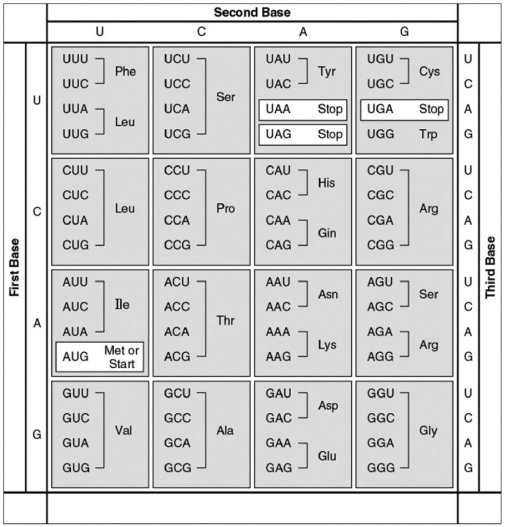 -Examine the table of codons in the figure above.A peptide has the sequence NH2-phe-pro-lys-gly-phe-pro-COOH.Which of the following sequences in the coding strand of the DNA could code for this peptide?
 (Multiple Choice)
4.9/5 (64)
(64) A particular triplet of bases in the template strand of DNA is 5'-AGT-3'.The corresponding codon for the mRNA transcribed is
(Multiple Choice)
4.7/5 (81)
(81) Which of the following DNA mutations is likely to have the most negative effect on the protein it specifies?
(Multiple Choice)
4.9/5 (80)
(80) A transfer RNA (#1)attached to the amino acid lysine enters the ribosome.The lysine binds to the growing polypeptide on the other tRNA (#2)already in the ribosome.Where does tRNA #2 move to after this bonding of lysine to the polypeptide?
(Multiple Choice)
4.8/5 (80)
(80) Which of the following statements is correct regarding protein synthesis in prokaryotes and eukaryotes?
(Multiple Choice)
4.7/5 (73)
(73) In an experimental situation,a student researcher inserts an mRNA molecule into a eukaryotic cell after she has removed its 5' cap and poly-A tail.Which of the following would you expect her to find?
(Multiple Choice)
4.8/5 (73)
(73) Which of the following statements correctly defines the process of gene expression?
(Multiple Choice)
5.0/5 (74)
(74) The process of translation in both prokaryotes and eukaryotes requires tRNAs,amino acids,and ribosomal subunits.Which of the following components must also be present for translation to proceed?
(Multiple Choice)
4.9/5 (77)
(77) When the genome of a particular species is said to include 20,000 protein-coding regions,what does this imply?
(Multiple Choice)
5.0/5 (63)
(63) 
Filters
- Essay(0)
- Multiple Choice(0)
- Short Answer(0)
- True False(0)
- Matching(0)