



 Chat with AI
Exam 14: Gene Expression: From Gene to Protein

Exam 1: Introduction: Evolution and the Foundations of Biology36 Questions
Exam 2: The Chemical Context of Life135 Questions
Exam 3: Carbon and the Molecular Diversity of Life136 Questions
Exam 4: A Tour of the Cell75 Questions
Exam 5: Membrane Transport and Cell Signaling86 Questions
Exam 6: An Introduction to Metabolism79 Questions
Exam 7: Cellular Respiration and Fermentation99 Questions
Exam 8: Photosynthesis68 Questions
Exam 9: The Cell Cycle57 Questions
Exam 10: Meiosis and Sexual Life Cycles59 Questions
Exam 11: Mendel and the Gene Idea57 Questions
Exam 12: The Chromosomal Basis of Inheritance43 Questions
Exam 13: The Molecular Basis of Inheritance62 Questions
Exam 14: Gene Expression: From Gene to Protein77 Questions
Exam 15: Regulation of Gene Expression48 Questions
Exam 16: Development,stem Cells,and Cancer34 Questions
Exam 17: Viruses35 Questions
Exam 18: Genomes and Their Evolution31 Questions
Exam 19: Descent With Modification61 Questions
Exam 20: Phylogeny72 Questions
Exam 21: The Evolution of Populations81 Questions
Exam 22: The Origin of Species75 Questions
Exam 23: Broad Patterns of Evolution60 Questions
Exam 24: Early Life and the Diversification of Prokaryotes99 Questions
Exam 25: The Origin and Diversification of Eukaryotes80 Questions
Exam 26: The Colonization of Land by Plants and Fungi128 Questions
Exam 27: The Rise of Animal Diversity93 Questions
Exam 28: Plant Structure and Growth67 Questions
Exam 29: Resource Acquisition,nutrition,and Transport in Vascular Plants115 Questions
Exam 30: Reproduction and Domestication of Flowering Plants72 Questions
Exam 31: Plant Responses to Internal and External Signals74 Questions
Exam 32: Homeostasis and Endocrine Signaling116 Questions
Exam 33: Animal Nutrition75 Questions
Exam 34: Circulation and Gas Exchange94 Questions
Exam 35: The Immune System96 Questions
Exam 36: Reproduction and Development123 Questions
Exam 37: Neurons,synapses,and Signaling77 Questions
Exam 38: Nervous and Sensory Systems105 Questions
Exam 39: Motor Mechanisms and Behavior83 Questions
Exam 40: Population Ecology and the Distribution of Organisms93 Questions
Exam 41: Ecological Communities59 Questions
Exam 42: Ecosystems and Energy86 Questions
Exam 43: Conservation Biology and Global Change71 Questions
Select questions type


Which of the following events in translation is the first to occur in eukaryotes?
(Multiple Choice)
4.9/5  (75)
(75) In eukaryotes there are several different types of RNA polymerase.Which type is involved in transcription of mRNA known as pre-mRNA?
(Multiple Choice)
4.8/5 (74)
(74) A eukaryotic mutation upstream of a particular gene has been identified that changes the sequence of the TATA box to GATA.How would you predict that this mutation would affect the transcription of this gene?
(Multiple Choice)
4.9/5 (87)
(87) 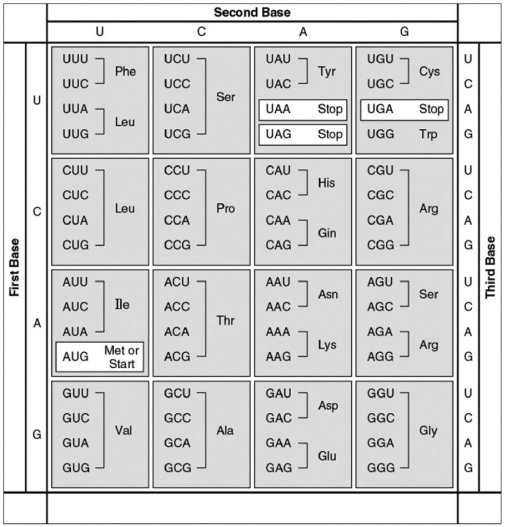 -Examine the table of codons in the figure above.A possible sequence of nucleotides in the template strand of DNA that would code for the polypeptide sequence phe-leu-ile-val would be
 (Multiple Choice)
5.0/5 (83)
(83) Accuracy in the translation of mRNA into the sequence of amino acids in a polypeptide depends on specificity in which of the following characteristics?
(Multiple Choice)
4.8/5 (82)
(82) The "universal" genetic code is now known to have exceptions.Evidence for this can be found if which of the following statements is true?
(Multiple Choice)
4.9/5 (70)
(70) When the ribosome reaches a stop codon on the mRNA,no corresponding tRNA enters the A site.If the translation reaction were to be experimentally stopped at this point,which of the following sets of structures would you be able to isolate from the cell?
(Multiple Choice)
4.8/5 (89)
(89) Which of the following mutations would be most likely to have a harmful effect on an organism?
(Multiple Choice)
4.9/5 (69)
(69) In comparing DNA replication with RNA transcription in the same cell,which of the following is true only of replication?
(Multiple Choice)
4.9/5 (71)
(71) How do small RNAs in the spliceosome initiate the splicing of the pre-mRNA?
(Multiple Choice)
4.7/5 (79)
(79) In the 1920s,Hermann Muller discovered that X-rays caused genetic changes in the fruit fly Drosophila.In a related series of experiments in the 1940s,other scientists discovered that other types of chemicals have a similar effect.A new chemical food additive is developed by a cereal manufacturer.Why is it necessary to test for its ability to cause mutation?
(Multiple Choice)
4.7/5 (69)
(69) 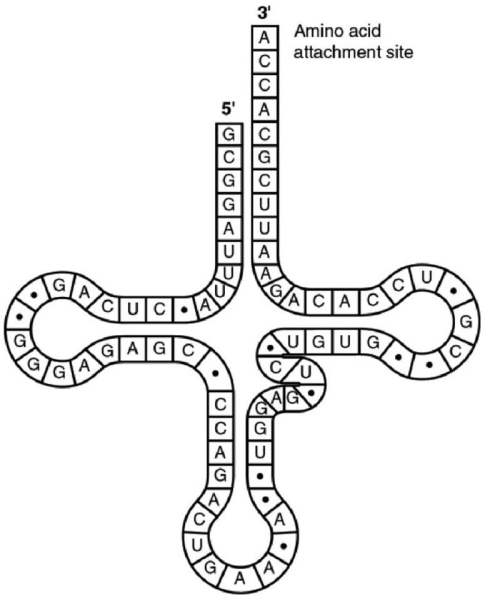 -What type of bonding is responsible for maintaining the shape of the tRNA molecule in the figure above?
 (Multiple Choice)
4.8/5 (87)
(87) Which of the following is a function of a poly-A tail in mRNA?
(Multiple Choice)
4.9/5 (68)
(68) A part of the promoter,called the TATA box,is said to be highly conserved in many different organisms through evolution.Which of the following correctly describes why this is the case?
(Multiple Choice)
4.9/5 (75)
(75) During the process of alternative RNA splicing,where on a pre-mRNA transcript does a spliceosome bind?
(Multiple Choice)
4.9/5 (82)
(82) The genetic code is essentially the same for all organisms.Based on this information,one can logically assume which of the following statements to be correct?
(Multiple Choice)
4.8/5 (74)
(74) Transcription in eukaryotes requires which of the following in addition to RNA polymerase?
(Multiple Choice)
4.8/5 (70)
(70) Which of the following types of mutation,resulting in an error in the mRNA just after the 5ʹ AUG start codon,is likely to have the most serious effect on the polypeptide product?
(Multiple Choice)
4.7/5 (76)
(76) 
Filters
- Essay(0)
- Multiple Choice(0)
- Short Answer(0)
- True False(0)
- Matching(0)