



 Chat with AI
Exam 33: Animal Nutrition

Exam 1: Introduction: Evolution and the Foundations of Biology36 Questions
Exam 2: The Chemical Context of Life135 Questions
Exam 3: Carbon and the Molecular Diversity of Life136 Questions
Exam 4: A Tour of the Cell75 Questions
Exam 5: Membrane Transport and Cell Signaling86 Questions
Exam 6: An Introduction to Metabolism79 Questions
Exam 7: Cellular Respiration and Fermentation99 Questions
Exam 8: Photosynthesis68 Questions
Exam 9: The Cell Cycle57 Questions
Exam 10: Meiosis and Sexual Life Cycles59 Questions
Exam 11: Mendel and the Gene Idea57 Questions
Exam 12: The Chromosomal Basis of Inheritance43 Questions
Exam 13: The Molecular Basis of Inheritance62 Questions
Exam 14: Gene Expression: From Gene to Protein77 Questions
Exam 15: Regulation of Gene Expression48 Questions
Exam 16: Development,stem Cells,and Cancer34 Questions
Exam 17: Viruses35 Questions
Exam 18: Genomes and Their Evolution31 Questions
Exam 19: Descent With Modification61 Questions
Exam 20: Phylogeny72 Questions
Exam 21: The Evolution of Populations81 Questions
Exam 22: The Origin of Species75 Questions
Exam 23: Broad Patterns of Evolution60 Questions
Exam 24: Early Life and the Diversification of Prokaryotes99 Questions
Exam 25: The Origin and Diversification of Eukaryotes80 Questions
Exam 26: The Colonization of Land by Plants and Fungi128 Questions
Exam 27: The Rise of Animal Diversity93 Questions
Exam 28: Plant Structure and Growth67 Questions
Exam 29: Resource Acquisition,nutrition,and Transport in Vascular Plants115 Questions
Exam 30: Reproduction and Domestication of Flowering Plants72 Questions
Exam 31: Plant Responses to Internal and External Signals74 Questions
Exam 32: Homeostasis and Endocrine Signaling116 Questions
Exam 33: Animal Nutrition75 Questions
Exam 34: Circulation and Gas Exchange94 Questions
Exam 35: The Immune System96 Questions
Exam 36: Reproduction and Development123 Questions
Exam 37: Neurons,synapses,and Signaling77 Questions
Exam 38: Nervous and Sensory Systems105 Questions
Exam 39: Motor Mechanisms and Behavior83 Questions
Exam 40: Population Ecology and the Distribution of Organisms93 Questions
Exam 41: Ecological Communities59 Questions
Exam 42: Ecosystems and Energy86 Questions
Exam 43: Conservation Biology and Global Change71 Questions
Select questions type


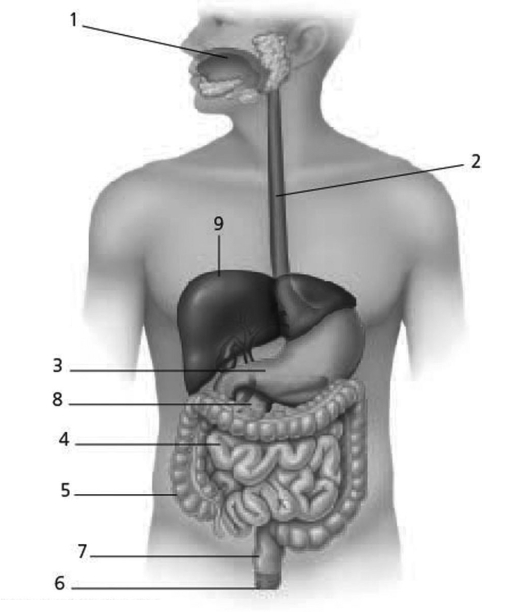 -Examine the digestive system structures in the figure.Enzymatic hydrolysis of macromolecules occurs to the highest extent at location(s)
 (Multiple Choice)
4.9/5  (79)
(79) Scurvy is a disease that results from a vitamin deficiency.Symptoms of scurvy include poor wound healing,bleeding from the gums and skin,loose teeth,and bones that break more easily,all of which are due to abnormal collagen production.A deficiency in what vitamin could result in scurvy?
(Multiple Choice)
5.0/5 (71)
(71) Constipation can result from the consumption of a substance that
(Multiple Choice)
4.9/5 (77)
(77) Fat digestion yields fatty acids and glycerol.Protein digestion yields amino acids.Both digestive processes
(Multiple Choice)
5.0/5 (82)
(82) When the digestion and absorption of organic carbohydrates result in more energy-rich molecules than are immediately required by an animal,the excess is
(Multiple Choice)
4.7/5 (79)
(79) After surgical removal of the gallbladder,a person might need to limit their dietary intake of
(Multiple Choice)
4.7/5 (79)
(79) Use the following table showing the contents of a multivitamin supplement and its percentage of recommended daily values (% DV)to answer the following question.
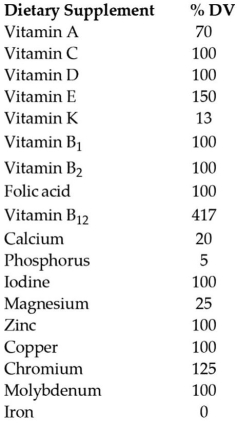 Figure 33.1
-The most likely reason that some of the vitamins and minerals in this supplement are found at less than 100% is that
Figure 33.1
-The most likely reason that some of the vitamins and minerals in this supplement are found at less than 100% is that (Multiple Choice)
4.9/5 (65)
(65) Trypsin is a digestive enzyme that hydrolyzes proteins at the carboxyl terminus of lysine or arginine amino acids.Suppose you added trypsin to a test tube with a protein that contained lysine and arginine amino acids and that the conditions allowed trypsin to be active.What would you expect to observe as the reaction occurred?
(Multiple Choice)
4.9/5 (68)
(68) A general rule relating the capacity of a specific animal's digestive system to provide adequate access to substrates for biosynthesis of cellular components as well as energy molecules needed for ATP production is that the animal should have access to
(Multiple Choice)
4.7/5 (90)
(90) Carbohydrate digestion yields monosaccharides,whereas protein digestion yields amino acids.Both digestive processes
(Multiple Choice)
4.9/5 (96)
(96) Upon activation by stomach acidity,the secretions of the parietal cells
(Multiple Choice)
4.9/5 (78)
(78) Please use the following information to answer the questions below.
Once a person turns 25 years of age,his or her BMR decreases by approximately 2% to 6% every 10 years.This is due to the fact that as you age,muscle mass decreases and fat levels increase.These changes decrease BMR and therefore the amount of calories the body burns at rest.
-If a person wants to stay the same weight between 10-year periods without changing his activity level,what action should he take?
(Multiple Choice)
4.7/5 (80)
(80) Most individuals diagnosed with type 1 diabetes have an increased probability of having inherited the disease from both parents.Additionally,Caucasians have the highest diagnosed rate of type 1 diabetes.What can you conclude from this information?
(Multiple Choice)
4.9/5 (78)
(78)  -Examine the figure above,which shows the proportional diversity of bacteria in the human microbiome.What can you conclude?
 (Multiple Choice)
4.9/5 (71)
(71) Obesity in humans is most clearly a contributing risk factor to the development of
(Multiple Choice)
4.8/5 (96)
(96) Identical twins have identical genes.If one twin has type 1 diabetes,the other twin will also have type 1 diabetes approximately 50% of the time.What can you conclude from this information?
(Multiple Choice)
4.8/5 (84)
(84) 
Filters
- Essay(0)
- Multiple Choice(0)
- Short Answer(0)
- True False(0)
- Matching(0)