



 Chat with AI
Exam 33: Animal Nutrition

Exam 1: Introduction: Evolution and the Foundations of Biology36 Questions
Exam 2: The Chemical Context of Life135 Questions
Exam 3: Carbon and the Molecular Diversity of Life136 Questions
Exam 4: A Tour of the Cell75 Questions
Exam 5: Membrane Transport and Cell Signaling86 Questions
Exam 6: An Introduction to Metabolism79 Questions
Exam 7: Cellular Respiration and Fermentation99 Questions
Exam 8: Photosynthesis68 Questions
Exam 9: The Cell Cycle57 Questions
Exam 10: Meiosis and Sexual Life Cycles59 Questions
Exam 11: Mendel and the Gene Idea57 Questions
Exam 12: The Chromosomal Basis of Inheritance43 Questions
Exam 13: The Molecular Basis of Inheritance62 Questions
Exam 14: Gene Expression: From Gene to Protein77 Questions
Exam 15: Regulation of Gene Expression48 Questions
Exam 16: Development,stem Cells,and Cancer34 Questions
Exam 17: Viruses35 Questions
Exam 18: Genomes and Their Evolution31 Questions
Exam 19: Descent With Modification61 Questions
Exam 20: Phylogeny72 Questions
Exam 21: The Evolution of Populations81 Questions
Exam 22: The Origin of Species75 Questions
Exam 23: Broad Patterns of Evolution60 Questions
Exam 24: Early Life and the Diversification of Prokaryotes99 Questions
Exam 25: The Origin and Diversification of Eukaryotes80 Questions
Exam 26: The Colonization of Land by Plants and Fungi128 Questions
Exam 27: The Rise of Animal Diversity93 Questions
Exam 28: Plant Structure and Growth67 Questions
Exam 29: Resource Acquisition,nutrition,and Transport in Vascular Plants115 Questions
Exam 30: Reproduction and Domestication of Flowering Plants72 Questions
Exam 31: Plant Responses to Internal and External Signals74 Questions
Exam 32: Homeostasis and Endocrine Signaling116 Questions
Exam 33: Animal Nutrition75 Questions
Exam 34: Circulation and Gas Exchange94 Questions
Exam 35: The Immune System96 Questions
Exam 36: Reproduction and Development123 Questions
Exam 37: Neurons,synapses,and Signaling77 Questions
Exam 38: Nervous and Sensory Systems105 Questions
Exam 39: Motor Mechanisms and Behavior83 Questions
Exam 40: Population Ecology and the Distribution of Organisms93 Questions
Exam 41: Ecological Communities59 Questions
Exam 42: Ecosystems and Energy86 Questions
Exam 43: Conservation Biology and Global Change71 Questions
Select questions type


Certain nutrients are considered "essential" in the diets of some animals because
(Multiple Choice)
4.9/5  (69)
(69) The absorption of fats differs from that of carbohydrates in that the
(Multiple Choice)
4.7/5 (74)
(74) In the process of intracellular digestion,what do you predict will happen if food vacuoles are unable to fuse with lysosomes?
(Multiple Choice)
4.7/5 (90)
(90) Imagine you are a biologist who is attempting to get an accurate measure of an animal's basal metabolic rate.The best time to measure the metabolic rate is when the animal
(Multiple Choice)
5.0/5 (69)
(69) A main difference between organisms with simple body plans and those with complex body plans is that
(Multiple Choice)
4.9/5 (86)
(86) 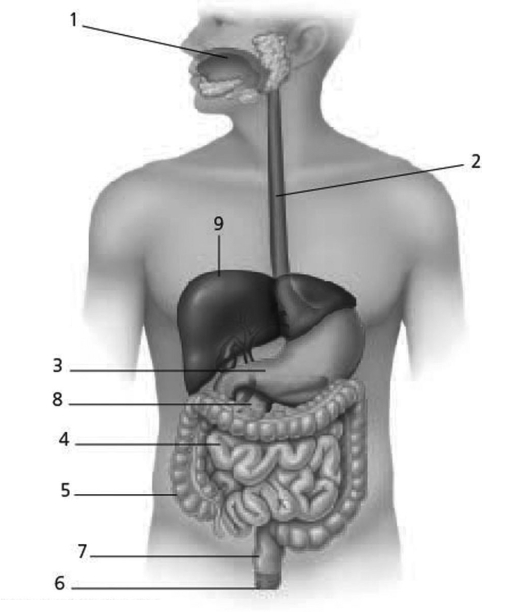 -Examine the digestive system structures in the figure.The agent(s)that help emulsify fats are produced in location
 (Multiple Choice)
5.0/5 (84)
(84) Stomach cells are moderately well adapted to the acidity and protein-digesting activities in the stomach by having
(Multiple Choice)
4.8/5 (90)
(90) A hiatal hernia that disrupts the functional relationship between the smooth muscle in the esophagus and that in the stomach would be most likely to increase the frequency of
(Multiple Choice)
4.9/5 (79)
(79) Vitamins A,D,E,and K can be grouped together because they share a common property.What is this property?
(Multiple Choice)
4.8/5 (82)
(82)  -Examine the teeth of this organism.What type of organism is it?

-Examine the teeth of this organism.What type of organism is it? (Multiple Choice)
4.9/5 (73)
(73) If you were to jog 1 km a few hours after lunch,which stored fuel would you probably tap?
(Multiple Choice)
4.9/5 (71)
(71)
-Examine the digestive system structures in the figure.Most of the digestion of fats occurs in location(s)
-Examine the digestive system structures in the figure.Most of the digestion of fats occurs in location(s) (Multiple Choice)
4.8/5 (75)
(75) What is the correct order of structures that a piece of food would encounter as it travels through the alimentary canal of a bald eagle?
(Multiple Choice)
4.9/5 (80)
(80) The small intestine has a very large surface area that directly facilitates high rates of
(Multiple Choice)
4.9/5 (78)
(78) Ingested dietary substances must cross cell membranes to be used by the body,a process known as
(Multiple Choice)
5.0/5 (90)
(90) Animals that migrate great distances would obtain the greatest energetic benefit from storing chemical energy as
(Multiple Choice)
4.7/5 (62)
(62) 
Filters
- Essay(0)
- Multiple Choice(0)
- Short Answer(0)
- True False(0)
- Matching(0)