



 Chat with AI
Exam 39: Agriculture: Problems, Policies, and Unintended Effects

Exam 1: What Economics Is About168 Questions
Exam 2: Production Possibilities Frontier Framework152 Questions
Exam 3: Supply and Demand: Theory227 Questions
Exam 4: Prices: Free, Controlled, and Relative107 Questions
Exam 5: Supply, Demand, and Price: Applications83 Questions
Exam 6: Macroeconomic Measurements: Prices and Unemployment129 Questions
Exam 7: Macroeconomic Measurements: GDP and Real GDP138 Questions
Exam 8: Aggregate Demand and Aggregate Supply208 Questions
Exam 9: Classical Macroeconomics and the Self Regulating Economy167 Questions
Exam 10: Keynesian Macroeconomics and Economic Instability: A Critique of the Self-Regulating Economy198 Questions
Exam 11: Fiscal Policy and the Federal Budget164 Questions
Exam 12: Money, Banking,and the Financial System124 Questions
Exam 13: The Federal Reserve System184 Questions
Exam 14: Money and the Economy125 Questions
Exam 15: Monetary Policy176 Questions
Exam 16: Expectations Theory and the Economy146 Questions
Exam 17: Economic Growth: Resources, Technology, Ideas, and Institutions82 Questions
Exam 18: The Financial Crisis of 2007-200970 Questions
Exam 19: Debates in Macroeconomics Over the Role and Effects of Government69 Questions
Exam 20: Elasticity198 Questions
Exam 21: Consumer Choice: Maximizing Utility and Behavioral Economics176 Questions
Exam 22: Production and Costs247 Questions
Exam 23: Perfect Competition191 Questions
Exam 24: Monopoly191 Questions
Exam 25: Monopolistic Competition, Oligopoly, and Game Theory167 Questions
Exam 26: Government and Product Markets: Antitrust and Regulation165 Questions
Exam 27: Factor Markets: With Emphasis on the Labor Market181 Questions
Exam 28: Wages,Unions,and Labor134 Questions
Exam 29: The Distribution of Income and Poverty93 Questions
Exam 30: Interest, Rent, and Profit199 Questions
Exam 31: Market Failure: Externalities, Public Goods, and Asymmetric Information185 Questions
Exam 32: Public Choice and Special-Interest-Group Politics131 Questions
Exam 33: Building Theories to Explain Everyday Life: From Observations to Questions to Theories to Predictions60 Questions
Exam 34: International Trade152 Questions
Exam 35: International Finance119 Questions
Exam 36: Globalization and International Impacts on the Economy136 Questions
Exam 37: The Economic Case For and Against Government: Five Topics Considered82 Questions
Exam 38: Stocks, Bonds, Futures, and Options108 Questions
Exam 39: Agriculture: Problems, Policies, and Unintended Effects149 Questions
Select questions type


Stating that income elasticity of demand for potatoes equals 0.15 is equivalent to stating that if income
(Multiple Choice)
5.0/5  (68)
(68) Exhibit 39-4
 -Refer to Exhibit 39-4.At a target price of $4 per bushel,what price does the consumer pay?
 (Multiple Choice)
4.7/5 (69)
(69) The major way that the government supports crop prices is by granting nonrecourse loans to farmers.
(True/False)
4.8/5 (79)
(79) A farmer has 500 acres on which he has previously grown corn.His yield per acre is 100 bushels of corn.If his production flexibility contract payment is $21,250,then what is the corn payment rate?
(Multiple Choice)
4.8/5 (66)
(66) Exhibit 39-4
-Refer to Exhibit 39-4.The price elasticity of demand for wheat between the prices of $3 and $4 is
-Refer to Exhibit 39-4.The price elasticity of demand for wheat between the prices of $3 and $4 is (Multiple Choice)
4.8/5 (92)
(92) In 2000,farmers in the United States represented approximately what percentage of the population?
(Multiple Choice)
4.9/5 (79)
(79) Exhibit 39-7
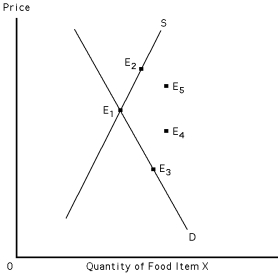 -Refer to Exhibit 39-7.Let E1 represent the initial equilibrium in the market for X.Population growth combined with the widely publicized results of medical research extolling the virtues of consuming X will,ceteris paribus,result in a new equilibrium at
 (Multiple Choice)
4.8/5 (87)
(87) One unintended consequence of the various attempts to restrict farm acreage was that
(Multiple Choice)
4.9/5 (68)
(68) The price of a foodstuff falls and the total revenue (received by farmers for selling the foodstuff)rises.What could explain this?
(Multiple Choice)
4.8/5 (90)
(90) Exhibit 39-2
 -Refer to Exhibit 39-2.Given a target price of P?,what is the total deficiency payment made by the government?
 (Multiple Choice)
5.0/5 (77)
(77) Demand for a food item increases by more than the supply of the food item.One thing for certain is that
(Multiple Choice)
4.8/5 (90)
(90) Suppose iceberg lettuce has an income elasticity of demand of 0.35.A 10 percent increase in income causes the quantity demanded of iceberg lettuce to _______________ by ______________ percent.
(Multiple Choice)
4.7/5 (76)
(76) Exhibit 39-8
 -Refer to Exhibit 39-8.Assume that E1 represents the initial equilibrium in the market for grain X.As a result of increased agricultural productivity,total revenues for farmers in this market will
 (Multiple Choice)
4.9/5 (73)
(73) Exhibit 39-8
-Refer to Exhibit 39-8.Assume that E1represents the initial equilibrium in the market for grain X.If all the farmers agree to restrict production and abide by the agreement,
-Refer to Exhibit 39-8.Assume that E1represents the initial equilibrium in the market for grain X.If all the farmers agree to restrict production and abide by the agreement, (Multiple Choice)
5.0/5 (82)
(82) Exhibit 39-5
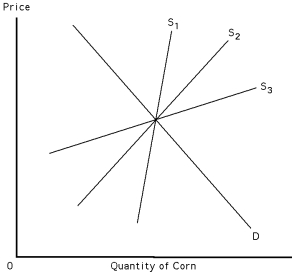 -Refer to Exhibit 39-5.Low price elasticity of demand for corn coupled with unpredictable weather makes both price and total revenue in the market for corn extremely volatile.Which of the supply curves would result in the least volatility?
 (Multiple Choice)
4.9/5 (74)
(74) If the government establishes a price floor for agricultural products,then
(Multiple Choice)
4.8/5 (81)
(81) Increased productivity in the agricultural sector is not always a benefit to farmers because it is accompanied by
(Multiple Choice)
4.9/5 (74)
(74) A government agricultural policy in which a mandated minimum price is set is the
(Multiple Choice)
4.8/5 (74)
(74) 
Filters
- Essay(0)
- Multiple Choice(0)
- Short Answer(0)
- True False(0)
- Matching(0)