



 Chat with AI
Exam 37: The Economic Case For and Against Government: Five Topics Considered

Exam 1: What Economics Is About168 Questions
Exam 2: Production Possibilities Frontier Framework152 Questions
Exam 3: Supply and Demand: Theory227 Questions
Exam 4: Prices: Free, Controlled, and Relative107 Questions
Exam 5: Supply, Demand, and Price: Applications83 Questions
Exam 6: Macroeconomic Measurements: Prices and Unemployment129 Questions
Exam 7: Macroeconomic Measurements: GDP and Real GDP138 Questions
Exam 8: Aggregate Demand and Aggregate Supply208 Questions
Exam 9: Classical Macroeconomics and the Self Regulating Economy167 Questions
Exam 10: Keynesian Macroeconomics and Economic Instability: A Critique of the Self-Regulating Economy198 Questions
Exam 11: Fiscal Policy and the Federal Budget164 Questions
Exam 12: Money, Banking,and the Financial System124 Questions
Exam 13: The Federal Reserve System184 Questions
Exam 14: Money and the Economy125 Questions
Exam 15: Monetary Policy176 Questions
Exam 16: Expectations Theory and the Economy146 Questions
Exam 17: Economic Growth: Resources, Technology, Ideas, and Institutions82 Questions
Exam 18: The Financial Crisis of 2007-200970 Questions
Exam 19: Debates in Macroeconomics Over the Role and Effects of Government69 Questions
Exam 20: Elasticity198 Questions
Exam 21: Consumer Choice: Maximizing Utility and Behavioral Economics176 Questions
Exam 22: Production and Costs247 Questions
Exam 23: Perfect Competition191 Questions
Exam 24: Monopoly191 Questions
Exam 25: Monopolistic Competition, Oligopoly, and Game Theory167 Questions
Exam 26: Government and Product Markets: Antitrust and Regulation165 Questions
Exam 27: Factor Markets: With Emphasis on the Labor Market181 Questions
Exam 28: Wages,Unions,and Labor134 Questions
Exam 29: The Distribution of Income and Poverty93 Questions
Exam 30: Interest, Rent, and Profit199 Questions
Exam 31: Market Failure: Externalities, Public Goods, and Asymmetric Information185 Questions
Exam 32: Public Choice and Special-Interest-Group Politics131 Questions
Exam 33: Building Theories to Explain Everyday Life: From Observations to Questions to Theories to Predictions60 Questions
Exam 34: International Trade152 Questions
Exam 35: International Finance119 Questions
Exam 36: Globalization and International Impacts on the Economy136 Questions
Exam 37: The Economic Case For and Against Government: Five Topics Considered82 Questions
Exam 38: Stocks, Bonds, Futures, and Options108 Questions
Exam 39: Agriculture: Problems, Policies, and Unintended Effects149 Questions
Select questions type


Most economists believe that the market __________ produce nonexcludable public goods because of the __________.
(Multiple Choice)
4.8/5  (71)
(71) "I'm not going to pay for the good if,once produced,the good cannot be denied to anyone." This statement is most relevant to
(Multiple Choice)
4.8/5 (83)
(83) A divisive society is one in which members of society work together for the common good.
(True/False)
4.9/5 (79)
(79) To say that government sometimes functions as a "transfer mechanism," means that government sometimes
(Multiple Choice)
4.8/5 (77)
(77) Consider a setting in which there is a negative externality,but no positive externality. The market outcome is __________________; government can bring about the ___________________ outcome if it sets a tax equal to the __________________.
(Multiple Choice)
5.0/5 (87)
(87) Special interest group Q receives a 1/10,000?? slice of the economic pie. Its net benefit from either an economic growth policy or a transfer policy is $50,000. In order for group Q to be indifferent between the two policies,the economic growth policy would have to make the size of the economic pie (Real GDP)grow by _________________. This type of analysis is used to show that special interest groups tend press government for ______________ instead of ________________.
(Multiple Choice)
4.9/5 (81)
(81) Consider a setting in which there is a positive externality,but no negative externality. The market outcome is __________________; government can bring about the ___________________ outcome if it sets a subsidy equal to the __________________.
(Multiple Choice)
4.9/5 (76)
(76) A consequence of a negative externality is that social costs __________ private costs,and the efficient level of output __________.
(Multiple Choice)
4.8/5 (82)
(82) Special interest group Z receives a 1/200th slice of the economic pie. Its net benefit from both an economic growth policy and a transfer policy is $30,000. How much does the size of the economic pie (Real GDP)need to grow before group Z is indifferent between the two policies?
(Multiple Choice)
4.8/5 (75)
(75) Economist B thinks that it is important to identify the condition(s)under which the case for government is strongest. With respect to the provision of nonexcludable public goods,she says
(Multiple Choice)
5.0/5 (92)
(92) Suppose that for Jim the marginal benefit (MB)of producing is $60 and that the marginal cost (MC)of producing is $10. Suppose also that his marginal benefit of stealing is $50 and the marginal cost of stealing is $10. Is Jim currently maximizing utility in terms of producing and stealing? If not,should he produce more and steal less,or produce less and steal more to move toward utility maximization?
(Multiple Choice)
4.7/5 (80)
(80) Individuals want nonexcludable public good X,but the market does not provide it because of the free rider problem. Government overcomes the free rider problem by ______________ individuals and then either producing good X itself or paying someone to produce it.
(Multiple Choice)
4.8/5 (87)
(87) Exhibit 37-1
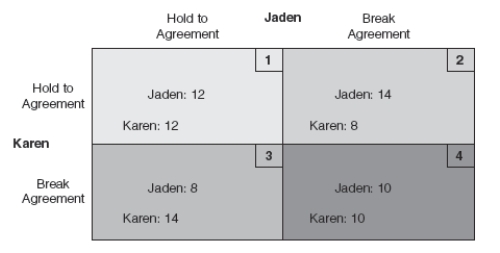 -Refer to Exhibit 37-1,where the higher the number,the better the position for the person to whom the number is connected. Jaden and Karen are currently in box 4,each receiving 10. they would like to move to box 1,where each receives 12. Without someone to ________________ their agreement,moving from box 4 is ______________________.
 (Multiple Choice)
4.7/5 (78)
(78) The strongest case for government with respect to a negative externality is that government needs to set the
(Multiple Choice)
4.8/5 (85)
(85) The essence of a prisoner's dilemma setting is that if both person A and person B do what is best for each of them,
(Multiple Choice)
4.7/5 (77)
(77) In the case of a negative externality,in order to achieve efficiency the government must set the _________________ equal to the marginal ____________________.
(Multiple Choice)
4.9/5 (79)
(79) In the prisoner's dilemma setting for producing and stealing,a tax imposed on participants could end up changing the payoff matrix so that
(Multiple Choice)
4.9/5 (82)
(82) In the case of a nonexcludable public good,the market will fail to produce the good because of the free rider problem.
(True/False)
4.7/5 (84)
(84) 
Filters
- Essay(0)
- Multiple Choice(0)
- Short Answer(0)
- True False(0)
- Matching(0)