



 Chat with AI
Exam 32: Public Choice and Special-Interest-Group Politics

Exam 1: What Economics Is About168 Questions
Exam 2: Production Possibilities Frontier Framework152 Questions
Exam 3: Supply and Demand: Theory227 Questions
Exam 4: Prices: Free, Controlled, and Relative107 Questions
Exam 5: Supply, Demand, and Price: Applications83 Questions
Exam 6: Macroeconomic Measurements: Prices and Unemployment129 Questions
Exam 7: Macroeconomic Measurements: GDP and Real GDP138 Questions
Exam 8: Aggregate Demand and Aggregate Supply208 Questions
Exam 9: Classical Macroeconomics and the Self Regulating Economy167 Questions
Exam 10: Keynesian Macroeconomics and Economic Instability: A Critique of the Self-Regulating Economy198 Questions
Exam 11: Fiscal Policy and the Federal Budget164 Questions
Exam 12: Money, Banking,and the Financial System124 Questions
Exam 13: The Federal Reserve System184 Questions
Exam 14: Money and the Economy125 Questions
Exam 15: Monetary Policy176 Questions
Exam 16: Expectations Theory and the Economy146 Questions
Exam 17: Economic Growth: Resources, Technology, Ideas, and Institutions82 Questions
Exam 18: The Financial Crisis of 2007-200970 Questions
Exam 19: Debates in Macroeconomics Over the Role and Effects of Government69 Questions
Exam 20: Elasticity198 Questions
Exam 21: Consumer Choice: Maximizing Utility and Behavioral Economics176 Questions
Exam 22: Production and Costs247 Questions
Exam 23: Perfect Competition191 Questions
Exam 24: Monopoly191 Questions
Exam 25: Monopolistic Competition, Oligopoly, and Game Theory167 Questions
Exam 26: Government and Product Markets: Antitrust and Regulation165 Questions
Exam 27: Factor Markets: With Emphasis on the Labor Market181 Questions
Exam 28: Wages,Unions,and Labor134 Questions
Exam 29: The Distribution of Income and Poverty93 Questions
Exam 30: Interest, Rent, and Profit199 Questions
Exam 31: Market Failure: Externalities, Public Goods, and Asymmetric Information185 Questions
Exam 32: Public Choice and Special-Interest-Group Politics131 Questions
Exam 33: Building Theories to Explain Everyday Life: From Observations to Questions to Theories to Predictions60 Questions
Exam 34: International Trade152 Questions
Exam 35: International Finance119 Questions
Exam 36: Globalization and International Impacts on the Economy136 Questions
Exam 37: The Economic Case For and Against Government: Five Topics Considered82 Questions
Exam 38: Stocks, Bonds, Futures, and Options108 Questions
Exam 39: Agriculture: Problems, Policies, and Unintended Effects149 Questions
Select questions type


Rent seeking is more likely to occur in a family when the parents make their inheritance plans clear by telling the children ahead of time that their estate will be divided equally among the children (and that under no circumstances will the parents change their minds)than when there is more uncertainty with regards to the parents' inheritance plans.
(True/False)
4.7/5  (75)
(75) Exhibit 32-3
 -Refer to Exhibit 32-3.The exhibit shows the breakdown of benefits and costs for a five-person community considering whether to purchase a $5,000 statue of Adam Smith to put in the center of the public square.How will each of the five persons (from Milton to Kenneth,in order)vote?
 (Multiple Choice)
4.9/5 (82)
(82) Two candidates,Smith and Jones,are running for the same political office.Last night they were in a debate.It is generally accepted that Smith is perceived more to the left after the debate than before the debate.This is bad news for Jones if before the debate Smith was perceived
(Multiple Choice)
4.8/5 (62)
(62) Which of the following persons is most likely to become informed on the National Endowment for the Arts?
(Multiple Choice)
4.9/5 (77)
(77) The simple majority decision rule may generate results that are
(Multiple Choice)
4.8/5 (77)
(77) Exhibit 32-1
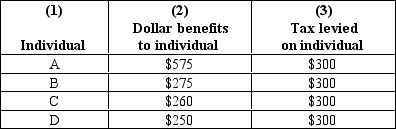 -Refer to Exhibit 32-l.The exhibit shows the breakdown of benefits and costs for a four-person town of a proposed $1,200 addition in books to the public library.The members of the community get to vote on the project at hand,and the majority rules.Given the data,the $1,200 will
 (Multiple Choice)
4.9/5 (82)
(82) Persons who choose not to become informed on political and governmental matters because they feel that the costs of becoming informed exceed the benefits of becoming informed are
(Multiple Choice)
4.9/5 (89)
(89) Political candidates in a two-person race prefer to be viewed as occupying the center of the political distribution because
(Multiple Choice)
4.7/5 (74)
(74) Would we expect the "average" person to take more time to learn about the car he or she is considering purchasing or about the issues in the upcoming U.S.Senate race in his or her state?
(Multiple Choice)
4.9/5 (78)
(78) A candidate who understands that in a two-person race the person closer to the center of the voter distribution will win is likely to
(Multiple Choice)
4.7/5 (80)
(80) The state of choosing not to acquire information because the costs of acquiring the information are greater than the benefits is referred to as
(Multiple Choice)
4.9/5 (72)
(72) A college professor berates his political science students for being uninformed on current political and government issues.For example,most of them do not know who represents them in the U.S.House of Representatives.He tells his students that they will never get very far in life by staying so uninformed and uninterested.The professor is probably overlooking the fact that
(Multiple Choice)
4.8/5 (77)
(77) 
Filters
- Essay(0)
- Multiple Choice(0)
- Short Answer(0)
- True False(0)
- Matching(0)