



 Chat with AI
Exam 29: The Distribution of Income and Poverty

Exam 1: What Economics Is About168 Questions
Exam 2: Production Possibilities Frontier Framework152 Questions
Exam 3: Supply and Demand: Theory227 Questions
Exam 4: Prices: Free, Controlled, and Relative107 Questions
Exam 5: Supply, Demand, and Price: Applications83 Questions
Exam 6: Macroeconomic Measurements: Prices and Unemployment129 Questions
Exam 7: Macroeconomic Measurements: GDP and Real GDP138 Questions
Exam 8: Aggregate Demand and Aggregate Supply208 Questions
Exam 9: Classical Macroeconomics and the Self Regulating Economy167 Questions
Exam 10: Keynesian Macroeconomics and Economic Instability: A Critique of the Self-Regulating Economy198 Questions
Exam 11: Fiscal Policy and the Federal Budget164 Questions
Exam 12: Money, Banking,and the Financial System124 Questions
Exam 13: The Federal Reserve System184 Questions
Exam 14: Money and the Economy125 Questions
Exam 15: Monetary Policy176 Questions
Exam 16: Expectations Theory and the Economy146 Questions
Exam 17: Economic Growth: Resources, Technology, Ideas, and Institutions82 Questions
Exam 18: The Financial Crisis of 2007-200970 Questions
Exam 19: Debates in Macroeconomics Over the Role and Effects of Government69 Questions
Exam 20: Elasticity198 Questions
Exam 21: Consumer Choice: Maximizing Utility and Behavioral Economics176 Questions
Exam 22: Production and Costs247 Questions
Exam 23: Perfect Competition191 Questions
Exam 24: Monopoly191 Questions
Exam 25: Monopolistic Competition, Oligopoly, and Game Theory167 Questions
Exam 26: Government and Product Markets: Antitrust and Regulation165 Questions
Exam 27: Factor Markets: With Emphasis on the Labor Market181 Questions
Exam 28: Wages,Unions,and Labor134 Questions
Exam 29: The Distribution of Income and Poverty93 Questions
Exam 30: Interest, Rent, and Profit199 Questions
Exam 31: Market Failure: Externalities, Public Goods, and Asymmetric Information185 Questions
Exam 32: Public Choice and Special-Interest-Group Politics131 Questions
Exam 33: Building Theories to Explain Everyday Life: From Observations to Questions to Theories to Predictions60 Questions
Exam 34: International Trade152 Questions
Exam 35: International Finance119 Questions
Exam 36: Globalization and International Impacts on the Economy136 Questions
Exam 37: The Economic Case For and Against Government: Five Topics Considered82 Questions
Exam 38: Stocks, Bonds, Futures, and Options108 Questions
Exam 39: Agriculture: Problems, Policies, and Unintended Effects149 Questions
Select questions type


Evidence seems to indicate that the distribution of income prior to adjusting for taxes and in-kind transfer payments is
(Multiple Choice)
4.9/5  (83)
(83) In 2012 a woman won a $100 million lottery.Her income is (most likely)largely due to her
(Multiple Choice)
4.7/5 (81)
(81) In order to make the income distribution more equal,the federal government could
(Multiple Choice)
4.9/5 (70)
(70) Exhibit 29-2
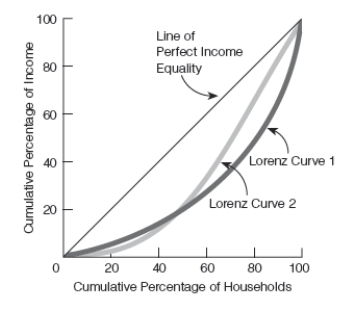 -Refer to Exhibit 29-2. This graph depicts the Lorenz curve for two countries,country 1 (Lorenz curve 1)and country 2 (Lorenz curve 2). Although the Gini coefficient is __________ in country 1 than in country 2,the bottom quintile in ____________ receives a larger share of income compared to the bottom quintile in _______________.
 (Multiple Choice)
4.9/5 (71)
(71) Consider the area between the line of perfect income equality and the Lorenz curve.In country A this area is larger than in country B.It follows that
(Multiple Choice)
4.9/5 (82)
(82) The social insurance justification for government welfare assistance holds that
(Multiple Choice)
4.8/5 (90)
(90) It is possible for everyone to be better off (in absolute terms)even though the income distribution has become more unequal.
(True/False)
4.8/5 (83)
(83) In the United States,the average household in the top quintile (of total money income)contains fewer persons than the average household in the bottom quintile.
(True/False)
4.9/5 (78)
(78) Which of the following is not an example of in-kind transfer payments?
(Multiple Choice)
4.9/5 (65)
(65) The practice of companies promoting from within is on the decline,possibly because of less regulated,increasingly competitive product markets.
(True/False)
4.9/5 (74)
(74) Based on the income data presented for the U.S.(in your text)the Gini coefficient was around 0.45 in 2007,which is higher than it was in 1947.
(True/False)
4.8/5 (76)
(76) Wage discrimination exists when individuals of __________ are paid different wage rates.
(Multiple Choice)
4.8/5 (81)
(81) 
Filters
- Essay(0)
- Multiple Choice(0)
- Short Answer(0)
- True False(0)
- Matching(0)