



 Chat with AI
Exam 26: Government and Product Markets: Antitrust and Regulation

Exam 1: What Economics Is About168 Questions
Exam 2: Production Possibilities Frontier Framework152 Questions
Exam 3: Supply and Demand: Theory227 Questions
Exam 4: Prices: Free, Controlled, and Relative107 Questions
Exam 5: Supply, Demand, and Price: Applications83 Questions
Exam 6: Macroeconomic Measurements: Prices and Unemployment129 Questions
Exam 7: Macroeconomic Measurements: GDP and Real GDP138 Questions
Exam 8: Aggregate Demand and Aggregate Supply208 Questions
Exam 9: Classical Macroeconomics and the Self Regulating Economy167 Questions
Exam 10: Keynesian Macroeconomics and Economic Instability: A Critique of the Self-Regulating Economy198 Questions
Exam 11: Fiscal Policy and the Federal Budget164 Questions
Exam 12: Money, Banking,and the Financial System124 Questions
Exam 13: The Federal Reserve System184 Questions
Exam 14: Money and the Economy125 Questions
Exam 15: Monetary Policy176 Questions
Exam 16: Expectations Theory and the Economy146 Questions
Exam 17: Economic Growth: Resources, Technology, Ideas, and Institutions82 Questions
Exam 18: The Financial Crisis of 2007-200970 Questions
Exam 19: Debates in Macroeconomics Over the Role and Effects of Government69 Questions
Exam 20: Elasticity198 Questions
Exam 21: Consumer Choice: Maximizing Utility and Behavioral Economics176 Questions
Exam 22: Production and Costs247 Questions
Exam 23: Perfect Competition191 Questions
Exam 24: Monopoly191 Questions
Exam 25: Monopolistic Competition, Oligopoly, and Game Theory167 Questions
Exam 26: Government and Product Markets: Antitrust and Regulation165 Questions
Exam 27: Factor Markets: With Emphasis on the Labor Market181 Questions
Exam 28: Wages,Unions,and Labor134 Questions
Exam 29: The Distribution of Income and Poverty93 Questions
Exam 30: Interest, Rent, and Profit199 Questions
Exam 31: Market Failure: Externalities, Public Goods, and Asymmetric Information185 Questions
Exam 32: Public Choice and Special-Interest-Group Politics131 Questions
Exam 33: Building Theories to Explain Everyday Life: From Observations to Questions to Theories to Predictions60 Questions
Exam 34: International Trade152 Questions
Exam 35: International Finance119 Questions
Exam 36: Globalization and International Impacts on the Economy136 Questions
Exam 37: The Economic Case For and Against Government: Five Topics Considered82 Questions
Exam 38: Stocks, Bonds, Futures, and Options108 Questions
Exam 39: Agriculture: Problems, Policies, and Unintended Effects149 Questions
Select questions type


The advantage of the Herfindahl index over the four- and eight-firm concentration ratios is that it provides information
(Multiple Choice)
4.8/5  (71)
(71) If government regulators want a natural monopolist to earn only zero economic profits,then they will set a price
(Multiple Choice)
4.8/5 (77)
(77) Exhibit 26-2
 -Refer to Exhibit 26-2.The four-firm concentration ratio in Year 5 was
 (Multiple Choice)
4.8/5 (79)
(79) The natural monopolist might have an incentive to go out of business under
(Multiple Choice)
4.9/5 (83)
(83) Under profit regulation,a natural monopolist has an incentive to be very careful about minimizing costs.
(True/False)
4.8/5 (80)
(80) Exhibit 26-1
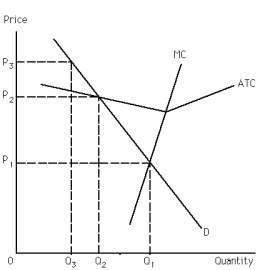 -Refer to Exhibit 26-1.Which of the following statements is false?
 (Multiple Choice)
4.9/5 (88)
(88) In Industry A,the largest four firms together have a 30 percent share of the market and there are a total of eight firms in the market.In Industry B,the largest four firms together have a 30 percent share of the market and there are 100 other firms in the market.If we want to distinguish between the concentration in these two industries,the best measure to use is the
(Multiple Choice)
4.8/5 (80)
(80) Exhibit 26-2
-Refer to Exhibit 26-2.The four-firm concentration ratio in Year 1 was
-Refer to Exhibit 26-2.The four-firm concentration ratio in Year 1 was (Multiple Choice)
4.9/5 (79)
(79) Exhibit 26-4
 -Refer to Exhibit 26-4.What is the productive-efficient level of output?
 (Multiple Choice)
4.7/5 (90)
(90) The public interest theory of regulation holds that regulators will
(Multiple Choice)
4.8/5 (74)
(74) Network goods such as telephones,computer operating systems and the like,will tend to become monopolies because consumers will naturally tend to buy from the largest supplier of the good.who will eventually become a monopoly.This monopoly position
(Multiple Choice)
4.9/5 (77)
(77) Define the term lock-in effect and explain how this effect might make a network monopoly that benefits from it less likely to innovate.
(Essay)
4.9/5 (73)
(73) If natural monopolies are regulated to produce where there is resource-allocative efficiency,they produce where
(Multiple Choice)
4.8/5 (83)
(83) What is the difference between the public interest theory of regulation and the public choice theory of regulation?
(Essay)
4.9/5 (90)
(90) The act that was passed in an attempt to decrease the failure rate of small businesses by protecting them from the competition of large and growing chain stores was the
(Multiple Choice)
4.9/5 (89)
(89) Exhibit 26-2
-Refer to Exhibit 26-2.The four-firm concentration ratio in Year 3 was
-Refer to Exhibit 26-2.The four-firm concentration ratio in Year 3 was (Multiple Choice)
4.8/5 (72)
(72) 
Filters
- Essay(0)
- Multiple Choice(0)
- Short Answer(0)
- True False(0)
- Matching(0)