



 Chat with AI
Exam 24: Monopoly

Exam 1: What Economics Is About168 Questions
Exam 2: Production Possibilities Frontier Framework152 Questions
Exam 3: Supply and Demand: Theory227 Questions
Exam 4: Prices: Free, Controlled, and Relative107 Questions
Exam 5: Supply, Demand, and Price: Applications83 Questions
Exam 6: Macroeconomic Measurements: Prices and Unemployment129 Questions
Exam 7: Macroeconomic Measurements: GDP and Real GDP138 Questions
Exam 8: Aggregate Demand and Aggregate Supply208 Questions
Exam 9: Classical Macroeconomics and the Self Regulating Economy167 Questions
Exam 10: Keynesian Macroeconomics and Economic Instability: A Critique of the Self-Regulating Economy198 Questions
Exam 11: Fiscal Policy and the Federal Budget164 Questions
Exam 12: Money, Banking,and the Financial System124 Questions
Exam 13: The Federal Reserve System184 Questions
Exam 14: Money and the Economy125 Questions
Exam 15: Monetary Policy176 Questions
Exam 16: Expectations Theory and the Economy146 Questions
Exam 17: Economic Growth: Resources, Technology, Ideas, and Institutions82 Questions
Exam 18: The Financial Crisis of 2007-200970 Questions
Exam 19: Debates in Macroeconomics Over the Role and Effects of Government69 Questions
Exam 20: Elasticity198 Questions
Exam 21: Consumer Choice: Maximizing Utility and Behavioral Economics176 Questions
Exam 22: Production and Costs247 Questions
Exam 23: Perfect Competition191 Questions
Exam 24: Monopoly191 Questions
Exam 25: Monopolistic Competition, Oligopoly, and Game Theory167 Questions
Exam 26: Government and Product Markets: Antitrust and Regulation165 Questions
Exam 27: Factor Markets: With Emphasis on the Labor Market181 Questions
Exam 28: Wages,Unions,and Labor134 Questions
Exam 29: The Distribution of Income and Poverty93 Questions
Exam 30: Interest, Rent, and Profit199 Questions
Exam 31: Market Failure: Externalities, Public Goods, and Asymmetric Information185 Questions
Exam 32: Public Choice and Special-Interest-Group Politics131 Questions
Exam 33: Building Theories to Explain Everyday Life: From Observations to Questions to Theories to Predictions60 Questions
Exam 34: International Trade152 Questions
Exam 35: International Finance119 Questions
Exam 36: Globalization and International Impacts on the Economy136 Questions
Exam 37: The Economic Case For and Against Government: Five Topics Considered82 Questions
Exam 38: Stocks, Bonds, Futures, and Options108 Questions
Exam 39: Agriculture: Problems, Policies, and Unintended Effects149 Questions
Select questions type


If a perfectly competitive firm and a single-price monopolist face the same demand and cost curves,then the competitive firm will produce a
(Multiple Choice)
4.7/5  (72)
(72) Exhibit 24-6
 -Refer to Exhibit 24-6.The price and quantity of a single-price monopolist producing good X are P0 and qB,respectively.The marginal revenue curve is represented by
 (Multiple Choice)
4.9/5 (72)
(72) Exhibit 24-7
 -Refer to Exhibit 24-7.If D represents the demand curve facing a perfectly price-discriminating monopolist,the price it charges for the last unit sold exceeds the marginal cost of the last unit by
 (Multiple Choice)
4.8/5 (92)
(92) By definition,monopolists sell a product for which there are absolutely no substitutes.
(True/False)
4.9/5 (92)
(92) A monopolist can sell 7,000 units at a price of $5 per unit.Lowering price to all buyers by $1 raises the quantity demanded by 500 units.What is the change in total revenue resulting from this price change?
(Multiple Choice)
5.0/5 (90)
(90) Suppose Johnny,seven years old,is selling lemonade and he sells each of his buyers the refreshment for the maximum price that each buyer is willing to pay.Johnny is practicing
(Multiple Choice)
4.8/5 (74)
(74) X-inefficiency occurs when a monopolist produces output at a cost that is greater than the lowest possible cost.
(True/False)
4.8/5 (71)
(71) Exhibit 24-7
-Competition is legally prohibited when barriers to entry take the form of
-Competition is legally prohibited when barriers to entry take the form of (Multiple Choice)
4.7/5 (75)
(75) Your school pays one rate for the first one million kilowatts of electricity and a lower rate for any power it uses over one million kilowatts.What is occurring here?
(Multiple Choice)
4.9/5 (80)
(80) Individuals who spend resources to influence public policy in a way that will redistribute income to themselves are
(Multiple Choice)
4.8/5 (67)
(67) Exhibit 24-4
 -Refer to Exhibit 24-4.The profit-maximizing single-price monopolist's maximum profit is
 (Multiple Choice)
4.8/5 (79)
(79) Exhibit 24-1
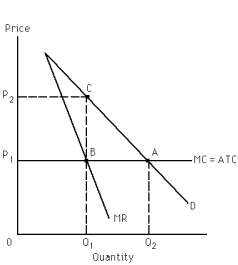 -Refer to Exhibit 24-1.According to economist Gordon Tullock,what area is subject to rent seeking activity?
 (Multiple Choice)
4.7/5 (66)
(66) Exhibit 24-7
-Refer to Exhibit 24-7.Let D be the demand curve facing a perfectly price-discriminating monopolist.The lowest price this monopolist will charge is
-Refer to Exhibit 24-7.Let D be the demand curve facing a perfectly price-discriminating monopolist.The lowest price this monopolist will charge is (Multiple Choice)
4.9/5 (81)
(81) Describe the circumstance under which profit maximization is the same as revenue maximization. Use a hypothetical numerical example to help explain why this is so.
(Essay)
4.9/5 (82)
(82) A monopolist that practices perfect price discrimination has the same deadweight loss triangle as the single-price monopolist.
(True/False)
4.8/5 (77)
(77) If the monopoly firm's marginal cost curve is either horizontal or upward sloping,it follows that its marginal revenue curve will cut its marginal cost curve at a __________ level of output than where its demand curve cuts its marginal cost curve.It also follows that if the firm were to produce the quantity of output consistent with where its demand curve cut its marginal cost curve,the firm would be __________.
(Multiple Choice)
4.8/5 (85)
(85) 
Filters
- Essay(0)
- Multiple Choice(0)
- Short Answer(0)
- True False(0)
- Matching(0)