



 Chat with AI
Exam 11: Fiscal Policy and the Federal Budget

Exam 1: What Economics Is About168 Questions
Exam 2: Production Possibilities Frontier Framework152 Questions
Exam 3: Supply and Demand: Theory227 Questions
Exam 4: Prices: Free, Controlled, and Relative107 Questions
Exam 5: Supply, Demand, and Price: Applications83 Questions
Exam 6: Macroeconomic Measurements: Prices and Unemployment129 Questions
Exam 7: Macroeconomic Measurements: GDP and Real GDP138 Questions
Exam 8: Aggregate Demand and Aggregate Supply208 Questions
Exam 9: Classical Macroeconomics and the Self Regulating Economy167 Questions
Exam 10: Keynesian Macroeconomics and Economic Instability: A Critique of the Self-Regulating Economy198 Questions
Exam 11: Fiscal Policy and the Federal Budget164 Questions
Exam 12: Money, Banking,and the Financial System124 Questions
Exam 13: The Federal Reserve System184 Questions
Exam 14: Money and the Economy125 Questions
Exam 15: Monetary Policy176 Questions
Exam 16: Expectations Theory and the Economy146 Questions
Exam 17: Economic Growth: Resources, Technology, Ideas, and Institutions82 Questions
Exam 18: The Financial Crisis of 2007-200970 Questions
Exam 19: Debates in Macroeconomics Over the Role and Effects of Government69 Questions
Exam 20: Elasticity198 Questions
Exam 21: Consumer Choice: Maximizing Utility and Behavioral Economics176 Questions
Exam 22: Production and Costs247 Questions
Exam 23: Perfect Competition191 Questions
Exam 24: Monopoly191 Questions
Exam 25: Monopolistic Competition, Oligopoly, and Game Theory167 Questions
Exam 26: Government and Product Markets: Antitrust and Regulation165 Questions
Exam 27: Factor Markets: With Emphasis on the Labor Market181 Questions
Exam 28: Wages,Unions,and Labor134 Questions
Exam 29: The Distribution of Income and Poverty93 Questions
Exam 30: Interest, Rent, and Profit199 Questions
Exam 31: Market Failure: Externalities, Public Goods, and Asymmetric Information185 Questions
Exam 32: Public Choice and Special-Interest-Group Politics131 Questions
Exam 33: Building Theories to Explain Everyday Life: From Observations to Questions to Theories to Predictions60 Questions
Exam 34: International Trade152 Questions
Exam 35: International Finance119 Questions
Exam 36: Globalization and International Impacts on the Economy136 Questions
Exam 37: The Economic Case For and Against Government: Five Topics Considered82 Questions
Exam 38: Stocks, Bonds, Futures, and Options108 Questions
Exam 39: Agriculture: Problems, Policies, and Unintended Effects149 Questions
Select questions type


Suppose Congress increases income taxes.This is an example of
(Multiple Choice)
4.8/5  (79)
(79) Exhibit 11-1
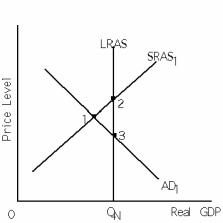 -Refer to Exhibit 11-1.The economy is currently at point 1.In this situation,Keynesian economists would most likely propose
 (Multiple Choice)
4.8/5 (75)
(75) A federal budget surplus occurs when government expenditures exceed tax revenues.
(True/False)
4.8/5 (77)
(77) The economy is in a recessionary gap.There is no crowding out and government has correctly estimated that to bring the economy into long-run equilibrium it should raise government purchases by $123 billion.If government purchases are raised by $123 billion,does it follow that the economy will be moved into long-run equilibrium?
(Multiple Choice)
4.9/5 (73)
(73) In June 2012,the public debt in the United States was approximately
(Multiple Choice)
4.8/5 (74)
(74) Between the data lag and the legislative lag falls the __________ lag.
(Multiple Choice)
4.7/5 (70)
(70) The AD curve shifts to the left with a __________ in government purchases (G)or a __________ in taxes.
(Multiple Choice)
4.8/5 (77)
(77) The answer is: "Policymakers are not aware of changes in the economy as soon as they happen." What is the question?
(Multiple Choice)
5.0/5 (86)
(86) Taxable income rises by $1,515 and taxes rise by $590.85.What is the marginal tax rate?
(Multiple Choice)
4.7/5 (90)
(90) Some economists argue that a rise in the interest rate,brought about by a rise in government borrowing in the loanable funds market to finance the deficit,brings in foreign funds in search of the higher interest rate return.This,in turn,dampens the rise in the interest rate.If this is true as far as it goes,there will be __________ crowding out than there would be if foreign funds did not flow into the country.
(Multiple Choice)
4.7/5 (82)
(82) A tax rate increase necessarily leads to an increase in tax revenue for the government.
(True/False)
4.9/5 (81)
(81) To finance a budget deficit the federal government borrow funds.
(True/False)
4.9/5 (88)
(88) Suppose aggregate demand is too high to bring about the Natural Real GDP level.A Keynesian policy prescription would call for a(n)_____________________ to close this inflationary gap.
(Multiple Choice)
4.8/5 (75)
(75) A curve showing the relationship between tax rates and tax revenues is called a __________ curve.
(Multiple Choice)
5.0/5 (84)
(84) 
Filters
- Essay(0)
- Multiple Choice(0)
- Short Answer(0)
- True False(0)
- Matching(0)