



 Chat with AI
Exam 5: Supply, Demand, and Price: Applications

Exam 1: What Economics Is About168 Questions
Exam 2: Production Possibilities Frontier Framework152 Questions
Exam 3: Supply and Demand: Theory227 Questions
Exam 4: Prices: Free, Controlled, and Relative107 Questions
Exam 5: Supply, Demand, and Price: Applications83 Questions
Exam 6: Macroeconomic Measurements: Prices and Unemployment129 Questions
Exam 7: Macroeconomic Measurements: GDP and Real GDP138 Questions
Exam 8: Aggregate Demand and Aggregate Supply208 Questions
Exam 9: Classical Macroeconomics and the Self Regulating Economy167 Questions
Exam 10: Keynesian Macroeconomics and Economic Instability: A Critique of the Self-Regulating Economy198 Questions
Exam 11: Fiscal Policy and the Federal Budget164 Questions
Exam 12: Money, Banking,and the Financial System124 Questions
Exam 13: The Federal Reserve System184 Questions
Exam 14: Money and the Economy125 Questions
Exam 15: Monetary Policy176 Questions
Exam 16: Expectations Theory and the Economy146 Questions
Exam 17: Economic Growth: Resources, Technology, Ideas, and Institutions82 Questions
Exam 18: The Financial Crisis of 2007-200970 Questions
Exam 19: Debates in Macroeconomics Over the Role and Effects of Government69 Questions
Exam 20: Elasticity198 Questions
Exam 21: Consumer Choice: Maximizing Utility and Behavioral Economics176 Questions
Exam 22: Production and Costs247 Questions
Exam 23: Perfect Competition191 Questions
Exam 24: Monopoly191 Questions
Exam 25: Monopolistic Competition, Oligopoly, and Game Theory167 Questions
Exam 26: Government and Product Markets: Antitrust and Regulation165 Questions
Exam 27: Factor Markets: With Emphasis on the Labor Market181 Questions
Exam 28: Wages,Unions,and Labor134 Questions
Exam 29: The Distribution of Income and Poverty93 Questions
Exam 30: Interest, Rent, and Profit199 Questions
Exam 31: Market Failure: Externalities, Public Goods, and Asymmetric Information185 Questions
Exam 32: Public Choice and Special-Interest-Group Politics131 Questions
Exam 33: Building Theories to Explain Everyday Life: From Observations to Questions to Theories to Predictions60 Questions
Exam 34: International Trade152 Questions
Exam 35: International Finance119 Questions
Exam 36: Globalization and International Impacts on the Economy136 Questions
Exam 37: The Economic Case For and Against Government: Five Topics Considered82 Questions
Exam 38: Stocks, Bonds, Futures, and Options108 Questions
Exam 39: Agriculture: Problems, Policies, and Unintended Effects149 Questions
Select questions type


The existence of a third party in the medical care market separates the buying of medical care from the paying for medical care.
(True/False)
4.8/5  (76)
(76) When the price of a good rises,the demand for its complements will tend to rise.
(True/False)
4.8/5 (90)
(90) If new legislation allowed patients to sue their health-maintenance organization (HMO),we would expect the supply curve for HMO-provided health care to shift to the right and the price of such coverage to fall.
(True/False)
4.8/5 (68)
(68) The higher the price of medical care in general,the lower the ____________________________ medical care and the ______________________ specific items that make up medical care (such as,x-rays).
(Multiple Choice)
4.8/5 (77)
(77) If a college sets its tuition __________ the equilibrium tuition,then it will have to use some form of nonprice-rationing device to determine who will be accepted for admission to the college.
(Multiple Choice)
4.9/5 (84)
(84) The NCAA rule governing the limits on the amount of a scholarship a college can offer an athlete is an effective price floor.
(True/False)
4.9/5 (85)
(85) Exhibit 5-1
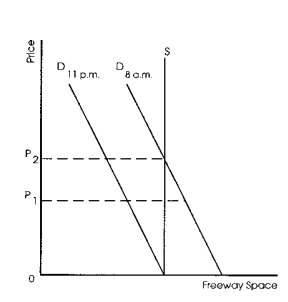 -Refer to Exhibit 5-1,which shows supply and demand for freeway space at both 8a.m.and ________ at 11 p.m.
 (Multiple Choice)
4.7/5 (74)
(74) The actions of speculators make the speculators better off,but they necessarily make the rest of society worse off.
(True/False)
5.0/5 (80)
(80) Exhibit 5-5
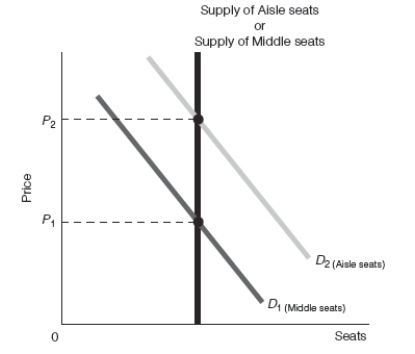 -Refer to Exhibit 5-5.If the airline charges price P? for both aisle seats and middle seats,the result will be
 (Multiple Choice)
4.8/5 (80)
(80) The price of a given good is likely to be less variable with speculators than it would be without speculators.
(True/False)
4.9/5 (84)
(84) Exhibit 5-2
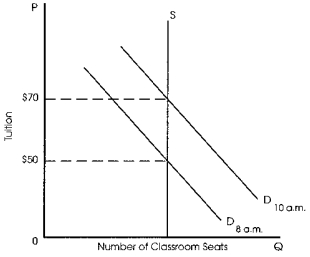 -Refer to Exhibit 5-2.If the tuition is set at $50 there will be
 (Multiple Choice)
4.7/5 (77)
(77) Suppose that television show A is much more popular than television show B. The equilibrium price for a ticket to view the taping of show A is $40 and the equilibrium price for a ticket to view the taping of show B is -$30. If free tickets are offered for the taping of both shows,it is likely that
(Multiple Choice)
4.9/5 (89)
(89) Exhibit 5-3
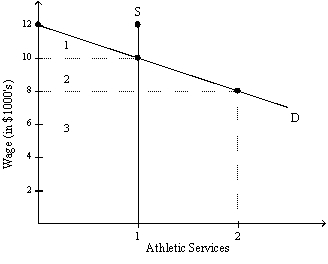 -Refer to Exhibit 5-3 which shows the demand and supply of a college athlete. If the college is allowed to pay this student athlete its market equilibrium wage of $10,000,what is the consumers' surplus for the college that buys this one athlete's services at this wage?
 (Multiple Choice)
4.8/5 (63)
(63) The supply of seats for an economics class at 10 a.m.is the same as the supply of seats for the same class at 12 noon,but while every student who wants to attend this class at 12 noon can,not every student who wants to attend the 10 a.m.class can.Tuition does not vary by time.It follows that the demand for the 10 a.m.class is __________ the demand for the 12 noon class.
(Multiple Choice)
4.9/5 (86)
(86) The demand to attend a certain college is represented by a downward-sloping demand curve.The supply of spots at the college is represented by a vertical supply curve.At the tuition that students are charged,there is a shortage of spots at the college.If the demand to attend the college rises,but the tuition stays constant,it follows that the
(Multiple Choice)
4.9/5 (73)
(73) In a given community,if the government builds more freeways,then the supply curve for freeway space shifts rightward and the demand curve for freeway space shifts leftward.
(True/False)
4.9/5 (75)
(75) 
Filters
- Essay(0)
- Multiple Choice(0)
- Short Answer(0)
- True False(0)
- Matching(0)