



 Chat with AI
Exam 52: Animal Development

Exam 1: The Science of Biology58 Questions
Exam 2: The Nature of Molecules and the Properties of Water76 Questions
Exam 3: The Chemical Building Blocks of Life74 Questions
Exam 4: Cell Structure63 Questions
Exam 5: Membranes76 Questions
Exam 6: Energy and Metabolism53 Questions
Exam 7: How Cells Harvest Energy59 Questions
Exam 8: Photosynthesis67 Questions
Exam 9: Cell Communication45 Questions
Exam 10: How Cells Divide62 Questions
Exam 11: Sexual Reproduction and Meiosis53 Questions
Exam 12: Patterns of Inheritance64 Questions
Exam 13: Chromosomes, mapping, and the Meiosisinheritance Connection58 Questions
Exam 14: Dna: the Genetic Material68 Questions
Exam 15: Genes and How They Work79 Questions
Exam 16: Control of Gene Expression62 Questions
Exam 17: Biotechnology48 Questions
Exam 18: Genomics52 Questions
Exam 19: Cellular Mechanisms of Development56 Questions
Exam 20: Genes Within Populations78 Questions
Exam 21: The Evidence for Evolution65 Questions
Exam 22: The Origin of Species67 Questions
Exam 23: Systematics,phylogenies,and Comparative Biology67 Questions
Exam 24: Genome Evolution54 Questions
Exam 25: The Origin and Diversity of Life35 Questions
Exam 26: Viruses62 Questions
Exam 27: Prokaryotes61 Questions
Exam 28: Protists55 Questions
Exam 29: Seedless Plants44 Questions
Exam 30: Seed Plants36 Questions
Exam 31: Fungi63 Questions
Exam 32: Animal Diversity and the Evolution of Body Plans42 Questions
Exam 33: Protostomes79 Questions
Exam 34: Deuterostomes83 Questions
Exam 35: Plant Form55 Questions
Exam 36: Transport in Plants51 Questions
Exam 37: Plant Nutrition and Soils47 Questions
Exam 38: Plant Defense Responses42 Questions
Exam 39: Sensory Systems in Plants50 Questions
Exam 40: Plant Reproduction86 Questions
Exam 41: The Animal Body and Principles of Regulation75 Questions
Exam 42: The Nervous System78 Questions
Exam 43: Sensory Systems88 Questions
Exam 44: The Endocrine System87 Questions
Exam 45: The Musculoskeletal System57 Questions
Exam 46: The Digestive System59 Questions
Exam 47: The Respiratory System54 Questions
Exam 48: The Circulatory System53 Questions
Exam 49: Osmotic Regulation and the Urinary System46 Questions
Exam 50: The Immune System49 Questions
Exam 51: The Reproductive System79 Questions
Exam 52: Animal Development69 Questions
Exam 53: Behavioral Biology91 Questions
Exam 54: Ecology of Individuals and Populations69 Questions
Exam 55: Community Ecology59 Questions
Exam 56: Dynamics of Ecosystems48 Questions
Exam 57: The Biosphere and Human Impacts41 Questions
Exam 58: Conservation Biology49 Questions
Select questions type


In 1999,researchers found that they could create hybrid embryos between two species of sea urchin that had been separated for 10 million years.By treating eggs to remove the jelly coat,the sperm of the other species was able to fertilize.What step of the fertilization process is normally blocked,preventing hybridization between these species?
(Multiple Choice)
4.8/5  (72)
(72) What is the term for segmented blocks of tissue that form on either side of the notochord and are added sequentially?
(Multiple Choice)
4.9/5 (79)
(79) In this diagram,which of the following numbers represents the actual event of egg activation? 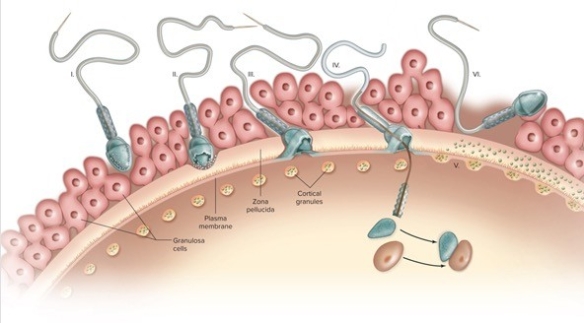
(Multiple Choice)
4.8/5 (64)
(64) What is the first milk that is produced after birth called?
(Multiple Choice)
4.8/5 (80)
(80) In 1998,researchers found that genes similar to the Drosophila gene tinman are necessary for heart development in vertebrates.What can you conclude about the ancient bilaterian ancestor of insects and vertebrates over 500 million years ago?
(Multiple Choice)
4.8/5 (78)
(78) What would result if a defect in gastrulation caused too little mesoderm inside the embryo?
(Multiple Choice)
4.8/5 (72)
(72) 400 micrograms a day of folic acid are recommended for all women of child-bearing age.Folic acid helps prevent neural tube defects in the first weeks of pregnancy,before most women even realize they are pregnant (and almost half of pregnancies in the U.S.are unintended).Knowing that folic acid promotes proper neural tube closure,which disease can be prevented by this supplement?
(Multiple Choice)
4.8/5 (68)
(68) In blind cave fish,eyes do not form.However,transplantation of the lens from a closely-related aboveground fish into the optic cup of the cave fish induces eye development.What does this suggest about the loss of vision in the cave fish?
(Multiple Choice)
4.9/5 (84)
(84) Which of the following animals undergoes rotational cleavage?
(Multiple Choice)
4.8/5 (92)
(92) What basic developmental challenge is solved by the organizer?
(Multiple Choice)
5.0/5 (67)
(67) What can you conclude about a species heavily reliant on diffusible morphogens in early development?
(Multiple Choice)
4.9/5 (70)
(70) Certain groups of cells move inward from the surface of the blastula in a carefully orchestrated migration called
(Multiple Choice)
4.9/5 (79)
(79) A couple conceives at the beginning of January.During which month will their child be undergoing organogenesis?
(Multiple Choice)
4.8/5 (81)
(81) Choose the letter of the best match from the following:
-The limbs,tail bud,and internal organs form.
(Multiple Choice)
4.8/5 (88)
(88) You are studying the development of a poorly-understood species at the 8-cell stage.You use a laser to zap away a certain one of the eight cells,and discover that part of the gut is missing once the embryos finish development.Your colleague,who is working on a different species,uses the laser to blast away one of the cells in her embryos,zapping each of the possible cells in a set of eight experiments.However,when the embryos finish development,every one is perfectly normal! What can you conclude about the two species?
(Multiple Choice)
4.8/5 (62)
(62) 
Filters
- Essay(0)
- Multiple Choice(0)
- Short Answer(0)
- True False(0)
- Matching(0)