



 Chat with AI
Exam 23: Systematics,phylogenies,and Comparative Biology

Exam 1: The Science of Biology58 Questions
Exam 2: The Nature of Molecules and the Properties of Water76 Questions
Exam 3: The Chemical Building Blocks of Life74 Questions
Exam 4: Cell Structure63 Questions
Exam 5: Membranes76 Questions
Exam 6: Energy and Metabolism53 Questions
Exam 7: How Cells Harvest Energy59 Questions
Exam 8: Photosynthesis67 Questions
Exam 9: Cell Communication45 Questions
Exam 10: How Cells Divide62 Questions
Exam 11: Sexual Reproduction and Meiosis53 Questions
Exam 12: Patterns of Inheritance64 Questions
Exam 13: Chromosomes, mapping, and the Meiosisinheritance Connection58 Questions
Exam 14: Dna: the Genetic Material68 Questions
Exam 15: Genes and How They Work79 Questions
Exam 16: Control of Gene Expression62 Questions
Exam 17: Biotechnology48 Questions
Exam 18: Genomics52 Questions
Exam 19: Cellular Mechanisms of Development56 Questions
Exam 20: Genes Within Populations78 Questions
Exam 21: The Evidence for Evolution65 Questions
Exam 22: The Origin of Species67 Questions
Exam 23: Systematics,phylogenies,and Comparative Biology67 Questions
Exam 24: Genome Evolution54 Questions
Exam 25: The Origin and Diversity of Life35 Questions
Exam 26: Viruses62 Questions
Exam 27: Prokaryotes61 Questions
Exam 28: Protists55 Questions
Exam 29: Seedless Plants44 Questions
Exam 30: Seed Plants36 Questions
Exam 31: Fungi63 Questions
Exam 32: Animal Diversity and the Evolution of Body Plans42 Questions
Exam 33: Protostomes79 Questions
Exam 34: Deuterostomes83 Questions
Exam 35: Plant Form55 Questions
Exam 36: Transport in Plants51 Questions
Exam 37: Plant Nutrition and Soils47 Questions
Exam 38: Plant Defense Responses42 Questions
Exam 39: Sensory Systems in Plants50 Questions
Exam 40: Plant Reproduction86 Questions
Exam 41: The Animal Body and Principles of Regulation75 Questions
Exam 42: The Nervous System78 Questions
Exam 43: Sensory Systems88 Questions
Exam 44: The Endocrine System87 Questions
Exam 45: The Musculoskeletal System57 Questions
Exam 46: The Digestive System59 Questions
Exam 47: The Respiratory System54 Questions
Exam 48: The Circulatory System53 Questions
Exam 49: Osmotic Regulation and the Urinary System46 Questions
Exam 50: The Immune System49 Questions
Exam 51: The Reproductive System79 Questions
Exam 52: Animal Development69 Questions
Exam 53: Behavioral Biology91 Questions
Exam 54: Ecology of Individuals and Populations69 Questions
Exam 55: Community Ecology59 Questions
Exam 56: Dynamics of Ecosystems48 Questions
Exam 57: The Biosphere and Human Impacts41 Questions
Exam 58: Conservation Biology49 Questions
Select questions type


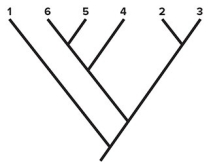 -Consider the cladogram shown.Which pair of species shares the greatest number of derived characters (synapomorphies)?
Free
(Multiple Choice)
5.0/5  (75)
(75) Correct Answer: Verified
C
Parental care in dinosaurs,crocodiles,and birds is an example of
Free
(Multiple Choice)
4.8/5 (68)
(68) Correct Answer:Verified
VerifiedE
The following are steps used to construct a cladogram that best reflects the evolutionary relationships of a group of species.Which step involves deciding which tree is most likely to have occurred,based on the fewest character state changes?
Free
(Multiple Choice)
4.9/5 (60)
(60) Correct Answer:Verified
VerifiedD
Characteristics between the branch points of a cladogram that are shared by all organisms above the branch point and are not present in any below it are called
(Multiple Choice)
4.8/5 (76)
(76) A derived character that is shared by all members of a clade is called a ________ of that clade.
(Short Answer)
4.8/5 (80)
(80) The biological specialty that deals with the grouping and naming of organisms is called taxonomy or ________.
(Short Answer)
4.9/5 (76)
(76) Indicate the phylogenies that show the same relationship as the phylogeny above (Select all that apply).
(Multiple Choice)
4.8/5 (67)
(67) 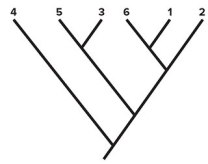 -Consider the cladogram shown.Which pair of species shares the greatest number of derived characters (synapomorphies)?
 (Multiple Choice)
4.7/5 (81)
(81) Character states shared by the ancestor or outgroup of a clade are called
(Multiple Choice)
4.8/5 (90)
(90) Saber teeth found in different groups of extinct carnivorous mammals are considered ________ structures,as the fossil record shows that saber teeth evolved independently among the groups.
(Short Answer)
4.9/5 (81)
(81) 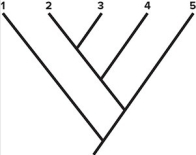 -Based on the phylogeny shown,the outgroup would be species
 (Multiple Choice)
4.9/5 (79)
(79) 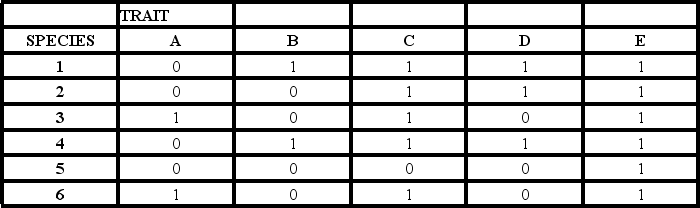 -The table shows the distribution of traits (A-E)in six extant species (1-6).A "0" indicates the ancestral condition,and a "1" indicates the derived condition.Which species would you designate as the outgroup?
 (Multiple Choice)
4.8/5 (75)
(75) Select the true statements describing why cladistics may not always be the best method for reconstructing phylogenies based on data from the DNA genome.
(Multiple Choice)
4.7/5 (76)
(76) Based on the phylogeny shown,which characteristic is homoplastic?
(Multiple Choice)
5.0/5 (80)
(80) Based on the phylogeny shown,indicate the groups that are monophyletic (Select all that apply).
(Multiple Choice)
4.9/5 (74)
(74) The evolution of saber teeth in a number of groups of extinct carnivorous mammals is an example of
(Multiple Choice)
4.8/5 (86)
(86) 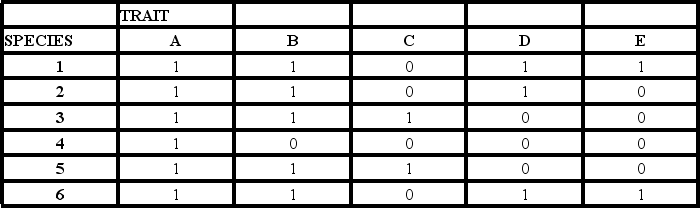 -The table shows the distribution of traits (A-E)in six extant species (1-6).A "0" indicates the ancestral condition,while "1" indicates the derived condition.Which trait is least informative of phylogenetic relationships within the group?
 (Multiple Choice)
4.9/5 (82)
(82) The principle of ________ favors the hypothesis that requires the fewest assumptions.
(Short Answer)
4.9/5 (80)
(80) Systematists often use DNA sequencing in ________,the study of the order of evolutionary events within a group sharing derived characters.
(Short Answer)
4.9/5 (75)
(75) 
Filters
- Essay(0)
- Multiple Choice(0)
- Short Answer(0)
- True False(0)
- Matching(0)