



 Chat with AI
Exam 23: Systematics,phylogenies,and Comparative Biology

Exam 1: The Science of Biology58 Questions
Exam 2: The Nature of Molecules and the Properties of Water76 Questions
Exam 3: The Chemical Building Blocks of Life74 Questions
Exam 4: Cell Structure63 Questions
Exam 5: Membranes76 Questions
Exam 6: Energy and Metabolism53 Questions
Exam 7: How Cells Harvest Energy59 Questions
Exam 8: Photosynthesis67 Questions
Exam 9: Cell Communication45 Questions
Exam 10: How Cells Divide62 Questions
Exam 11: Sexual Reproduction and Meiosis53 Questions
Exam 12: Patterns of Inheritance64 Questions
Exam 13: Chromosomes, mapping, and the Meiosisinheritance Connection58 Questions
Exam 14: Dna: the Genetic Material68 Questions
Exam 15: Genes and How They Work79 Questions
Exam 16: Control of Gene Expression62 Questions
Exam 17: Biotechnology48 Questions
Exam 18: Genomics52 Questions
Exam 19: Cellular Mechanisms of Development56 Questions
Exam 20: Genes Within Populations78 Questions
Exam 21: The Evidence for Evolution65 Questions
Exam 22: The Origin of Species67 Questions
Exam 23: Systematics,phylogenies,and Comparative Biology67 Questions
Exam 24: Genome Evolution54 Questions
Exam 25: The Origin and Diversity of Life35 Questions
Exam 26: Viruses62 Questions
Exam 27: Prokaryotes61 Questions
Exam 28: Protists55 Questions
Exam 29: Seedless Plants44 Questions
Exam 30: Seed Plants36 Questions
Exam 31: Fungi63 Questions
Exam 32: Animal Diversity and the Evolution of Body Plans42 Questions
Exam 33: Protostomes79 Questions
Exam 34: Deuterostomes83 Questions
Exam 35: Plant Form55 Questions
Exam 36: Transport in Plants51 Questions
Exam 37: Plant Nutrition and Soils47 Questions
Exam 38: Plant Defense Responses42 Questions
Exam 39: Sensory Systems in Plants50 Questions
Exam 40: Plant Reproduction86 Questions
Exam 41: The Animal Body and Principles of Regulation75 Questions
Exam 42: The Nervous System78 Questions
Exam 43: Sensory Systems88 Questions
Exam 44: The Endocrine System87 Questions
Exam 45: The Musculoskeletal System57 Questions
Exam 46: The Digestive System59 Questions
Exam 47: The Respiratory System54 Questions
Exam 48: The Circulatory System53 Questions
Exam 49: Osmotic Regulation and the Urinary System46 Questions
Exam 50: The Immune System49 Questions
Exam 51: The Reproductive System79 Questions
Exam 52: Animal Development69 Questions
Exam 53: Behavioral Biology91 Questions
Exam 54: Ecology of Individuals and Populations69 Questions
Exam 55: Community Ecology59 Questions
Exam 56: Dynamics of Ecosystems48 Questions
Exam 57: The Biosphere and Human Impacts41 Questions
Exam 58: Conservation Biology49 Questions
Select questions type


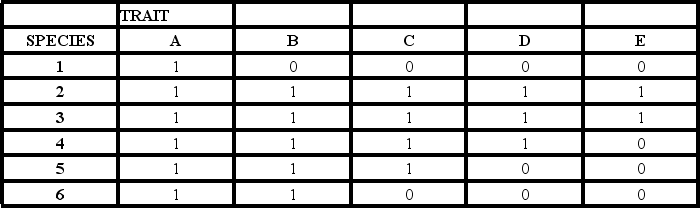 -The table shows the distribution of traits (A-E)in six extant species (1-6).A "0" indicates the ancestral condition,while a "1" indicates the derived condition.Which trait is represented by the greatest number of plesiomorphies?
 (Multiple Choice)
4.9/5  (77)
(77) 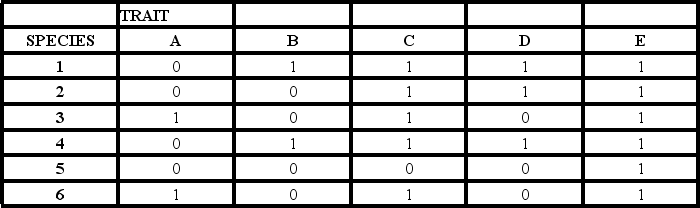 -The table shows the distribution of traits (A-E)in six extant species (1-6).A "0" indicates the ancestral condition,and a "1" indicates the derived condition.Which pair of species shares the greatest number of derived characters (synapomorphies)?
 (Multiple Choice)
4.8/5 (88)
(88) A ________ group does not contain the most recent common ancestor.
(Short Answer)
4.9/5 (80)
(80) The figure shows a cladogram of direct development versus development of a larval stage.Choose the true statements about the evolution of development in limpets. 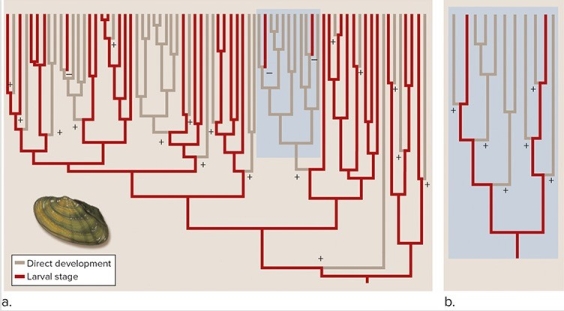
(Multiple Choice)
4.8/5 (81)
(81) The figure shows the evolutionary diversification of the largest clade of herbivorous beetles with the group of plants on which they specialize.Choose the true statements about the evolution of species richness in herbivorous beetles. 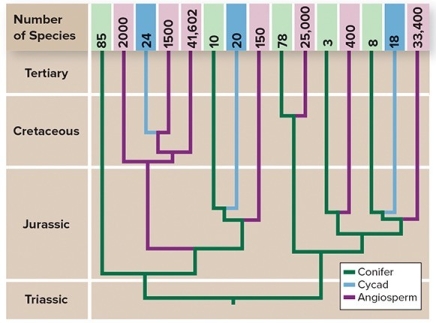
(Multiple Choice)
4.8/5 (63)
(63) 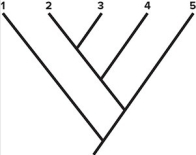 -Based on the phylogeny shown,we can conclude that species 2 is most closely related to species
 (Multiple Choice)
4.8/5 (86)
(86) The evolution of conducting tubes (sieve tubes)in land plants and brown algae is an example of
(Multiple Choice)
4.8/5 (78)
(78) 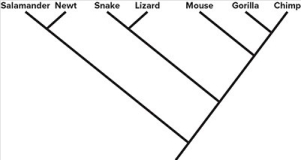 -Based on the phylogeny shown,choose the true statements about evolutionary relationships (Select all that apply).
 (Multiple Choice)
4.8/5 (88)
(88) 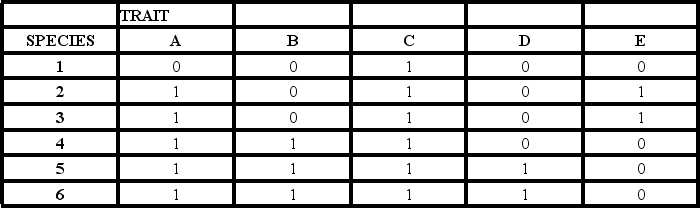 -The table shows the distribution of traits (A-E)in six extant species (1-6).A "0" indicates the ancestral condition,and a "1" indicates the derived condition.Which pair of species shares the fewest number of derived characters (synapomorphies)?
 (Multiple Choice)
4.8/5 (96)
(96) The biological specialty that deals with the reconstruction and study of phylogenies is called ________.
(Short Answer)
4.9/5 (75)
(75)
-The table shows the distribution of traits (A-E)in six extant species (1-6).A "0" indicates the ancestral condition,while a "1" indicates the derived condition.Based on this data,which pair of species diverged most recently?
-The table shows the distribution of traits (A-E)in six extant species (1-6).A "0" indicates the ancestral condition,while a "1" indicates the derived condition.Based on this data,which pair of species diverged most recently? (Multiple Choice)
4.9/5 (74)
(74)
-The table shows the distribution of traits (A-E)in six extant species (1-6).A "0" indicates the ancestral condition,and a "1" indicates the derived condition.Which trait is least informative of phylogenetic relationships within the group?
-The table shows the distribution of traits (A-E)in six extant species (1-6).A "0" indicates the ancestral condition,and a "1" indicates the derived condition.Which trait is least informative of phylogenetic relationships within the group? (Multiple Choice)
4.8/5 (85)
(85) 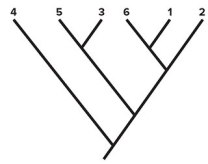 -Consider the cladogram shown.Based on this cladogram,which species has the greatest number of ancestral character states?
 (Multiple Choice)
4.9/5 (67)
(67) Choose the true statement about the morphological data in the chart shown below.The "1" in the box means the trait is present and the "0" indicates that the trait is absent.(Note: All of the characteristics across the top of the columns are considered "TRAITS" for purposes of reading the chart.). 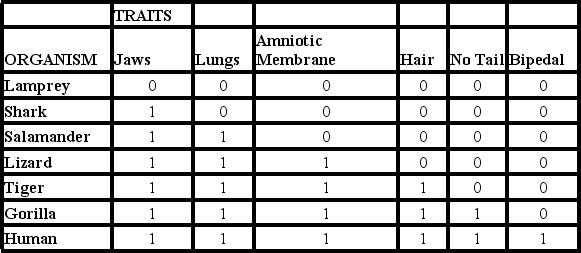
(Multiple Choice)
4.9/5 (84)
(84) Choose the true statements about the evolution of complex characters,such as powered flight.
(Multiple Choice)
4.8/5 (84)
(84) A ________ group consists of the most recent common ancestor and all of its descendants.
(Short Answer)
4.8/5 (78)
(78) The behavior of parental care exhibited by dinosaurs is thought to be ________ to this behavior in crocodiles and birds because phylogeny shows that these three groups share a common ancestor.
(Short Answer)
4.9/5 (73)
(73) Select all of the following that can result in homoplasies.
(Multiple Choice)
4.7/5 (73)
(73)
-The table shows the distribution of traits (A-E)in six extant species (1-6).A "0" indicates the ancestral condition,and a "1" indicates the derived condition.Which trait is least informative of phylogenetic relationships within the group?
-The table shows the distribution of traits (A-E)in six extant species (1-6).A "0" indicates the ancestral condition,and a "1" indicates the derived condition.Which trait is least informative of phylogenetic relationships within the group? (Multiple Choice)
4.8/5 (76)
(76) 
Filters
- Essay(0)
- Multiple Choice(0)
- Short Answer(0)
- True False(0)
- Matching(0)