



 Chat with AI
Exam 22: The Respiratory System

Exam 1: The Human Body: an Orientation110 Questions
Exam 2: Cells: the Living Units108 Questions
Exam 3: Basic Embryology112 Questions
Exam 4: Tissues110 Questions
Exam 5: The Integumentary System109 Questions
Exam 6: Bones and Skeletal Tissues108 Questions
Exam 7: Bones, Part 1: the Axial Skeleton110 Questions
Exam 8: Bones, Part 2: the Appendicular Skeleton113 Questions
Exam 9: Joints110 Questions
Exam 10: Skeletal Muscle Tissue110 Questions
Exam 11: Muscles of the Body160 Questions
Exam 12: Fundamentals of the Nervous System and Nervous Tissue112 Questions
Exam 13: The Central Nervous System109 Questions
Exam 14: The Peripheral Nervous System114 Questions
Exam 15: The Autonomic Nervous System and Visceral Sensory Neurons110 Questions
Exam 16: The Special Senses114 Questions
Exam 17: The Endocrine System115 Questions
Exam 18: Blood110 Questions
Exam 19: The Heart114 Questions
Exam 20: Blood Vessels113 Questions
Exam 21: The Lymphatic and Immune Systems115 Questions
Exam 22: The Respiratory System110 Questions
Exam 23: The Digestive System113 Questions
Exam 24: The Urinary System112 Questions
Exam 25: The Reproductive System116 Questions
Select questions type


Which of the following is not a function of the nasal conchae?
(Multiple Choice)
4.8/5  (80)
(80) Type II alveolar cells produce surfactant to keep the walls of the alveoli from collapsing or adhering together.
(True/False)
4.8/5 (85)
(85) The pleural cavities extend two ribs below the inferior border of the lungs.
(True/False)
4.7/5 (79)
(79) The vocal ligaments are attached between the cricoid and arytenoid cartilages.
(True/False)
4.9/5 (88)
(88) 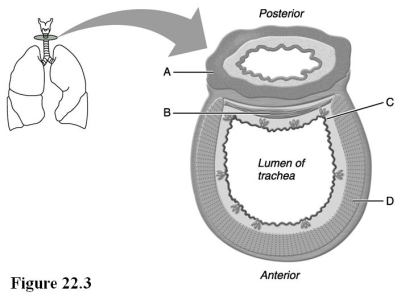 Use the diagram above to answer the following questions.
-Identify the letter that indicates the fibromusculocartilaginous layer with hyaline cartilaginous rings that allow the trachea to bend and elongate but not collapse.
Use the diagram above to answer the following questions.
-Identify the letter that indicates the fibromusculocartilaginous layer with hyaline cartilaginous rings that allow the trachea to bend and elongate but not collapse. (Multiple Choice)
4.9/5 (74)
(74) Some bronchi have names such as the "right upper-lobe bronchus," "left lower-lobe bronchus," and "right middle-lobe bronchus." These are ________ bronchi.
(Multiple Choice)
4.9/5 (68)
(68) The ________ tonsils, or adenoids, are located on the wall of the nasopharynx.
(Short Answer)
4.8/5 (74)
(74) The only laryngeal cartilage to form a complete ring is the cuneiform.
(True/False)
4.9/5 (88)
(88) Anatomical region of the nasal cavity containing nose hairs.
(Multiple Choice)
4.9/5 (86)
(86) Gas exchange occurs across the bronchi, bronchioles, and terminal bronchioles.
(True/False)
4.8/5 (92)
(92) The ________ intercostal muscles are involved in (forced) expiration.
(Short Answer)
4.7/5 (85)
(85) In a preserved cadaver, the first rib is likely to form a groove on which surface of the lung?
(Multiple Choice)
4.8/5 (72)
(72) Use the diagram above to answer the following questions.
-Identify the letter that indicates the trachealis muscle.
Use the diagram above to answer the following questions.
-Identify the letter that indicates the trachealis muscle. (Multiple Choice)
4.9/5 (82)
(82) Most foreign substances in inspired air fail to reach the lungs because of the
(Multiple Choice)
4.8/5 (79)
(79) The subdivisions of the lung from largest to smallest are the lobe, the segment, the ________, the alveolus.
(Short Answer)
4.8/5 (71)
(71) The respiratory mucosa is present throughout each of the following areas except the
(Multiple Choice)
4.8/5 (90)
(90) 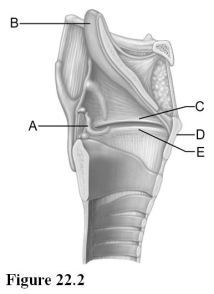 Use the diagram above to answer the following questions.
-Identify the letter that indicates the vestibular fold, or false vocal cord.
Use the diagram above to answer the following questions.
-Identify the letter that indicates the vestibular fold, or false vocal cord. (Multiple Choice)
4.8/5 (82)
(82) The trachea, bronchi, and bronchioles are all located within the lungs.
(True/False)
5.0/5 (70)
(70) 
Filters
- Essay(0)
- Multiple Choice(0)
- Short Answer(0)
- True False(0)
- Matching(0)