



 Chat with AI
Exam 22: The Respiratory System

Exam 1: The Human Body: an Orientation110 Questions
Exam 2: Cells: the Living Units108 Questions
Exam 3: Basic Embryology112 Questions
Exam 4: Tissues110 Questions
Exam 5: The Integumentary System109 Questions
Exam 6: Bones and Skeletal Tissues108 Questions
Exam 7: Bones, Part 1: the Axial Skeleton110 Questions
Exam 8: Bones, Part 2: the Appendicular Skeleton113 Questions
Exam 9: Joints110 Questions
Exam 10: Skeletal Muscle Tissue110 Questions
Exam 11: Muscles of the Body160 Questions
Exam 12: Fundamentals of the Nervous System and Nervous Tissue112 Questions
Exam 13: The Central Nervous System109 Questions
Exam 14: The Peripheral Nervous System114 Questions
Exam 15: The Autonomic Nervous System and Visceral Sensory Neurons110 Questions
Exam 16: The Special Senses114 Questions
Exam 17: The Endocrine System115 Questions
Exam 18: Blood110 Questions
Exam 19: The Heart114 Questions
Exam 20: Blood Vessels113 Questions
Exam 21: The Lymphatic and Immune Systems115 Questions
Exam 22: The Respiratory System110 Questions
Exam 23: The Digestive System113 Questions
Exam 24: The Urinary System112 Questions
Exam 25: The Reproductive System116 Questions
Select questions type


Describe the anatomical changes to the larynx that account for the deeper voice of men compared to women.
(Essay)
4.9/5  (81)
(81) The detergent-like molecule that keeps the alveoli from collapsing between breaths is called
(Multiple Choice)
4.8/5 (83)
(83) Which of these does not act as a protective mechanism in the respiratory system?
(Multiple Choice)
4.7/5 (80)
(80) 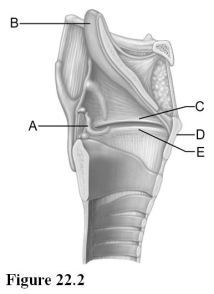 Use the diagram above to answer the following questions.
-Identify the letter that indicates the cartilage that anchors the vocal cords posteriorly.
Use the diagram above to answer the following questions.
-Identify the letter that indicates the cartilage that anchors the vocal cords posteriorly. (Multiple Choice)
4.8/5 (67)
(67) The ability to vary the pitch of the voice results from varying
(Multiple Choice)
4.8/5 (87)
(87) Which of the following changes does not occur as the conducting tubes of the respiratory tree become smaller?
(Multiple Choice)
4.9/5 (83)
(83) Which part of the nose is composed of dense fibrous connective tissue?
(Multiple Choice)
4.9/5 (86)
(86) In the wall of the trachea and bronchi, the cartilage rings lie within which tissue layer?
(Multiple Choice)
4.9/5 (86)
(86) Which of the following us true about the lungs in elderly individuals?
(Multiple Choice)
4.8/5 (78)
(78) These are peripheral chemoreceptors that monitor changes in respiratory gasses and blood acidity levels.
(Multiple Choice)
4.7/5 (80)
(80) Supportive cartilage disappears from the bronchial tree at the level of the
(Multiple Choice)
4.8/5 (68)
(68) When the diaphragm contracts, it raises the floor of the thoracic cavity upward.
(True/False)
4.9/5 (75)
(75) The region of the lung served by secondary, or lobar, bronchi.
(Multiple Choice)
4.9/5 (67)
(67) The main function of the elaborate venous plexus in the nasal mucosa is
(Multiple Choice)
4.9/5 (75)
(75) 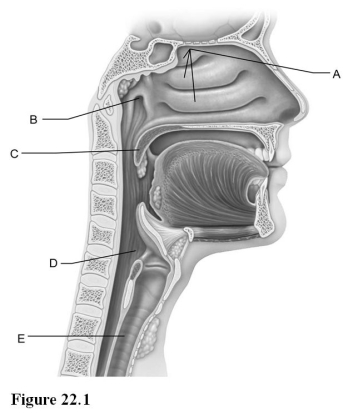 Use the diagram above to answer the following questions.
-Identify the letter that indicates structures that assist in filtering, heating, and humidifying inspired air.
Use the diagram above to answer the following questions.
-Identify the letter that indicates structures that assist in filtering, heating, and humidifying inspired air. (Multiple Choice)
4.7/5 (84)
(84) The lobes of a lung are easy to recognize and distinguish from one another because
(Multiple Choice)
4.9/5 (85)
(85) 
Filters
- Essay(0)
- Multiple Choice(0)
- Short Answer(0)
- True False(0)
- Matching(0)