



 Chat with AI
Exam 18: Blood

Exam 1: The Human Body: an Orientation110 Questions
Exam 2: Cells: the Living Units108 Questions
Exam 3: Basic Embryology112 Questions
Exam 4: Tissues110 Questions
Exam 5: The Integumentary System109 Questions
Exam 6: Bones and Skeletal Tissues108 Questions
Exam 7: Bones, Part 1: the Axial Skeleton110 Questions
Exam 8: Bones, Part 2: the Appendicular Skeleton113 Questions
Exam 9: Joints110 Questions
Exam 10: Skeletal Muscle Tissue110 Questions
Exam 11: Muscles of the Body160 Questions
Exam 12: Fundamentals of the Nervous System and Nervous Tissue112 Questions
Exam 13: The Central Nervous System109 Questions
Exam 14: The Peripheral Nervous System114 Questions
Exam 15: The Autonomic Nervous System and Visceral Sensory Neurons110 Questions
Exam 16: The Special Senses114 Questions
Exam 17: The Endocrine System115 Questions
Exam 18: Blood110 Questions
Exam 19: The Heart114 Questions
Exam 20: Blood Vessels113 Questions
Exam 21: The Lymphatic and Immune Systems115 Questions
Exam 22: The Respiratory System110 Questions
Exam 23: The Digestive System113 Questions
Exam 24: The Urinary System112 Questions
Exam 25: The Reproductive System116 Questions
Select questions type


All of the following are true regarding the anatomy of red bone marrow except

Free
(Multiple Choice)
4.7/5  (73)
(73) Correct Answer: Verified
D
Plasma minus clotting factors is called ________.
Free
(Short Answer)
4.8/5 (91)
(91) Correct Answer:Verified
Verifiedserum
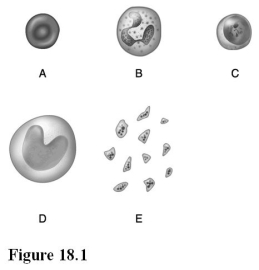 Use the diagram above to answer the following questions.
-Identify the letter that indicates the most abundant class of leukocyte.
Use the diagram above to answer the following questions.
-Identify the letter that indicates the most abundant class of leukocyte.Free
(Multiple Choice)
4.8/5 (72)
(72) Correct Answer:Verified
VerifiedB
The formed element that is flattened, circular, lacks a nucleus, lacks mitochondria or ribosomes, and is red because of the presence of hemoglobin is
(Multiple Choice)
5.0/5 (79)
(79) 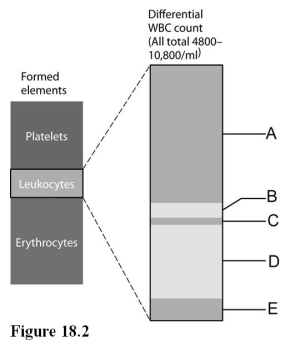 Use the diagram above to answer the following questions.
-Identify the letter that indicates the fraction of leukocytes that represents basophils.
Use the diagram above to answer the following questions.
-Identify the letter that indicates the fraction of leukocytes that represents basophils. (Multiple Choice)
4.7/5 (84)
(84) Giant cells located just outside of marrow sinusoids are called
(Multiple Choice)
4.9/5 (89)
(89) Which of the following groups of cells are most structurally related?
(Multiple Choice)
4.7/5 (75)
(75) Leukocytes can exit the blood vessels through a process called ________.
(Short Answer)
4.8/5 (80)
(80) Use the diagram above to answer the following questions.
-Identify the letter that indicates the formed element of the blood that is packed with molecules of hemoglobin.
Use the diagram above to answer the following questions.
-Identify the letter that indicates the formed element of the blood that is packed with molecules of hemoglobin. (Multiple Choice)
4.9/5 (68)
(68) Which of the following organs does not form blood cells in the fetus?
(Multiple Choice)
4.9/5 (88)
(88) Use the diagram above to answer the following questions.
-Identify the letter that indicates the fraction of leukocytes that represents eosinophils.
Use the diagram above to answer the following questions.
-Identify the letter that indicates the fraction of leukocytes that represents eosinophils. (Multiple Choice)
4.7/5 (82)
(82) ________ are cell fragments that initiate a blood clot formed of blood cells trapped in a network of fibrin protein.
(Short Answer)
4.8/5 (63)
(63) Which of the following statements concerning the various leukocytes is false?
(Multiple Choice)
4.9/5 (78)
(78) Platelets are cell fragments arising from megakaryocytes located just outside the sinusoids.
(True/False)
4.9/5 (76)
(76) In the differentiating cell line that leads to neutrophils, which of the following events occurs?
(Multiple Choice)
4.7/5 (85)
(85) Cell fragments, also called thrombocytes, involved in clotting are called
(Multiple Choice)
4.7/5 (81)
(81) 
Filters
- Essay(0)
- Multiple Choice(0)
- Short Answer(0)
- True False(0)
- Matching(0)