



 Chat with AI
Exam 18: Blood

Exam 1: The Human Body: an Orientation110 Questions
Exam 2: Cells: the Living Units108 Questions
Exam 3: Basic Embryology112 Questions
Exam 4: Tissues110 Questions
Exam 5: The Integumentary System109 Questions
Exam 6: Bones and Skeletal Tissues108 Questions
Exam 7: Bones, Part 1: the Axial Skeleton110 Questions
Exam 8: Bones, Part 2: the Appendicular Skeleton113 Questions
Exam 9: Joints110 Questions
Exam 10: Skeletal Muscle Tissue110 Questions
Exam 11: Muscles of the Body160 Questions
Exam 12: Fundamentals of the Nervous System and Nervous Tissue112 Questions
Exam 13: The Central Nervous System109 Questions
Exam 14: The Peripheral Nervous System114 Questions
Exam 15: The Autonomic Nervous System and Visceral Sensory Neurons110 Questions
Exam 16: The Special Senses114 Questions
Exam 17: The Endocrine System115 Questions
Exam 18: Blood110 Questions
Exam 19: The Heart114 Questions
Exam 20: Blood Vessels113 Questions
Exam 21: The Lymphatic and Immune Systems115 Questions
Exam 22: The Respiratory System110 Questions
Exam 23: The Digestive System113 Questions
Exam 24: The Urinary System112 Questions
Exam 25: The Reproductive System116 Questions
Select questions type


For the majority of fetal development, blood formation occurs primarily in the ________ and later in the bone marrow.
(Short Answer)
4.9/5  (87)
(87) Which of the following is true regarding T cells and B cells?
(Multiple Choice)
4.7/5 (83)
(83) The presence of dark purple-stained granules along with a two-lobed nucleus is indicative of a(n) ________.
(Short Answer)
4.9/5 (93)
(93) 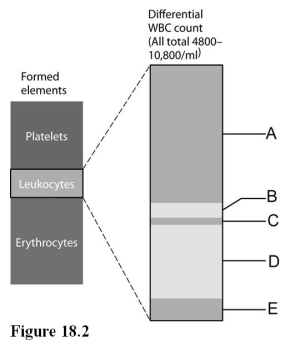 Use the diagram above to answer the following questions.
-Identify the letter that indicates the fraction that of leukocytes that represents monocytes.
Use the diagram above to answer the following questions.
-Identify the letter that indicates the fraction that of leukocytes that represents monocytes. (Multiple Choice)
4.9/5 (81)
(81) All of the following cell types are derived from the same precursor cell that generates neutrophils except the
(Multiple Choice)
4.8/5 (84)
(84) During embryonic development, blood cells form in the ________ of the yolk sac.
(Short Answer)
4.9/5 (86)
(86) All granulocytes have lobed nuclei and are phagocytic in function.
(True/False)
4.8/5 (82)
(82) Explain how platelets are involved in stopping blood flow through a wound.
(Essay)
4.8/5 (90)
(90) Along with leukocytes, these contribute less than 1% of whole blood.
(Multiple Choice)
5.0/5 (77)
(77) In adults, red bone marrow occurs in the skull, girdles, and diaphysis of the long bones.
(True/False)
4.8/5 (90)
(90) Use the diagram above to answer the following questions.
-Identify the letter that indicates the fraction of leukocytes that represents lymphocytes.
Use the diagram above to answer the following questions.
-Identify the letter that indicates the fraction of leukocytes that represents lymphocytes. (Multiple Choice)
4.7/5 (78)
(78) Blood clots are formed when cells become trapped among a tangle of the activated plasma protein ________ along with other clotting factors.
(Short Answer)
4.8/5 (78)
(78) Use the diagram above to answer the following questions.
-Identify the letter that indicates the fraction of leukocytes that represents neutrophils.
Use the diagram above to answer the following questions.
-Identify the letter that indicates the fraction of leukocytes that represents neutrophils. (Multiple Choice)
4.8/5 (83)
(83) Which of the following is not a committed cell in a blood cell line?
(Multiple Choice)
5.0/5 (83)
(83) 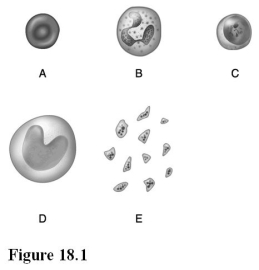 Use the diagram above to answer the following questions.
-Identify the letter that indicates formed elements of the blood that are important in blood clotting.
Use the diagram above to answer the following questions.
-Identify the letter that indicates formed elements of the blood that are important in blood clotting. (Multiple Choice)
5.0/5 (71)
(71) Erythrocytes eject their nuclei and other organelles prior to maturity.
(True/False)
4.9/5 (83)
(83) In the cell line that forms erythrocytes in red bone marrow, all of the following occur except that
(Multiple Choice)
4.7/5 (76)
(76) 
Filters
- Essay(0)
- Multiple Choice(0)
- Short Answer(0)
- True False(0)
- Matching(0)