



 Chat with AI
Exam 19: International Monetary Systems: an Historical Overview

Exam 1: Introduction37 Questions
Exam 2: World Trade: an Overview18 Questions
Exam 3: Labor Productivity and Comparative Advantage: the Ricardian Model47 Questions
Exam 4: Specific Factors and Income Distribution62 Questions
Exam 5: Resources and Trade: the Heckscher-Ohlin Model66 Questions
Exam 6: The Standard Trade Model45 Questions
Exam 7: External Economies of Scale and the International Location of Production37 Questions
Exam 8: Firms in the Global Economy: Export Decisions, Outsourcing, and Multinational Enterprises69 Questions
Exam 9: The Instruments of Trade Policy71 Questions
Exam 10: The Political Economy of Trade Policy57 Questions
Exam 11: Trade Policy in Developing Countries33 Questions
Exam 12: Controversies in Trade Policy46 Questions
Exam 13: National Income Accounting and the Balance of Payments72 Questions
Exam 14: Exchange Rates and the Foreign Exchange Market: an Asset Approach74 Questions
Exam 15: Money, Interest Rates, and Exchange Rates65 Questions
Exam 16: Price Levels and the Exchange Rate in the Long Run79 Questions
Exam 17: Output and the Exchange Rate in the Short Run114 Questions
Exam 18: Fixed Exchange Rates and Foreign Exchange Intervention80 Questions
Exam 19: International Monetary Systems: an Historical Overview153 Questions
Exam 20: Financial Globalization: Opportunity and Crisis113 Questions
Exam 21: Optimum Currency Areas and the Euro99 Questions
Exam 22: Developing Countries: Growth, Crisis, and Reform112 Questions
Select questions type


Under the Gold standard, a country is said to be in balance of payments equilibrium when the current account balance is
(Multiple Choice)
4.8/5  (75)
(75) The reason that the claim that floating exchange rates result in greater economic autonomy for individual countries may not be entirely accurate is that
(Multiple Choice)
5.0/5 (84)
(84) Refer to the payoff matrix below, which ________ a prisoner's dilemma. If both countries go it alone, Home will choose Policy ________ and Foreign will choose Policy ________. 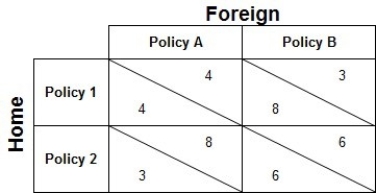
(Multiple Choice)
4.9/5 (88)
(88) Under fixed exchange rates, domestic asset transactions by the central bank
(Multiple Choice)
4.9/5 (78)
(78) Advocates of flexible exchange rates claim that under flexible exchange rates
(Multiple Choice)
4.9/5 (77)
(77) Refer to the graph below. The movement from point 1 to point 2 is stimulated by a disequilibrium in which there is domestic ________ and ________. 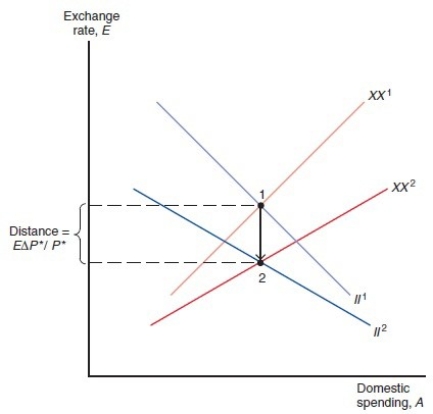
(Multiple Choice)
4.8/5 (85)
(85) The "rules of the game" under the gold standard can best be described as which of the following:
(Multiple Choice)
4.9/5 (85)
(85) The confidence problem of the Bretton Woods systems articulated by Robert Triffin refers to
(Multiple Choice)
4.8/5 (76)
(76) What are the outcomes of the following games, assuming the max-min criteria is used? 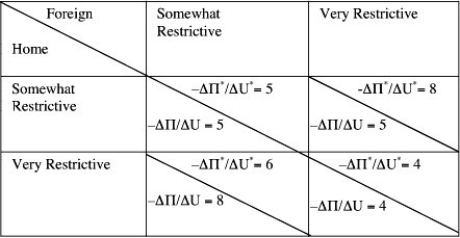
(Essay)
4.7/5 (80)
(80) Under a flexible exchange rate regime, an increase in real money demand
(Multiple Choice)
4.9/5 (88)
(88) An attempt by a central bank to alter the money supply by buying or selling domestic assets
(Multiple Choice)
4.7/5 (88)
(88) "The line distinguishing external from internal goals can be fuzzy." Discuss.
(Essay)
4.8/5 (72)
(72) Due to macroeconomics interdependence between large countries, the effect of a permanent fiscal expansion by Home is as follows: Home output
(Multiple Choice)
4.9/5 (92)
(92) Advocates of flexible exchange rates claim that under flexible exchange rates, a currency
(Multiple Choice)
4.7/5 (75)
(75) Which of the following is one component of the "trilemma" that is faced by policy makers in choosing monetary arrangements?
(Multiple Choice)
4.9/5 (85)
(85) The IMF agreement forced the U.S. to exchange gold for dollars at what price?
(Multiple Choice)
4.7/5 (63)
(63) Refer to the graph below, which shows the effect of ________ on the home economy. 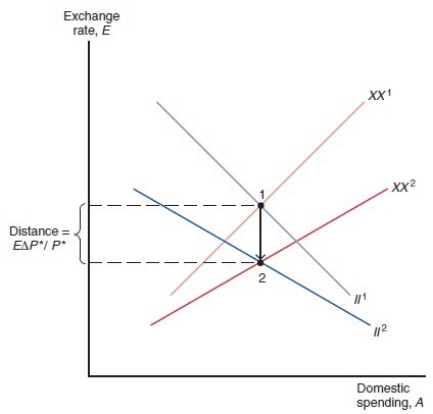
(Multiple Choice)
4.9/5 (102)
(102) Maintaining a fixed exchange rate over the long run is today
(Multiple Choice)
4.7/5 (78)
(78) 
Filters
- Essay(0)
- Multiple Choice(0)
- Short Answer(0)
- True False(0)
- Matching(0)