



 Chat with AI
Exam 19: International Monetary Systems: an Historical Overview

Exam 1: Introduction37 Questions
Exam 2: World Trade: an Overview18 Questions
Exam 3: Labor Productivity and Comparative Advantage: the Ricardian Model47 Questions
Exam 4: Specific Factors and Income Distribution62 Questions
Exam 5: Resources and Trade: the Heckscher-Ohlin Model66 Questions
Exam 6: The Standard Trade Model45 Questions
Exam 7: External Economies of Scale and the International Location of Production37 Questions
Exam 8: Firms in the Global Economy: Export Decisions, Outsourcing, and Multinational Enterprises69 Questions
Exam 9: The Instruments of Trade Policy71 Questions
Exam 10: The Political Economy of Trade Policy57 Questions
Exam 11: Trade Policy in Developing Countries33 Questions
Exam 12: Controversies in Trade Policy46 Questions
Exam 13: National Income Accounting and the Balance of Payments72 Questions
Exam 14: Exchange Rates and the Foreign Exchange Market: an Asset Approach74 Questions
Exam 15: Money, Interest Rates, and Exchange Rates65 Questions
Exam 16: Price Levels and the Exchange Rate in the Long Run79 Questions
Exam 17: Output and the Exchange Rate in the Short Run114 Questions
Exam 18: Fixed Exchange Rates and Foreign Exchange Intervention80 Questions
Exam 19: International Monetary Systems: an Historical Overview153 Questions
Exam 20: Financial Globalization: Opportunity and Crisis113 Questions
Exam 21: Optimum Currency Areas and the Euro99 Questions
Exam 22: Developing Countries: Growth, Crisis, and Reform112 Questions
Select questions type


Economic theory and experience since 1973 indicate that, under floating exchange rates, a country's fiscal and monetary policies in the short run and the long run can
(Multiple Choice)
4.9/5  (81)
(81) Why do governments prefer to avoid excessive current account surpluses? Or, why are growing domestic claims to foreign wealth ever a problem?
(Essay)
4.9/5 (69)
(69) Which one of the following statements is the MOST accurate? By the year 1932, the United States
(Multiple Choice)
4.8/5 (75)
(75) The mechanism behind the inflation insulation provided by a floating exchange rate is
(Multiple Choice)
4.8/5 (78)
(78) Which of the two features of the IMF Articles of Agreement helped promote flexibility in external adjustment?
(Multiple Choice)
4.8/5 (72)
(72) Advocates of flexible exchange rates claim that under flexible exchange rates, if the central bank faced unemployment
(Multiple Choice)
4.7/5 (82)
(82) Which system of interest rates is theoretically worst for policy coordination among the industrial countries of the world? How has this played out since the 1980s?
(Essay)
4.7/5 (74)
(74) Which of the following is NOT a result of a temporary fall in foreign demand on one country's exports under floating exchange rate?
(Multiple Choice)
4.8/5 (84)
(84) Refer to the payoff matrix below, which ________ a prisoner's dilemma. If both countries cooperate, Home will choose Policy ________ and Foreign will choose Policy ________. 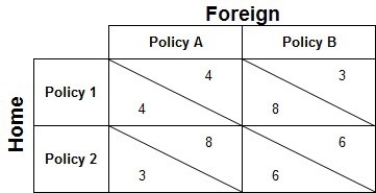
(Multiple Choice)
4.8/5 (85)
(85) Describe the effects of the Smoot-Hawley tariff imposed by the United States in 1930.
(Essay)
4.9/5 (85)
(85) 
Filters
- Essay(0)
- Multiple Choice(0)
- Short Answer(0)
- True False(0)
- Matching(0)