



 Chat with AI
Exam 20: Financial Globalization: Opportunity and Crisis

Exam 1: Introduction37 Questions
Exam 2: World Trade: an Overview18 Questions
Exam 3: Labor Productivity and Comparative Advantage: the Ricardian Model47 Questions
Exam 4: Specific Factors and Income Distribution62 Questions
Exam 5: Resources and Trade: the Heckscher-Ohlin Model66 Questions
Exam 6: The Standard Trade Model45 Questions
Exam 7: External Economies of Scale and the International Location of Production37 Questions
Exam 8: Firms in the Global Economy: Export Decisions, Outsourcing, and Multinational Enterprises69 Questions
Exam 9: The Instruments of Trade Policy71 Questions
Exam 10: The Political Economy of Trade Policy57 Questions
Exam 11: Trade Policy in Developing Countries33 Questions
Exam 12: Controversies in Trade Policy46 Questions
Exam 13: National Income Accounting and the Balance of Payments72 Questions
Exam 14: Exchange Rates and the Foreign Exchange Market: an Asset Approach74 Questions
Exam 15: Money, Interest Rates, and Exchange Rates65 Questions
Exam 16: Price Levels and the Exchange Rate in the Long Run79 Questions
Exam 17: Output and the Exchange Rate in the Short Run114 Questions
Exam 18: Fixed Exchange Rates and Foreign Exchange Intervention80 Questions
Exam 19: International Monetary Systems: an Historical Overview153 Questions
Exam 20: Financial Globalization: Opportunity and Crisis113 Questions
Exam 21: Optimum Currency Areas and the Euro99 Questions
Exam 22: Developing Countries: Growth, Crisis, and Reform112 Questions
Select questions type


What are the types of institution banks used to conduct foreign business?
(Multiple Choice)
4.8/5  (79)
(79) Why is it useful to make a distinction between debt and equity instruments?
(Essay)
4.9/5 (84)
(84) Assume interest parity holds. Calculate  for each of the following cases.
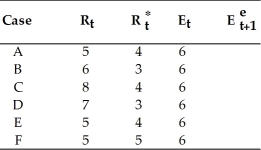
for each of the following cases. (Essay)
4.9/5 (78)
(78) What would best describe the international capital markets?
(Multiple Choice)
4.9/5 (78)
(78) In the Interest Parity Condition, Rt - R  t = (
 - Et)/Et + xt, where Rt - R
 t is the interest rate differential and (
 - Et)/Et is the expected change in the exchange rate, what does xt stand for if it potentially is a market efficient difference between the two?
t = ( - Et)/Et + xt, where Rt - R t is the interest rate differential and ( - Et)/Et is the expected change in the exchange rate, what does xt stand for if it potentially is a market efficient difference between the two? (Multiple Choice)
4.9/5 (71)
(71) Does the interest rate parity hold in each of the following cases? In case it does not hold, calculate the risk premium.
A. Rt = 5,  = 3, Et = 5,
 = 7
B. Rt = 6,
 = 3, Et = 5,
 = 7
C. Rt = 7,
 = 3, Et = 5,
 = 7
D. Rt = 8,
 = 3, Et = 5,
 = 7
E. Rt = 5,
 = 4, Et = 5,
 = 7
F. Rt = 5,
 = 5, Et = 5,
 = 7
G. Rt = 5,
 = 6, Et = 5,
 = 7
H. Rt = 5,
 = 3, Et = 6,
 = 7
I. Rt = 5,
 = 3, Et = 7,
 = 7
J. Rt = 5,
 = 3, Et = 8,
 = 7
K. Rt = 5,
 = 3, Et = 5,
 = 8
L. Rt = 5,
 = 3, Et = 5,
 = 9
M. Rt = 5,
 = 3, Et = 5,
 = 10
= 3, Et = 5, = 7
B. Rt = 6, = 3, Et = 5, = 7
C. Rt = 7, = 3, Et = 5, = 7
D. Rt = 8, = 3, Et = 5, = 7
E. Rt = 5, = 4, Et = 5, = 7
F. Rt = 5, = 5, Et = 5, = 7
G. Rt = 5, = 6, Et = 5, = 7
H. Rt = 5, = 3, Et = 6, = 7
I. Rt = 5, = 3, Et = 7, = 7
J. Rt = 5, = 3, Et = 8, = 7
K. Rt = 5, = 3, Et = 5, = 8
L. Rt = 5, = 3, Et = 5, = 9
M. Rt = 5, = 3, Et = 5, = 10 (Essay)
4.9/5 (84)
(84) Credit Suisse, Goldman Sachs, and Lazard Freres are examples of
(Multiple Choice)
4.7/5 (96)
(96) What is a difficulty encountered in regulating international banking?
(Multiple Choice)
4.8/5 (88)
(88) If you are offered a gamble in which you win 500 dollars 3/8 of the time and you lose 500 dollars 5/8 of the time, what is your expected payoff and your behavior given that you are a risk-lover?
(Multiple Choice)
4.8/5 (76)
(76) Who is the Basel Committee? Discuss both their involvement in the Concordat as well as the role of the Concordat in international banking.
(Essay)
4.8/5 (85)
(85) Suppose one is offered a gamble in which you win $1,000 half the time but lose $1,000 half the time. Since in this case one is as likely to win as to lose the $1,000, the average payoff on this gamble-its expected value-is: 0.5 ∗ $1,000 + 0.5 ∗ (-$1,000) = 0.
Under such circumstances:
(Multiple Choice)
5.0/5 (89)
(89) 
Filters
- Essay(0)
- Multiple Choice(0)
- Short Answer(0)
- True False(0)
- Matching(0)