



 Chat with AI
Exam 20: Financial Globalization: Opportunity and Crisis

Exam 1: Introduction37 Questions
Exam 2: World Trade: an Overview18 Questions
Exam 3: Labor Productivity and Comparative Advantage: the Ricardian Model47 Questions
Exam 4: Specific Factors and Income Distribution62 Questions
Exam 5: Resources and Trade: the Heckscher-Ohlin Model66 Questions
Exam 6: The Standard Trade Model45 Questions
Exam 7: External Economies of Scale and the International Location of Production37 Questions
Exam 8: Firms in the Global Economy: Export Decisions, Outsourcing, and Multinational Enterprises69 Questions
Exam 9: The Instruments of Trade Policy71 Questions
Exam 10: The Political Economy of Trade Policy57 Questions
Exam 11: Trade Policy in Developing Countries33 Questions
Exam 12: Controversies in Trade Policy46 Questions
Exam 13: National Income Accounting and the Balance of Payments72 Questions
Exam 14: Exchange Rates and the Foreign Exchange Market: an Asset Approach74 Questions
Exam 15: Money, Interest Rates, and Exchange Rates65 Questions
Exam 16: Price Levels and the Exchange Rate in the Long Run79 Questions
Exam 17: Output and the Exchange Rate in the Short Run114 Questions
Exam 18: Fixed Exchange Rates and Foreign Exchange Intervention80 Questions
Exam 19: International Monetary Systems: an Historical Overview153 Questions
Exam 20: Financial Globalization: Opportunity and Crisis113 Questions
Exam 21: Optimum Currency Areas and the Euro99 Questions
Exam 22: Developing Countries: Growth, Crisis, and Reform112 Questions
Select questions type


Many observers believe that the largely unregulated nature of global banking activity leaves the world financial system vulnerable to bank failure on a massive scale. Is this a real threat? If so, what measures have governments taken to reduce it?
(Essay)
4.8/5  (85)
(85) Does the interest rate parity hold in each of the following cases? In case it does not hold, calculate the risk premium.
N. Rt = 8,  = 3, Et = 5,
 = 7
O. Rt = 7,
 = 4, Et = 6,
 = 8
P. Rt = 6,
 = 5, Et = 5,
 = 7
Q. Rt = 5,
 = 4, Et = 6,
 = 8
R. Rt = 8,
 = 6, Et = 5,
 = 7
S. Rt = 7,
 = 5, Et = 6,
 = 8
T. Rt = 6,
 = 4, Et = 5,
 = 7
U. Rt = 5,
 = 3, Et = 6,
 = 8
V. Rt = 8,
 = 5, Et = 6,
 = 8
W. Rt = 7,
 = 3, Et = 8,
 = 9
X. Rt = 6,
 = 7, Et = 7,
 = 8
Y. Rt = 5,
 = 6, Et = 5,
 = 9
Z. Rt = 4,
 = 3, Et = 5,
 = 10
= 3, Et = 5, = 7
O. Rt = 7, = 4, Et = 6, = 8
P. Rt = 6, = 5, Et = 5, = 7
Q. Rt = 5, = 4, Et = 6, = 8
R. Rt = 8, = 6, Et = 5, = 7
S. Rt = 7, = 5, Et = 6, = 8
T. Rt = 6, = 4, Et = 5, = 7
U. Rt = 5, = 3, Et = 6, = 8
V. Rt = 8, = 5, Et = 6, = 8
W. Rt = 7, = 3, Et = 8, = 9
X. Rt = 6, = 7, Et = 7, = 8
Y. Rt = 5, = 6, Et = 5, = 9
Z. Rt = 4, = 3, Et = 5, = 10 (Essay)
4.9/5 (73)
(73) Explain the forecast error, ut+1, in terms of:
(1) Its equation (what it is equal to)
(2) How it is used
(3) Its accuracy
(Essay)
4.8/5 (87)
(87) Which type of main institution in the international capital market most often is involved in foreign exchange intervention?
(Multiple Choice)
4.8/5 (76)
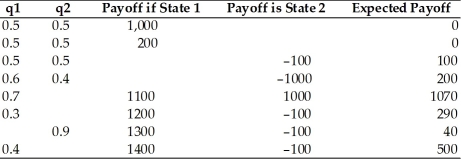
(76) 
Capital markets of poor developing countries that liberalized their financial systems to allow private asset trade with foreigners are called
(Multiple Choice)
4.9/5 (84)
(84) Large differences in interest rates between countries would indicate that
(Multiple Choice)
4.9/5 (81)
(81) Suppose you are offered a gamble in which you win $1,000 half the time but lose $1,000 half the time. If you are risk averter will you take the gamble?
(Essay)
4.8/5 (70)
(70) Explain why large interest rate differences would be strong evidence of unrealized gains from trade.
(Essay)
4.7/5 (88)
(88) 
Filters
- Essay(0)
- Multiple Choice(0)
- Short Answer(0)
- True False(0)
- Matching(0)