



 Chat with AI
Exam 15: Respiratory System

Exam 1: The Study of Life58 Questions
Exam 2: The Molecules of Cells79 Questions
Exam 3: Cell Structure and Function75 Questions
Exam 4: Membrane Structure and Function75 Questions
Exam 5: Cell Division74 Questions
Exam 6: Metabolism: Energy and Enzymes74 Questions
Exam 7: Cellular Respiration67 Questions
Exam 8: Photosynthesis79 Questions
Exam 9: Plant Organization and Function89 Questions
Exam 10: Plant Reproduction and Responses73 Questions
Exam 11: Human Organization78 Questions
Exam 12: Cardiovascular System84 Questions
Exam 13: Lymphatic and Immune Systems79 Questions
Exam 14: Digestive System and Nutrition90 Questions
Exam 15: Respiratory System69 Questions
Exam 16: Urinary System and Excretion80 Questions
Exam 17: Nervous System92 Questions
Exam 18: Senses87 Questions
Exam 19: Musculoskeletal System76 Questions
Exam 20: Endocrine System81 Questions
Exam 21: Reproductive System93 Questions
Exam 22: Development and Aging67 Questions
Exam 23: Patterns of Gene Inheritance73 Questions
Exam 24: Chromosomal Basis of Inheritance53 Questions
Exam 25: Dna Structure and Gene Expression82 Questions
Exam 26: Biotechnology and Genomics58 Questions
Exam 27: Evolution of Life79 Questions
Exam 28: Microbiology74 Questions
Exam 29: Protists and Fungi56 Questions
Exam 30: Plants75 Questions
Exam 31: Animals: the Invertebrates93 Questions
Exam 32: Animals: Chordates and Vertebrates61 Questions
Exam 33: Behavioral Ecology54 Questions
Exam 34: Population and Community Ecology77 Questions
Exam 35: Nature of Ecosystems70 Questions
Exam 36: Major Ecosystems of the Biosphere74 Questions
Exam 37: Conservation Biology57 Questions
Select questions type


List and describe the three major functions of the respiratory system.
(Essay)
4.9/5  (69)
(69) Which is a correct association of respiratory problems and symptoms?
(Multiple Choice)
4.8/5 (82)
(82) The breathing rate is controlled by chemoreceptors that detect
(Multiple Choice)
5.0/5 (81)
(81) Identify the four respiratory volumes that can be measured with a spirometer.
(Essay)
4.9/5 (90)
(90) A short while after a person has died, a "gasp" of air may occur as the lungs collapse. This flow would represent the
(Multiple Choice)
4.7/5 (75)
(75) Which of the following groups are collectively known as chronic obstructive pulmonary disease (COPD)?
(Multiple Choice)
4.9/5 (74)
(74) The type of respiration in which gases are exchanged between the blood and tissue fluid is termed
(Multiple Choice)
5.0/5 (87)
(87) Which of the following respiratory structures will have the least amount of cartilage and the thinnest walls?
(Multiple Choice)
4.8/5 (76)
(76) Scientific studies have shown that which of the following is associated with smoking?
(Multiple Choice)
4.7/5 (82)
(82) Both inspiration and expiration require active engagement of the diaphragm and the rib muscles.
(True/False)
4.8/5 (75)
(75) The exchange of gases between the lungs and the blood occurs by the process of
(Multiple Choice)
4.8/5 (75)
(75) 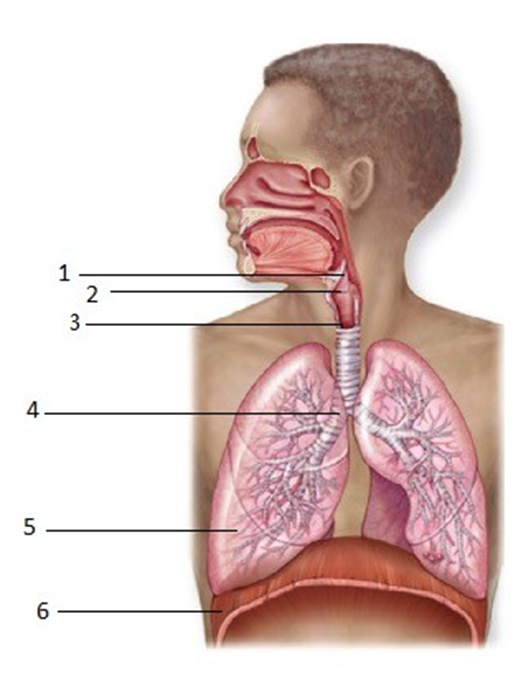 -Which point in Figure 15.1 produces vocal sounds when air passes through it?
 (Multiple Choice)
4.7/5 (82)
(82) Oxygen in the lungs diffuses from the capillary walls to enter the alveolar walls.
(True/False)
4.8/5 (92)
(92) 
Filters
- Essay(0)
- Multiple Choice(0)
- Short Answer(0)
- True False(0)
- Matching(0)