



 Chat with AI
Exam 13: Urban Patterns

Exam 1: Basic Concepts112 Questions
Exam 2: Population and Health102 Questions
Exam 3: Migration104 Questions
Exam 4: Folk and Popular Culture111 Questions
Exam 5: Languages123 Questions
Exam 6: Religions118 Questions
Exam 7: Ethnicities113 Questions
Exam 8: Political Geography128 Questions
Exam 9: Development99 Questions
Exam 10: Food and Agriculture132 Questions
Exam 11: Industry and Manufacturing118 Questions
Exam 12: Services and Settlements117 Questions
Exam 13: Urban Patterns113 Questions
Select questions type


Cities in less developed countries have eliminated most signs of European colonial rule.
(True/False)
4.9/5  (79)
(79) 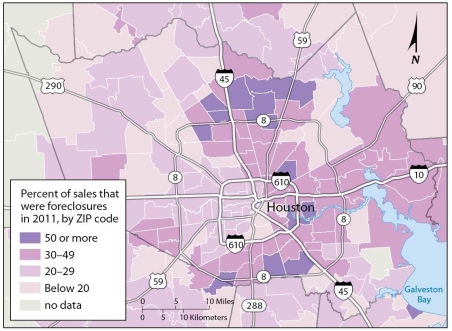 -According to this map of foreclosures and home sales in Houston, most foreclosure sales were clustered along the region's major highways, where land was less valuable.
 (True/False)
4.8/5 (71)
(71) To what extent do the three models explain the internal structure of cities outside of North America?
(Short Answer)
4.7/5 (68)
(68) As a result of high land costs, the American CBD is characterized by
(Multiple Choice)
4.9/5 (77)
(77) When the models of urban structure developed in Chicago are applied to Sao Paulo, one conclusion is that
(Multiple Choice)
4.8/5 (74)
(74) Many scholars argue that U.S. cities are too dependant on automobiles. In your opinion, assuming you must replace automobiles for a large proportion of the population, what alternative modes of transportation seem most promising in terms of urban planning and individual lifestyle choices?
(Essay)
5.0/5 (65)
(65) In your community, name and describe a neighborhood or area that seems to be a zone in transition. How does the urban landscape of this zone compare to the typical zone in transition described in this chapter?
(Essay)
4.8/5 (78)
(78) How do the ways in which food is produced, advertized, and "consumed" in the United States today add unduly to our costs of transportation, public services, and urban poverty? What changes could you propose that would have the most immediate beneficial impact on the nexus between food, health, economics, and U.S. quality of life? Also, how much of a chance does your plan have of succeeding, given the challenges in U.S. culture and society? In order to form a more complete answer, synthesize information from previous chapters on agriculture, services, and transportation with the concerns over urban growth and transition in this chapter.
(Essay)
5.0/5 (80)
(80)  -According to this map of the St. Louis area, the
In a simplified model of a city, the zone where retail and office activities are clustered is the
(Multiple Choice)
4.8/5 (67)
(67) Some environmentalists have recommended urban gardening and the raising of chickens within urban areas as ways to improve urban living standards and dietary needs in poor areas. Imagine the types of economic, social, and governmental barriers that these efforts might encounter in different zones or neighborhoods of a large urban area. In which urban districts might these efforts meet with more resistance? Less resistance? Why?
(Essay)
4.7/5 (92)
(92) A legal form of segregation in U.S. cities is achieved through
(Multiple Choice)
4.8/5 (77)
(77) The city of ________ declined from 1.8 million inhabitants in 1950 to 700,000 in 2010.
(Multiple Choice)
4.8/5 (81)
(81) The basic building block for MSAs is the county, because of the ease of obtaining data.
(True/False)
4.7/5 (78)
(78) The process of legally adding land area to a city in the United States is
(Multiple Choice)
4.8/5 (89)
(89) We may fool ourselves into thinking that cities serve only their human residents, but in reality hundreds of millions of pets and other animals also inhabit cities in the United States alone. Assuming that human concerns will not be forgotten, set those concerns aside for a moment and consider cities as habitats for pets and wild animals. Now imagine that you are authoring a plan to vastly improve the quality of life for all animals that currently inhabit your city or neighborhood-but without lowering the quality of life for humans, of course. What changes would you propose?
(Essay)
4.8/5 (83)
(83) 
Filters
- Essay(0)
- Multiple Choice(0)
- Short Answer(0)
- True False(0)
- Matching(0)